Get Full Government Meeting Transcripts, Videos, & Alerts Forever!
Get email alerts on the Elections Candidacy topic
No spam. Unsubscribe anytime.
Senate committee debates bill to let government employees run for office without mandatory leave
Summary
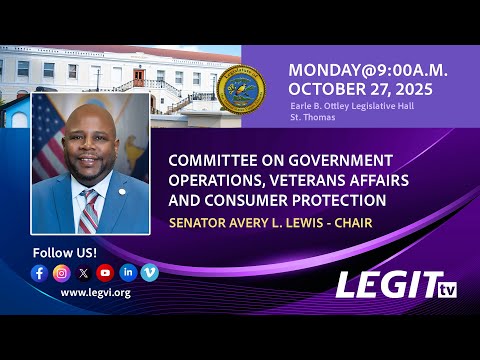
The Committee on Government Operations, Veterans Affairs, and Consumer Protection heard hours of testimony Oct. 27 on a bill that would let most territorial government employees run for elective office without taking the automatic leave now required under Title 18, though federal Hatch Act restrictions and judicial codes would still apply.
The Committee on Government Operations, Veterans Affairs, and Consumer Protection of the 30th Legislature held a lengthy hearing Oct. 27 on bill 36-0134, which would repeal and reenact Title 18, Virgin Islands Code, chapter 1, section 2 to allow government employees to be nominated and run for elective office while remaining actively employed unless federal law or other applicable U.S. regulations prohibit their candidacy.
Sponsor Sen. Maurice C. James said the measure "rests on a simple but powerful idea" that removing financial barriers will broaden participation and make elections more representative. He told the committee the bill "does not remove accountability. It simply ensures that employees can remain employed while they exercise their constitutional right to run for office."
The bill would remove the current automatic leave requirement that begins on filing nomination papers and ends after election while retaining prohibitions on campaigning during working hours, use of government time or resources for campaign purposes, and exclusions for judicial officers and law clerks governed by judicial codes of conduct. The text also notes employees paid wholly or in part with federal funds remain subject to restrictions in 5 U.S.C. §§1501–1508 (the Hatch Act).
Josh Springett, chief negotiator for the Office of Collective Bargaining, summarized the current law and the proposal, saying the existing statute requires a leave of absence from the date nomination papers are filed until the general election and that the proposed version "removes the requirement that employees take [a] leave of absence" while preserving limitations on on-duty campaign activity. He told the committee he had testified on earlier iterations of the bill and raised no objections to the current draft.
Written testimony from Cindy L. Richardson, director of the Division of Personnel, supported the bill while flagging implementation tasks. Richardson asked the division be allowed to issue guidance to agency heads on permissible political activity, conflicts of interest and how workplaces should handle post-election transitions or voluntary leave to campaign. Her letter stressed existing personnel rules and disciplinary procedures would remain available to manage any misconduct.
Carol Burke, chairwoman of the Democratic Party of the Virgin Islands, endorsed the measure as a means to expand participation and cited federal and territorial constitutional principles. Retired educator Ophelia Williams Jackson presented personal examples of the law’s effects, saying she "temporarily lost my family government health insurance, went months without pay, half a year to be exact," and described how 10‑month employees such as teachers face acute hardship because they have no annual leave.
Committee members raised several substantive issues during a multi‑round Q&A: how the Hatch Act applies to federal‑funded positions; how to define and enforce "on‑duty" political activity; whether a short paid leave window before election day would be appropriate; and how to provide written notice to candidates about federal funding that might trigger Hatch Act restrictions. Senator Kenneth Gittens recommended a requirement that employees confirm in writing whether their positions are federally funded; several other members urged clearer definitions and added enforcement language linking violations to personnel rules or an ethics referral.
Regina Peterson, appearing for the judicial branch, reiterated that judicial officers and law clerks are governed by judicial conduct codes and noted the judiciary would rely on its internal policies where applicable. Peterson and Division of Personnel testimony both emphasized that agency authority to address performance or misconduct would not be removed by the bill.
Committee discussion produced no recorded final vote on bill 36-0134 during the Oct. 27 session; the hearing closed after questions and the panel recessed for 5 minutes before moving to the next block of business. Multiple senators signaled support while asking for amendments or clarifications on definitions, Hatch Act interactions, and implementation guidance.
The hearing record shows the committee heard broad bipartisan testimony and focused on implementation details: ensuring employees know whether their salary is federally funded, clarifying the definition of political activity, preserving agency authority to address misconduct, and directing administrative guidance and training if the law is changed. The Division of Personnel said it stands ready to prepare training and written guidance if the Legislature adopts the bill.
What happens next: No formal committee action on bill 36-0134 is recorded in the transcript excerpt. Senators discussed potential amendments and the sponsor indicated willingness to work with colleagues on refinement before any vote was taken in committee or on the floor.