Get Full Government Meeting Transcripts, Videos, & Alerts Forever!
Get email alerts on the Right Of Way Solicitation topic
No spam. Unsubscribe anytime.
Eugene council schedules public hearing on proposed ban of soliciting in travel lanes after 5-4 vote
Summary
After divided debate about safety, data and equity, the City Council voted 5-4 to direct the city manager to schedule a public hearing on a draft ordinance that would prohibit transferring items or soliciting from the vehicular portion of the right of way.
The Eugene City Council voted 5-4 on Oct. 27 to schedule a public hearing on a draft ordinance that would prohibit what staff described as “unlawful transfer on vehicular portions of the right of way” — a proposal aimed at stopping people from soliciting or distributing items in travel lanes.
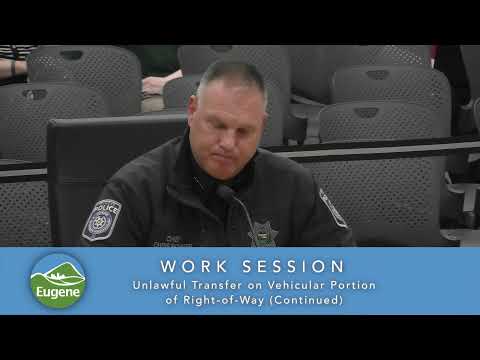
Chief Skinner of the Eugene Police Department opened the discussion as a continuation from a Sept. 17 work session and framed it as a safety issue, alongside related topics the council has considered this year such as metal theft and shopping cart recovery. The council debated whether the ordinance would address a genuine traffic-safety hazard, duplicate existing laws, or unfairly target people who are unhoused.
Councilor Groves, citing experience as a fire captain, argued the practice is dangerous: “Nobody's saying in this proposition that people cannot donate to people. It's just get out of the travel lane. It shouldn't be done in the middle of the street. It poses a danger to the motorists,” he said, adding that related near-miss incidents are common in high-traffic corridors.
Councilor Kaczynski urged caution about effectiveness and cited existing crash data: “The major contributing factors to fatalities and serious injuries crashes… are speeding, driving while intoxicated, and, visibility,” she said, adding that staff have data-driven strategies to target those risks.
Several councilors, including Clark and Keating, supported sending the draft ordinance to a public hearing so residents could weigh in. Councilor Clark said she preferred public input: “Should we ask the general public what they think? Because that's the only question on the table is moving this to a public hearing or not.”
Opponents argued the ordinance risks criminalizing visible homelessness and may be unnecessary because similar conduct can already be addressed under existing laws. Councilor Zelenka said he considered the proposal unconstitutional and unnecessary because existing statutes already apply. Councilor Yeh said she had seen no new evidence since earlier discussions and would vote no.
Council President moved the motion to “direct the city manager to schedule a public hearing on the draft unlawful transfer on vehicular portions of the right of way ordinance as set forth in Attachment A to this AIS.” The motion was seconded (second not identified in the record), and the council counted four votes in favor and four opposed on a voice/hand vote. The mayor cast the deciding vote in favor; the motion passed 5–4.
The immediate result of the vote is procedural: the council will schedule a public hearing to receive testimony and additional information before deciding whether to adopt an ordinance. Staff and several councilors said the public hearing would be the vehicle to surface community views and additional evidence; others urged staff to prioritize data-driven street-safety measures that target speeding, impaired driving and visibility issues.
Staff also told the council that existing traffic-crash reporting systems do not easily capture whether a collision was preceded by roadside solicitation; identifying such incidents would require manual review of crash narratives. Fire staff said the National Fire Incident Reporting System (NFIRS/INFRIS) similarly does not collect the granular detail that would make automated queries straightforward.
Next steps: the city manager will schedule the public hearing and staff may prepare additional materials, including legal analysis, data requests and proposed educational signage or outreach strategies, for council and the public prior to the hearing.