Get Full Government Meeting Transcripts, Videos, & Alerts Forever!
Get email alerts on the Public Safety Alerts topic
No spam. Unsubscribe anytime.
Proponents say substitute House Bill 23 would let emergency-alert system notify public of dangerous escaped inmates
Summary
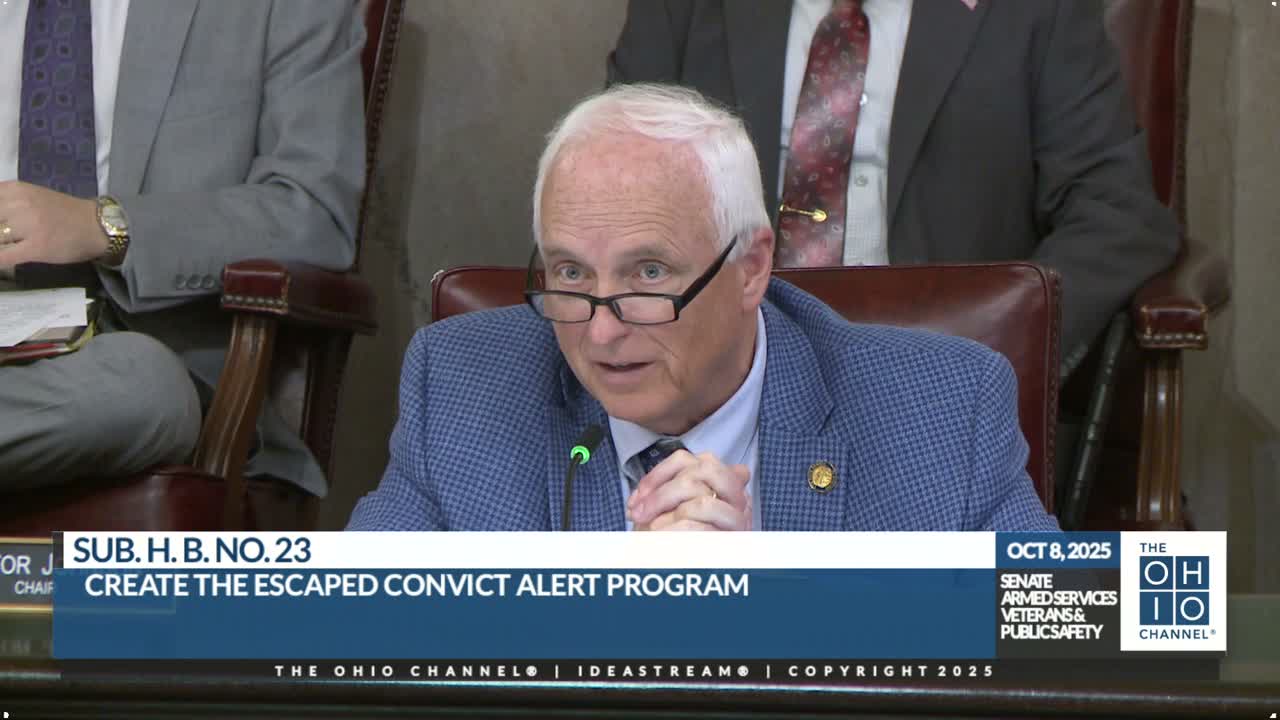
Proponent testimony from former state lawmaker Kevin Coughlin described substitute House Bill 23 as adding dangerous escaped inmates to Ohio's emergency information network, subject to standards meant to prevent overuse of alerts.
Proponent testimony before the Senate Armed Services, Veterans Affairs and Public Safety Committee described substitute House Bill 23 as an expansion of Ohio's emergency information network to allow alerts for dangerous escaped inmates under defined standards.
Kevin Coughlin, a former state representative and state senator who authored the 2002–03 law authorizing Ohio's AMBER Alert system, provided oral testimony and praised the bill's standard-setting approach. "I would absolutely say that the dangerous inmate that has escaped a jail is clearly a legitimate use for the emergency alert system," Coughlin told committee members, adding that the bill includes standards so alerts would be used only for inmates deemed dangerous to the community.
Coughlin said the AMBER Alert and other emergency alert systems have been expanded previously and cautioned against overuse, which can reduce public responsiveness. The substitute bill, he said, sets a "pretty high standard" to preserve the potency of alerts and identifies dangerous escapes, not routine custody errors or transfer mishaps, as a trigger.
The committee also received written-only testimony from Sheriff Bruce Zukowski and Shane Barker, which members said they would review. No committee vote or further action on the substitute House Bill 23 was recorded in the transcript.