Get Full Government Meeting Transcripts, Videos, & Alerts Forever!
Get email alerts on the Consumer Protection topic
No spam. Unsubscribe anytime.
Ohio Attorney General's office seeks clearer definitions to prosecute robocallers in state court
Summary
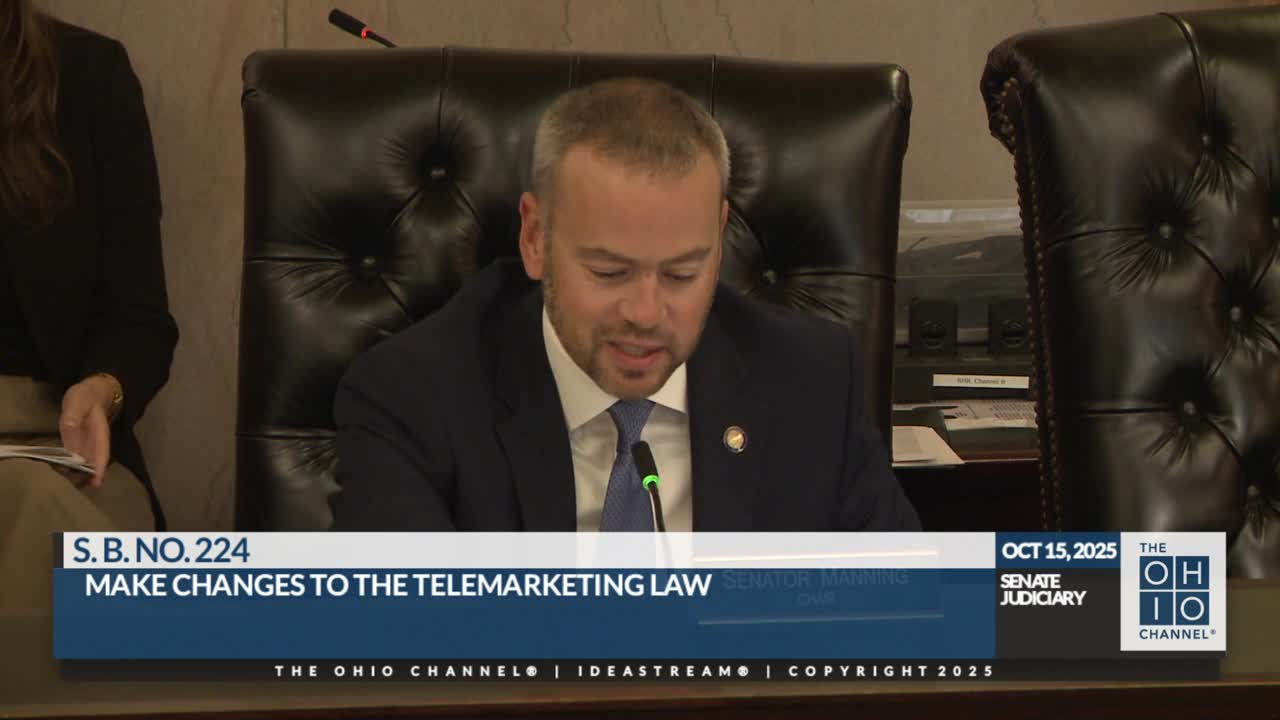
Senate Bill 224 would revise Ohio's robocalling statute safe-harbor language so the Attorney General can use PUCO and SEC designations to identify noncooperative voice providers and bring state-law cases against bad actors, the AG's office told the Senate Judiciary Committee.
A staff attorney for the Ohio Attorney General's office told the Senate Judiciary Committee on Wednesday that Senate Bill 224 would restore and refine the safe-harbor provisions in Ohio's robocall law, enabling the state to pursue bad actors in state court without relying on a slow private-industry traceback process.
Katie Blankenmeier, testifying on behalf of the Attorney General, said the bill uses designations from the Public Utilities Commission of Ohio and the U.S. Securities and Exchange Commission to define "good actors" and "bad actors," rather than depending on the National Industry Traceback Group (ITG) and lengthy Federal Communications Commission procedures. "As long as providers do not receive that designation, they are afforded the protections provided by Ohio's Safe Harbor," Blankenmeier said, describing how the absence of ITG designations has hampered state enforcement since 2021.
The testimony explained that a safe-harbor clause is intended to protect telecommunications providers that follow best practices while enabling state prosecutors to bring civil actions against companies that enable illegal robocalls. Under the proposed change, the attorney general's consumer-protection team would have clearer authority to pursue civil enforcement of robocalling violations in state court.
Committee members questioned whether federal agencies had legislative authority or whether federal action could address the problem; Blankenmeier said the FCC works with the ITG but that the process has been slow and that the proposed state standard would permit more timely state enforcement. She said the office would verify details about federal statutes if requested by members.
Senators did not vote on the bill during the hearing; the session was recorded as the bill's second hearing and the attorney general's office said it would answer follow-up questions as needed.