Get Full Government Meeting Transcripts, Videos, & Alerts Forever!
Get email alerts on the Victim Services topic
No spam. Unsubscribe anytime.
Sponsor urges expanding Ohio's Safe at Home program to include gunshot and other violent-assault survivors
Summary
Senate Bill 225 would expand eligibility for Ohio's Safe at Home Address Confidentiality Program to include survivors of gun violence and family members of homicide victims; the sponsor said funds are already in the state operating budget and the bill only needs legislative authority to extend protections.
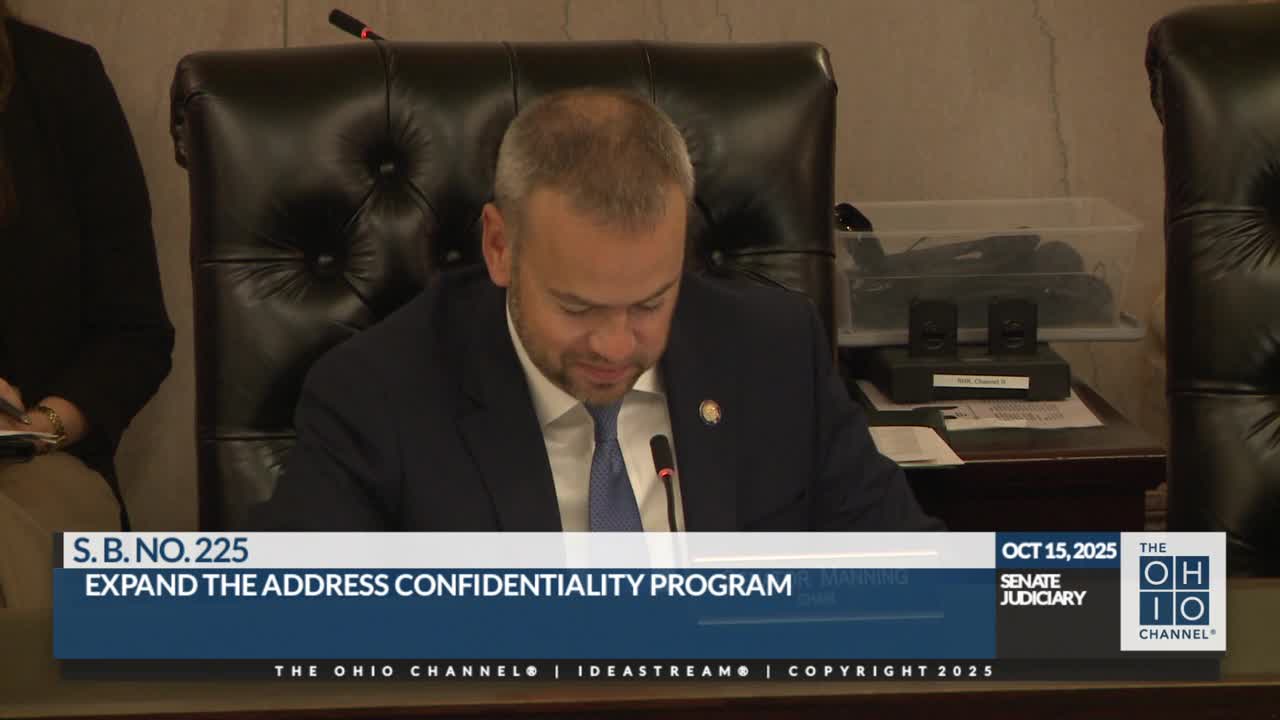
Senate Bill 225 would broaden eligibility for Ohio's Safe at Home Address Confidentiality Program to include survivors of additional forms of violent assault, including gunshot victims and family members of homicide victims, the bill's sponsor told the Senate Judiciary Committee on Wednesday.
Senator Manchester, offering sponsor testimony, said Ohio's program — established in 2016 to protect survivors of domestic violence, stalking and human trafficking by allowing participants to keep home addresses confidential — should be available to people who face similar safety risks stemming from other violent crimes. "Expanding the program ensures that Ohioans impacted by violence can protect themselves and their families from future harm," Senator Manchester said.
Manchester told the committee that funds to support the expansion were included in the most recent state operating budget and that Senate Bill 225 would provide the statutory authority needed to extend eligibility without requiring additional appropriations.
The sponsor framed the change as an extension of an existing, successful program that has provided "peace of mind and physical safety to countless individuals" since 2016. The bill's language would add survivors of other violent assaults to the list of qualifying applicants.
The committee posed no questions that changed the bill's scope during the hearing; no votes were taken and the testimony was recorded as the bill's first hearing.
The sponsor said he would be available to answer questions and expected additional law-enforcement agencies to provide supportive testimony in later hearings.