Committee advances University Boulevard quarter plan recommendations, flags street‑grid and neighborhood impacts
Loading...
Summary
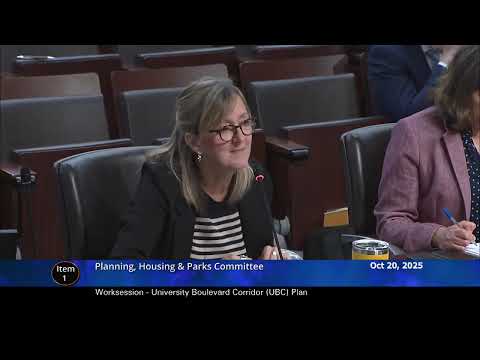
The Planning, Housing and Parks Committee continued its multi‑session review of the University Boulevard quarter plan on Oct. 20, advancing multiple staff land‑use recommendations while pausing on street‑grid and driveway language and asking staff to return clearer transition and public‑access protections.
The Planning, Housing and Parks Committee on Oct. 20 continued a multi‑session review of the University Boulevard quarter plan and advanced a set of land‑use and urban‑design recommendations while pausing several transportation and historic‑preservation decisions for further refinement.
The committee and planning staff largely agreed to staff recommendations for neighborhood rezoning translations required by the 2014 zoning rewrite, but members repeatedly flagged the proposed street‑grid changes and driveway relocations for deeper review, citing pedestrian‑safety concerns in adjacent residential areas.
The committee’s discussion opened with Chair Friedson noting the group was “continuing our work from the September 29 work session” and reminding the public that staff intentionally spaced meetings to allow additional agency and community input. Council staff and planning staff then walked the committee through zoning and urban‑design recommendations for more than a dozen neighborhoods in the University Boulevard quarter, including WTOP, Hearthstone Village, Inwood House, Arcola Avenue, Dennis Avenue, Northwood and multiple 4 Corners subareas.
Why it matters: the quarter plan proposes to translate older, now‑obsolete zones into the county’s current code, to rezone select institutional properties for higher residential capacity near planned bus‑rapid‑transit (BRT) stations, and to add urban‑design guidance intended to encourage pedestrian amenities and privately owned public spaces. Committee members said they support those goals but repeatedly cautioned that changes to the street grid or to where driveways and access are located could transfer safety risks into residential neighborhoods if not handled carefully.
Key committee actions and outcomes
Votes at a glance
- WTOP neighborhood: reconfirmed zoning for retail properties at 2119 University Boulevard (U.S. Postal Service) and approved rezoning of the WTOP transmitter property from R‑90 to a CRT zone (staff report items). Outcome: approved (committee reported unanimous on earlier session; later ratified without objection in work session). - Berkeley Court (Westchester): recommended height reduced from 50 to 45 feet (committee decision reported earlier in process). Outcome: approved (unanimous earlier vote). - Inwood House (10921 Inwood Ave): recommended rezoning to CRT 1.5 (C 0.25, R 1.5) with a 70‑foot maximum height to reflect redevelopment potential near a planned BRT station. Outcome: advanced by committee (vote recorded as 2–0 in the work session). - University Towers / Warwick / Arcola Tower properties: recommended translation from RH (residential high‑rise) to CR (200‑foot compatible CR zone) so existing high‑rise residential remains conforming. Outcome: advanced without objection. - 4 Corners median parcels (Colesville & University): after debate, committee directed a lower height than the planning‑board draft for the central median parcel — staff and committee converged on a 65‑foot guideline for the constrained median parcel, with 60 feet recommended for many adjacent properties (final numeric standards to be refined). Outcome: committee consensus to adopt lower heights (exact wording and cross‑lot consistency to be refined in subsequent work session). - Woodmore Shopping Center: committee reinstated the public‑hearing‑draft approach (staff recommended zoning and a 60‑foot height, and to include a recommendation to evaluate the property for potential listing on the master‑plan historic sites list). Outcome: committee directed staff to return language consistent with the public‑hearing draft and to include the historic evaluation placeholder (2–0 vote on moving forward with staff’s approach).
What the committee debated
Zoning translation versus neighborhood impacts. Planning staff repeatedly reminded the committee that a number of legacy zones (PD, RT, RH, R200 and others) were not carried forward in the 2014 rewrite and must be “translated” to conforming zones. Staff recommended CRT/CRN/CR zones aimed at preserving existing character while allowing modest infill. Committee members agreed with the translation principle but asked for consistent rules about which single‑family parcels immediately abutting University Boulevard should be rezoned and what the height transitions should be.
Street grid and driveway consolidation. The committee reserved major judgment on proposed street‑grid changes and on language that would promote relocating or consolidating driveways fronting University Boulevard. Council member Mink and others said neighborhood streets like Gilmore Drive should not be repurposed to carry cut‑through traffic without guaranteed funding for pedestrian infrastructure and explicit protections for neighborhood safety. Planning staff and parks staff recommended editing the master‑plan language to make the intent and limits clearer — for example, specifying that any transfer of right‑of‑way or driveway consolidation must retain public access and not convert public corridors to private land.
Institutional parcels near planned BRT stations. Several institutional properties — including Inwood House, a handful of churches (Canaan Christian Church, Northwood Presbyterian, Good Shepherd Episcopal) and HOC‑owned Oaks at 4 Corners — were recommended for CRT or CRT‑family zones with heights of 60–70 feet in places close to the planned BRT stops. Supporters argued the modest density increases would allow colocation of housing and small commercial uses and improve access to services; skeptics asked for clear stepbacks and height‑transition language where properties abut detached houses.
Woodmore Shopping Center and historic‑preservation concerns. The plan originally included a placeholder recommending an evaluation of the Woodmore Shopping Center for the master‑plan historic site list; the planning board omitted that placeholder in its subsequent work session. Committee members and testimony from the Art Deco Historical Society pressed to reinsert an evaluation recommendation. Planning staff noted that a formal historic evaluation and any listing are separate processes and that an evaluation placeholder simply signals future study; the committee asked staff to reinsert language from the public‑hearing draft so the community’s interest is recorded in the plan.
Parking and circulation. Several council members and planning staff said the current parking and circulation patterns (for example, around 4 Corners pub, Safeway and other small parcels) are functionally inadequate and that consolidation and redevelopment could be an opportunity to improve parking, but only if redevelopment occurs. Staff warned that reducing permitted height on sites that already carry high zoning could remove property‑owner value; the committee discussed stronger transition language as an alternative to across‑the‑board down‑zoning.
Other specific items discussed
- Historic preservation: the committee supported listing the Romeo and Elsie Horad House for preservation in the master plan and asked staff to consider language that would allow adaptive reuse while preserving the building’s setting. - North 4 Corners HOC property (Oaks at 4 Corners): planning recommends CRT with an option for off‑site open‑space contribution in lieu of on‑site open space; parks staff and planning staff agreed chapter 59 (zoning code) provides flexibility but asked for clearer plan language to guide any off‑site contributions. - Park right‑of‑way transfers: parks staff asked the committee to clarify master‑plan language that would prevent trail corridors (for example, the Northwood Chesapeake Bay Trail connection) from reverting to private ownership by abandonment of a right‑of‑way; committee directed staff to return stronger language to preserve public use and clarify mechanisms (abandonment, dedication, purchase) for ensuring continuity.
Quotes from the meeting
“We have been listening, that we are listening,” Chair Friedson said, answering community concerns that the plan was a “fait accompli.”
“[The Inwood House] units are huge. People who live there have been there for, like, 20, 30 years, and that sells a lot,” Council member Fanny (Fontaine) Gonzalez said in support of a modest zoning increase at the planned Inwood BRT station.
“The recommendation to connect the parks is important,” Zubin Adirimwala (planning staff) told the committee when discussing the Northwood Chesapeake Bay Trail alignment and mechanisms for maintaining public access.
What the committee asked staff to do next
- Redraft street‑grid, driveway and access language to explicitly avoid shifting traffic hazards into residential streets; provide intersection‑by‑intersection analysis before any final decisions. - Provide firmer, more specific stepback and height‑transition language for properties that abut single‑family zones, including numerical examples where possible. - Reinsert the public‑hearing‑draft placeholder language recommending evaluation of the Woodmore Shopping Center for master‑plan historic listing and return suggested wording that clarifies the schedule and process for evaluation. - Clarify master‑plan language on park right‑of‑way so the plan explicitly reserves public access and identifies negotiation mechanisms (transfer, dedication, purchase) among Parks, DOT and property owners.
Context and next steps
Committee members said the group intentionally scheduled multiple monthly work sessions to allow more agency and public input; the committee expects to reconvene (tentatively Nov. 3 or Nov. 10) to finish zoning decisions that were held for later consideration and to start in‑depth discussion of street designations, Complete Streets implications and the proposed internal street grid. Planning staff will return revised text and figures to reflect the committee’s direction and to make the packet consistent across land‑use and transportation sections.
Ending
The committee did not finalize all numeric standards or master‑plan language; instead members advanced the bulk of staff’s zoning translations and asked staff to return with clarified street‑grid and transition language, a restored Woodmore evaluation placeholder and tightened park‑right‑of‑way protections before the next work session.