Get Full Government Meeting Transcripts, Videos, & Alerts Forever!
Get email alerts on the Signs topic
No spam. Unsubscribe anytime.
Troy Board denies sign variance for Livernois gas station over future right‑of‑way concerns
Summary
The Troy Board of Zoning Appeals denied a requested 15‑foot variance for a 50‑square‑foot ground sign at a new gas station on Livernois Road, citing compliance with the City of Troy thoroughfare plan; vote was 2‑2 so motion failed.
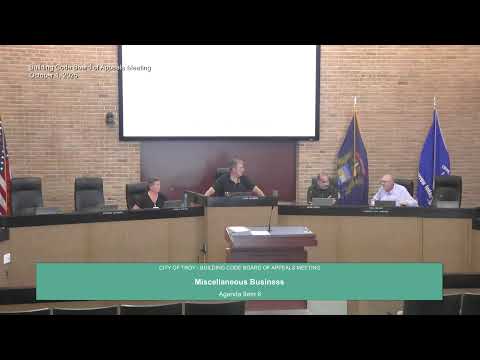
The Troy Board of Zoning Appeals on Oct. 1 denied a request to allow a 50‑square‑foot ground sign closer to Livernois Road than the City of Troy’s thoroughfare plan allows, after members split 2‑2 on a motion to grant the variance.
The variance application covered property at 16111613 Livernois. City staff said the petitioner sought a 15‑foot variance because the master thoroughfare plan identifies a future 120‑foot total right‑of‑way for Livernois Road — which translates to 60 feet from the recorded center line on the subject side — and the proposed sign would sit 45 feet west of that center line.
Petitioner Kenny Cozza, the property owner, told the board the new gas station is complete and that he believed sign placement was part of the approved site plan. “I thought it was approved at site plan with the signage because we did show it,” Cozza said. He added, “I can't really open the gas station without putting gas to any signage there.”
City planning staff explained that the sign ordinance is separate from site‑plan approvals and that site‑plan review does not authorize signs outside the rules of Chapter 85 (Signs). Staff also noted the thoroughfare plan calls for potential future acquisition of a 15‑foot strip on the site side, which, if acquired, would place the sign in the city right‑of‑way and require its removal.
Board members discussed alternative compliant locations the petitioner could use — including a peninsula area near the corner with the adjacent property and a north strip that would meet the 60‑foot setback — and noted tradeoffs between visibility and compliance. Staff pointed out the property is eligible for ground signage under the ordinance if placed at the required setback (for example, a sign up to 50 square feet and 10 feet tall can be sited with a zero setback from the future 60‑foot line).
After deliberation, an unidentified board member moved to grant the variance, a second was recorded, and the roll call vote produced two votes in favor and two opposed (Mister Friesen: no; Mister Wilson: no; Mister Abathura: yes; Miss Brooks: yes). The chair announced, “Sorry. Your motion failed.” The board did not adopt any conditions or direct staff to take further action on the application during that meeting.
The petitioner was offered options if the variance is denied: locate signage in a compliant location and seek administrative approval, submit a revised, reduced variance, or appeal the board’s decision in circuit court.
The board noted that if and when the City of Troy purchases the additional right‑of‑way shown in the thoroughfare plan, any sign placed inside that future area would have to be removed at the property owner’s expense.