Get Full Government Meeting Transcripts, Videos, & Alerts Forever!
Get email alerts on the Budget topic
No spam. Unsubscribe anytime.
New Freedom reviews 2026 draft budget as capital projects, emergency services drive temporary deficits
Summary
Borough staff presented a draft 2026 budget showing planned use of fund balances to cover major capital projects and emergency services cost increases; council discussed a possible local services tax on nonresidents and several program pressures, including animal control, EMS costs and stormwater obligations.
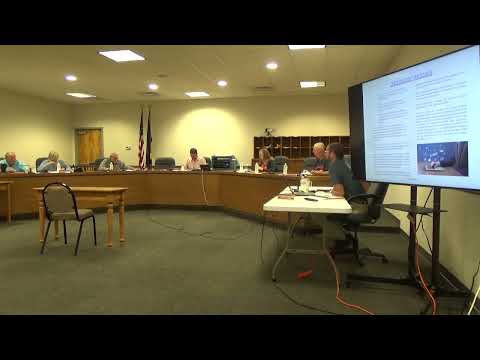
New Freedom Borough officials opened their first budget workshop of the fall to review a draft 2026 spending plan that relies on one-time cash and committed fund balances to cover large capital projects and rising emergency-services costs.
The borough manager, Andrew (staff member), said the draft budget shows planned deficits in several funds next year because the borough will draw down cash that was accumulated for capital projects. "We're showing a $3,500 deficit in cash" in the general fund for 2026, he said, adding that the borough still projects an available general-fund balance of about $616,000. "It's the use of cash," he said, not an inability to pay ongoing bills.
Why it matters: Council faces choices about whether to use reserves to smooth large, one‑time construction and engineering costs — notably water and sewer upgrades and a planned Pleasant Avenue culvert replacement — or to increase recurring revenue. Staff outlined several possible revenue options and places to reduce spending, and warned that some lines will be unusually lumpy because grant reimbursements and treasury investments are being spent in different years than they were received.
Major budget drivers and discussions
Local services tax: staff discussed a proposed local services tax on employees who work in the borough but live elsewhere. Andrew described the levy as "charged on employees in the borough" and noted the York/Adams tax bureau estimates about 1,400 employees work in New Freedom. At a $52 annual levy per nonresident employee, Andrew estimated New Freedom's share (after bureau collections and the borough's 2% share similar to earned-income tax collections) would be roughly $52,000 in gross receipts and about $52,000 less collection adjustments in the way the borough calculates net receipts. He said council would have to adopt a new ordinance and advertise it publicly before the tax could take effect.
Emergency services and EMS tax allocation: rising emergency-services costs were repeatedly cited as a pressure. Staff explained workers' compensation costs for fire and EMS and said reimbursements from neighboring municipalities reduce the borough's net payments. For example, a hypothetical $75,000 in workers' comp could net only $50,000 after a $25,000 reimbursement from other municipalities. The borough also reviewed how it now separates the EMS and fire line items so each organization receives a cash donation that reflects reimbursements and net expenditures rather than having shared expenses offset inside the budget.
Animal control and SPCA contract: council members raised complaints residents and local nonprofits have reported to them about the SPCA's intake policy and reduced hours. Andrew said the SPCA has struggled to recruit a replacement after an animal-control officer died and that the proposed 2026 contract (to appear on the October 20 agenda) would budget approximately $4,500 for housing and animal care. He cautioned that the SPCA has indicated an operating shortfall countywide and has requested additional support; one figure mentioned in the meeting was an $800,000 funding gap countywide, which could lead to higher municipal contributions in the future.
Capital projects and reserves: the draft budget shows planned use of funds held in short-term U.S. Treasury instruments to pay for water-well upgrades and construction-phase costs. Andrew said the borough plans to use roughly $400,000 of reserves for well upgrades and related engineering and construction costs in 2026. Separately, the capital reserve includes a planned dump-truck replacement in 2026 and a $250,000 placeholder for the Pleasant Avenue culvert/bridge replacement; staff said that number remains preliminary and may change as engineering advances.
Refuse fund and tipping fees: council reviewed the refuse fund showing a planned deficit in 2026 of roughly $59,000 driven in part by scheduled contract price increases and incinerator tipping-fee growth. Staff said the fund was intentionally built up in prior years to absorb a contract-year increase and that a larger rate adjustment is likely in 2027 when a new contract will be negotiated.
Stormwater and MS4 compliance: the draft includes modest stormwater expenditures ($10,000 programmed for 2026) and staff recommended continuing to build the stormwater fund for future, larger repairs or MS4 (municipal separate storm sewer system) compliance work. Council discussed jurisdictional complexity where PennDOT-owned roads in borough limits still leave stormwater responsibility on the borough and noted pending state conversations about shifting responsibility.
Community center and maintenance needs: councilors emphasized the aging community center's HVAC system, saying the building is more than 100 years old but that the primary operational problem is heating, ventilation and air conditioning. Staff said the community-center committee will evaluate options and return recommendations to council; the draft budget shifts some community-center maintenance expenditures back to the general fund while showing a small surplus in the community-center fund.
Police and public safety costs: council discussed a supplemental request from the Southern Regional Police Commission and the department's budget drivers, especially health insurance. The commission representative said worst-case actuarial estimates had been as high as roughly 24.9% for health-insurance renewals but that the board had indicated it would cap any increase at 20%. Council also discussed replacing a retiring school-resource/officer and the timing and added training cost for overlap.
Other items: staff said the borough expects to finalize a 2026 contract for animal control at the October meeting; the Joan Davis Park project is winding down with county grant proceeds applied; and the borough will continue to track franchise-fee revenue declines as cable subscriptions shrink.
What council asked staff to do
Council asked staff to prepare comparative summary sheets that aggregate cross‑fund line items (for example, public‑works labor that is now spread across water, sewer and general funds) and to present clearer charts that separate one‑time grant or treasury receipts from recurring operating revenue so the graphs are not misleading. Staff agreed to return with supplemental materials and with more detailed options for the local services tax, alternatives for balancing the general fund, and refined cost estimates for the culvert, well upgrades and community-center HVAC.
Next steps
The borough scheduled a second budget meeting for Nov. 3 and plans to advertise the draft budget and related tax ordinance or resolution before the public inspection period that begins in late November. Council will consider final adoption of the budget and any tax ordinance in December, per the usual calendar.