Get Full Government Meeting Transcripts, Videos, & Alerts Forever!
Get email alerts on the Homelessness topic
No spam. Unsubscribe anytime.
Placer County reviews homeless services funding, directs staff to renegotiate shelter contracts and pursue regional coordination
Summary
Placer County Health & Human Services presented a countywide overview of homelessness spending and program outcomes. The Board directed staff to negotiate contract extensions for Mid Placer shelters and to continue regional coordination; the move drew public calls for audits and transparency.
Placer County supervisors received an overview Feb. 18 of homeless services paid for with county general-fund dollars and by state and federal programs, and directed county staff to negotiate contract extensions for Mid Placer shelters and continue regional work on homelessness.
County CEO staffer Jeff Merriman and Dr. Rob Oldham, director of Health & Human Services (HHS), told the board that Placer County funds about $5.7 million annually in locally supported outreach, shelters and encampment management while state and federal programs tied to housing and services amount to roughly $12.9 million. Merriman and Oldham said the county is emphasizing permanent supportive housing and prevention programs, and that the outreach-focused Homeless Liaison Team (HLT) plays a central role in case coordination.
The presentation came after years of county planning documents, including a Marbot study and a regional homelessness response process, and followed the board’s earlier approval of a 10-year regional forest health action plan and other initiatives. HHS presented program-level outcomes for county-supported congregate shelters and the mobile temporary shelter (MTS), noting that shelters run close to capacity and that many shelter guests are ‘‘housing ready’’ but lack housing placements. Dr. Oldham described the county’s emphasis on permanent supportive housing as a long-term strategy because it shows stronger retention outcomes than emergency shelter alone.
Board action and staff recommendation
Staff recommended, and the board approved, two directions: (1) direct staff to start negotiations with the current Mid Placer shelter operator to amend or renew contracts (including clearer admission/exit criteria and program requirements); (2) direct staff to continue to participate in regional planning and coordination with cities, other counties and the Continuum of Care to identify sites and align investments. Supervisor Cindy Gustafson moved the first recommendation; Supervisor Bonnie Gore (substituting for vote sequencing) seconded earlier motions; the negotiations motion was approved on a roll call vote.
Why it matters
HHS officials told the board that county general-fund spending concentrates on outreach (including four deputy sheriffs and a multi‑discipline HLT), emergency shelters and encampment management, while state/federal funds focus heavily on permanent supportive housing, intensive case management and prevention programs run through CalWORKs, HCD and other programs. The distinction matters because program types have different outcomes: HHS said roughly 85% of people placed in permanent supportive housing remain housed after two years, while shelter exit outcomes are more varied.
Public reaction and oversight requests
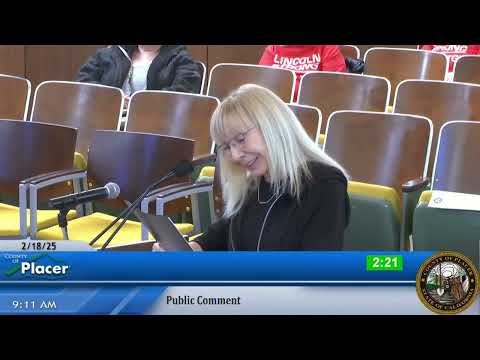
Public comment was lengthy and split. Supporters of local providers described volunteer efforts and private fundraising that augment county services. Nick Golling, chief program officer at The Gathering Inn (a key shelter provider), said the organization served 1,609 unique individuals in FY 23–24 and that 199 “leavers” moved to improved housing destinations, 119 of them to permanent housing.
Other speakers pressed the board for additional oversight, citing concerns about one provider’s conduct in Lincoln and requesting an independent audit. Nellie Collins, a Placer County resident, urged the board to seek “an external audit voluntarily requested by the county,” saying “internal audit and TGI‑generated data will not repair trust.” Diane Weasel and other speakers likewise urged greater transparency on contracts and grant reporting.
What the board required of staff
The board’s direction to staff will allow negotiations to (a) add clearer residency and admission criteria, (b) set length‑of‑stay parameters, (c) adopt performance or pay‑for‑performance metrics where feasible, and (d) continue regional residency principles developed through the Regional Homelessness Response Project. Staff said the county will seek opportunities to strengthen contract monitoring and incorporate more measurable performance expectations in future procurement or contract amendments.
Next steps and fiscal context
HHS and the CEO’s office said they will return with negotiated contract language and implementation details. HHS noted that many state and federal programs change year to year and that some services (for example, medical respite) are now funded through Medi‑Cal managed care and hospital partners rather than directly by the county. HHS also said it will continue pursuing Homekey and other capital and operating funds to expand permanent supportive housing.
Ending note
Supervisors framed the board’s decision as a step to improve program accountability and to keep services operating while working toward longer‑term housing outcomes. The board did not adopt a requirement for an immediate independent financial audit of all homelessness contracts on Feb. 18, but multiple supervisors and public commenters requested further review and greater public reporting as staff proceeds with negotiations and regional coordination.