
Boulder City Council adopts 2024 International Building Codes, citing safety and simplification
Get AI-powered insights, summaries, and transcripts
Sign Up Free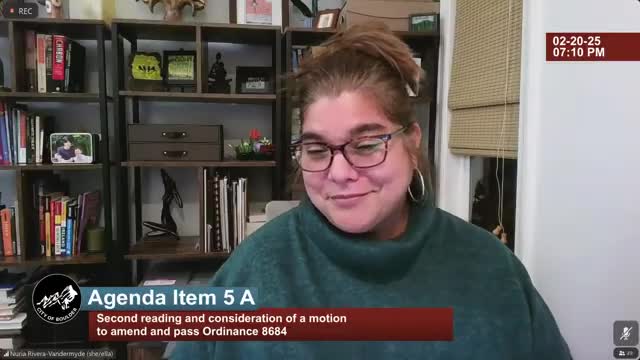
Summary
Council voted unanimously to adopt ordinance 86 84, updating local codes to the 2024 International Code Council family and removing several local amendments intended to lower compliance costs and advance wildfire resiliency.
Boulder City Council on Thursday unanimously adopted ordinance 86 84 to update the city's building and safety rules to the 2024 editions of the International Code Council family of codes.
The change, presented by Rob Adrian, chief building official for Planning and Development Services, brings Boulder's building, mechanical, plumbing, fire and related codes into alignment with the latest national standards and eliminates a number of local amendments that staff said had added complexity and cost. "We really recommend that the City Council adopt ordinance 86 84," Adrian said during the presentation.
Staff told council the updates are meant to reduce unnecessary local variations, improve clarity for builders and homeowners, and address specific safety gaps. Key changes highlighted by staff include requiring permits for replacement windows and siding so that work in the wildland-urban interface (WUI) can be reviewed for noncombustible materials; exempting small, low decks and larger small storage sheds in mobile-home parks from permitting to reduce disproportionate enforcement impacts; raising the allowable size for unpermitted storage sheds from 80 to 120 square feet; and removing a local requirement that panel upgrades include arc-fault breakers, a change staff said removes a frequent, costly barrier to home electrification and EV charging.
Adrian also pointed to other technical updates in the 2024 codes: allowance for newer refrigerants (A2L), a lower minimum ceiling height (6 ft. 8 in.) for habitable basements and attics in existing buildings to ease conversions and ADU creation, and new guidance on temporary emergency uses of buildings that staff said could speed reuse after disasters.
"Our goals were to adopt the codes with as few local amendments as possible to reduce complexity," Brad Mueller, director of Planning and Development Services, told council. Mueller said staff also used the city's racial equity instrument in the review and cited examples where code changes were intended to reduce disproportionate cost or enforcement impacts on lower-income households.
Councilmembers asked staff about outreach and potential cost impacts; staff said two public office hours drew industry and resident participants. After deliberation, Councilmember Lauren Marquis moved to adopt the ordinance; the roll call vote was unanimous and the ordinance was amended and passed at the meeting.
Councilmembers and staff said they will continue outreach and will present the wildfire interface code (WUI) separately after more community engagement because of its cost implications for homeowners.
The adopted ordinance updates local references to the international residential code, international building code, international fire code, property maintenance code, plumbing, mechanical and fuel gas codes, and adopts by reference national electric code provisions with local adjustments.
Supporters said the updates lower administrative hurdles and clarify inspections and permitting for common retrofit and small-scale projects; critics who spoke in public comment cited isolated concerns about specific retrofits and the city's contracted retrofit programs.
The ordinance takes effect as provided in the enactment language; staff said they will publish guidance on the most consequential changes and engage contractors and community groups on implementation.