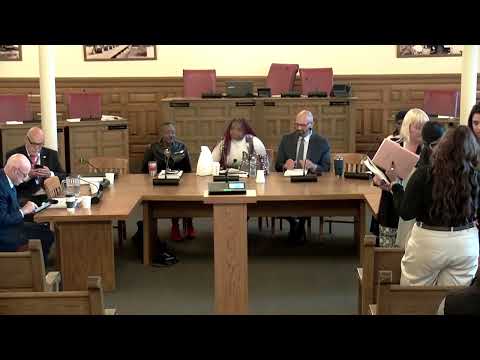
Syracuse City Council backs monthlong parking-ticket amnesty; staff to deploy outreach and payment options
Loading...
Summary
City staff told council members an amnesty program modeled on a 2020 effort would run in November, letting drivers pay original fines and state surcharges without accumulated penalties, with online self-service, in-person help and $25-a-month payment plans available.
Syracuse City Council members discussed a proposed parking-ticket amnesty that staff said would run for the month of November, allowing people with qualifying unpaid parking citations to pay the original fine plus the New York State surcharge without later penalty accrual. Council members and staff agreed to a monthlong window beginning Nov. 1, with online payments accepted through Nov. 30 and in-person assistance available at the City Payment Center.
The amnesty is intended to mirror a 2020 program that cleared about 34,000 tickets and collected just under $1 million, staff said. City staff told the council the current unpaid-ticket ledger includes roughly 140,000 outstanding citations, with about 16,605 from 1997–2006 and about 124,000 issued from 2007 to the present. The total outstanding balance across all unpaid tickets was described as about $11.4 million; staff estimated roughly $10.6 million of that total dates to 2007 or later and about $780,000 to 1997–2006. After removing accumulated penalties, staff said the amount eligible to be paid during amnesty was about $5.3 million.
Why it matters: staff said the amnesty reduces the barrier for people to clear old debt and can return otherwise uncollectible sums to the city. Officials also emphasized outreach and self-service options to avoid the heavy call volume and mail costs that accompanied the earlier program.
Key details and eligibility - Staff described the core penalty and surcharge structure: a base parking fine of $25 plus a New York State surcharge (currently $15 for most violations; accessibility-related surcharges are higher and were cited as $100 in examples). Under the city's penalty schedule recounted during the briefing, penalties begin to accrue after 21 days: the first penalty equals the amount of the initial fine (for example, an added $25), a second penalty of $30 can accrue between days 31 and 75, and a third penalty of $40 after day 75. Amnesty would remove those added penalty amounts and reduce eligible citations back to the base fine plus surcharge for the amnesty period. - Boot and boot fees: staff said a boot adds a $50 fee. People who are already booted are still eligible to pay the reduced amnesty amount if they resolve tickets during the amnesty window, but boot procedures and eligibility remain governed by existing rules. - Payment plans and handling of existing plans: the city will allow people already on a parking payment plan to have amnesty applied manually to tickets they pay in full during the amnesty period; remaining tickets would revert to standard amounts and could remain on a payment plan. Staff said payment plans can be as low as $25 per month; once enrolled and current, a plan can remove boot eligibility. - Access and outreach: staff said the city will advertise the amnesty on its website and social media, deploy kiosks at City offices to enable self-service lookups by last name, plate or ticket number, and provide a dedicated phone line with Spanish interpretation and an email for inquiries. A vendor, identified in the briefing as EDC, provides the city's parking software and performs DMV lookups for many states to match plates to current addresses; staff said four states currently do not provide automated data to the vendor.
Collection limits and older tickets Staff noted legal and practical limits on collecting very old tickets. Collection agencies cannot legally collect debts older than six years under relevant rules staff cited, and many tickets that predate available system records lack the notice history that statutes require before certain enforcement steps (such as booting) can be applied. Council members were told legislation is expected to address write-offs for older tickets (1997–2006), but the transcript did not record a specific ordinance vote or final adoption of write-off legislation during this meeting.
Data and follow-up Staff committed to supplying additional breakout figures after the meeting, including dollar totals by date range. Vinny Scipione, director of digital services, provided preliminary figures in the briefing and staff said they will return with a more detailed accounting for the '97–'06 and 2007–present ranges.
Discussion and council direction Council members asked about the amnesty window, with some members urging a full month so residents receiving biweekly or monthly paychecks would have an opportunity to participate. City staff said operating capacity and front-line staffing shaped the proposed window; council and staff agreed the month of November (Nov. 1–30) would be the working plan, with online payments accepted through Nov. 30 and in-person assistance during business hours. Staff will lead outreach and implementation and will report back with results and data after the amnesty ends.
What the council did not do The transcript of this session does not record a formal roll-call vote or ordinance adoption implementing the amnesty; council members verbally agreed on the monthlong timing during the discussion, and staff noted that any amendment or formal change would need to be acted on according to the council's voting procedures. The briefing included multiple operational clarifications but did not show a formal ordinance text or an executed vote in the record provided.
Ending City staff said their aim is to make it easy for residents to see outstanding tickets and pay reduced amounts where eligible, while protecting the city's legal ability to collect where enforcement rules apply. Staff also emphasized that data from this amnesty will be evaluated against the 2020 effort to measure effectiveness and inform future steps.