Get Full Government Meeting Transcripts, Videos, & Alerts Forever!
Get email alerts on the Housing Hopwa topic
No spam. Unsubscribe anytime.
Durham staff outline HOPWA spending plan and vendor transition after contractor collapse
Summary
City staff described current and planned uses of HOPWA funds for the five-county Durham EMSA, said Durham is operating some tenant-based rental assistance in-house after a contractor shutdown and announced an RFP to distribute remaining allocations.
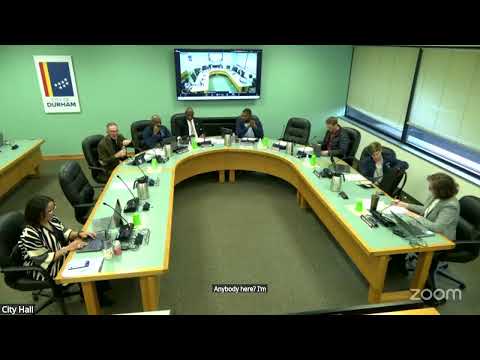
Durham City staff on Thursday gave a detailed briefing on how the city manages Housing Opportunities for Persons with AIDS (HOPWA) funds for the five-county Durham eligible metropolitan statistical area, explained why some HOPWA activity is temporarily being run by the city, and described next steps to put the rest of the funding under contract.
The city’s HOPWA administrator, Reginald J. Johnson, director of the Community Development Department, opened the presentation and then turned the report over to Colin Davis, manager of the Homeless System. Davis said HOPWA “is the only federal program that is dedicated to housing for people living with HIV and AIDS.” He described what activities are eligible and how the city prioritizes limited funding for lower-income households.
The nut of the presentation: the city is contracting tenant-based rental assistance (TBRA), short-term rent/mortgage/utility (STRMU) assistance, supportive services and one-time permanent housing placement costs; staff will issue an RFP to select project sponsors to administer most of this work going forward. Davis said the city expects to release an RFP funded from existing grant agreements (the 2023–24 allocations) and to also use a portion of the awards for a HOPWA strategic needs assessment and system planning.
City staff provided recent spending and program figures. From 2020 through Dec. 31, 2024, the city reported about $1.07 million spent on tenant-based rental assistance supporting 28 unduplicated households; STRMU assistance for 18 households ($431,000); supportive services for 62 households; and permanent housing placement payments for 49 households. Davis told council the program serves residents across Chatham, Durham, Granville, Orange and Person counties and that per-HUD program rules HOPWA beneficiaries need not be homeless but must be low-income and living with HIV/AIDS; the city prioritizes households at 30% of area median income and below.
Davis also addressed a vendor disruption that affected TBRA administration. Durham had previously relied on the Durham Housing Authority (DHA) for some HOPWA work and then contracted with a nonprofit provider, Central Piedmont Community Action (CPCA), to manage TBRA across the EMSA after DHA stepped back. According to staff, CPCA abruptly ceased operations; the city retrieved TBRA records and briefly took administration work in-house to keep payments to landlords flowing. Reginald Johnson said staff reached out to landlords, reconciled outstanding payments and used city processes to make checks while preparing the new RFP. "We literally were in their office having a normal technical assistance meeting with them... The next day, it's posted on our website. All of our staff are furloughed," Davis said of the abrupt CPCA shutdown.
Council members pressed staff on two recurring concerns: (1) slower-than-expected draws of federal HOPWA allocations and whether any money had been returned to HUD; and (2) whether the city’s procurement and oversight approach gives the community sufficient voice when allocations and priorities are set. On draws, staff said funds are drawn on a reimbursement basis: money is drawn after contracts are executed and invoices paid. Davis said HUD grant agreements give the city several years to draw funds and that some recent allocations remain available to be put under contract. Johnson and Davis said a small amount (they cited an $8,000 administrative return from 2018) had been returned previously but that most of the current allocations remain available; they offered to provide the council the HOPWA CAPER and the needs assessment used to set program priorities.
On community engagement and priority-setting, staff said the current program design traces to an earlier needs assessment and to program continuity requirements when the jurisdiction inherited HOPWA responsibility. The city intends to use a combination of data, provider input and the forthcoming RFP process to determine how much to allocate to TBRA, STRMU, supportive services and permanent housing placement. Davis said staff will include external stakeholders in scoring panels and in the planned strategic plan update.
Davis listed the preliminary funding breakdown the city plans to include in the RFP (allocations are from existing HUD grant agreements and must be reported in the consolidated plan): about $677,000 for tenant-based rental assistance; $323,734 for short-term rent/mortgage/utility assistance; $339,225 for supportive services; $27,382.36 for permanent housing placement; and roughly $330,000 intended as contract funds for a department that will provide administrative support to finish the current fiscal year.
Council members raised operational concerns: the administrative burden of running TBRA across five counties, the difficulty of rapidly standing up a capable provider after a vendor failure, and how to balance HUD regulatory compliance with the need to move funds quickly to households. Mayor Williams and others urged better, earlier communication to the public when problems arise; staff said they will provide the CAPER and the previous needs assessment and that they are pursuing hiring and contract options to create more capacity.
Staff described two near-term steps: (1) an amendment to an existing contract to fund immediate obligations to project sponsors and to clear outstanding reimbursements; and (2) an RFP for HOPWA project sponsors for TBRA, STRMU, supportive services and permanent housing placement. Davis said the city will also fund a strategic plan and system mapping exercise to align services across the five-county EMSA.
The presentation concluded with staff offering to share the CAPER, the earlier needs assessment, and a timeline for the RFP. Council members said they wanted regular updates as the RFP proceeds and as the city finishes reconciling the vendor transition.
Ending: City staff framed the HOPWA briefing as a mixture of continuing operations and corrective work after an external provider failure. Councilmembers asked for more transparency, and staff agreed to return with procurement timelines, the CAPER, and the needs-assessment materials that underlie program priorities.