Get Full Government Meeting Transcripts, Videos, & Alerts Forever!
Get email alerts on the Comprehensive Plan topic
No spam. Unsubscribe anytime.
Nampa launches year‑and‑a‑half update of comprehensive plan, officials stress housing, downtown and transportation in outreach
Summary
City of Nampa planning staff and consultants outlined early findings and outreach results for “Nampa 2050” at a public workshop, saying the process will run about 18 months and focus community input on how the city should manage rapid growth, housing needs, transportation and downtown revitalization.
City of Nampa planning staff and consultants outlined early findings and outreach results for “Nampa 2050” at a public workshop, saying the process will run about 18 months and focus community input on how the city should manage rapid growth, housing needs, transportation and downtown revitalization.
Miriam McGilvray, a planner with consultant firm Logan Simpson, told participants the update is intended to replace the current Nampa 2040 plan and serve as the city’s primary long‑range policy document. “A comprehensive plan is really your primary policy document for the long range future of your city,” McGilvray said.
The presentation and discussion centered on two sets of facts: data snapshots the consultant team is assembling and the first months of community engagement. McGilvray said the city’s estimated population is about 123,000 and that regional forecasts show continuing growth. She said the most recent housing needs assessment identified about a 2,400‑unit shortage and that some projections estimate roughly 19,000 additional units could be needed over time to accommodate forecasted population increases and to address the existing shortage.
Brianna, a city outreach staff member, summarized outreach to date, saying staff and consultants have attended more than a dozen community events and pop‑ups, produced about 470 completed questionnaires and estimated roughly 2,291 event contacts (people who stopped at tables, took postcards or spoke briefly). “We really relied a lot on ... social media and press releases and pushing that out,” she said, and staff are continuing outreach at high schools, community events and neighborhood groups.
Public input recorded at the workshop and in questionnaires clustered around several recurring themes: downtown revitalization and placemaking, managing growth and infill, traffic and transit, public safety and preserving the small‑town character that many residents cited as a core value. McGilvray said the team will organize plan recommendations around a short set of “vision themes” rather than long, siloed chapters.
City staff answered specific questions about transit and funding. Mark Steuer, senior director of development services, described the city’s relationship with Valley Regional Transit and summarized transit spending in the current budget: “This year in the budget, we spent about $850,000 to provide those services to us,” Steuer said, noting the agency leverages federal funds and provides multiple services including regional routes, an on‑demand service and paratransit. He added that the total value of services provided to the city is roughly $2,000,000 and that providing an on‑demand service directly would cost the city about $1,000,000 if done outside the regional provider.
Several participants raised questions about downtown policy and local regulation. Councilman Bills and other elected officials and attendees debated whether historic‑design rules and form‑based requirements are constraining private investment in the core and whether code or financing tools (for example, a downtown development corporation acquiring sites or coordinating infrastructure) should be adjusted to encourage reinvestment. One attendee said permitting and design requirements sometimes feel like “set design” that can stifle private creativity; another urged that the plan include ways to free the market to respond while protecting community values.
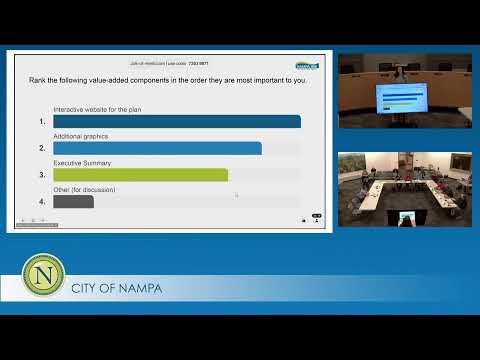
Workshop participants also asked for clear educational materials in the plan: simple explanations of how growth pays for growth, how schools and roads are funded in Idaho, and basic metrics showing the city’s current mix of residential, commercial and industrial uses and how many rooftops typically support retail and other services. Several speakers recommended adding a brief “FAQ” or two‑page explainer the public could use before and during hearings.
City staff described the intended structure and timing: a shorter, graphic plan built around a small number of vision themes, a future land use map, and an implementation chapter to track actions. McGilvray said phase 1 (visioning and data snapshots) is wrapping up, phase 2 will include steering‑committee and focus‑group workshops to work through policy details, and phase 3 will move to plan adoption, with an expected completion around 2027.
No formal votes or policy actions were taken at the workshop; the meeting functioned as public outreach and a briefing on the consultant’s early analysis. City staff asked attendees for additional groups and venues they should reach to broaden participation.
Next steps described at the workshop include finishing phase‑1 outreach, publishing short data snapshots to inform the public and steering committee, continuing pop‑ups and high‑school engagement, and beginning the phase‑2 work sessions where staff and the steering committee will test specific policy and land‑use options.