
RTC: $1.4 billion regional road maintenance shortfall; proposes smart traffic management and new revenue options
Get AI-powered insights, summaries, and transcripts
Sign Up Free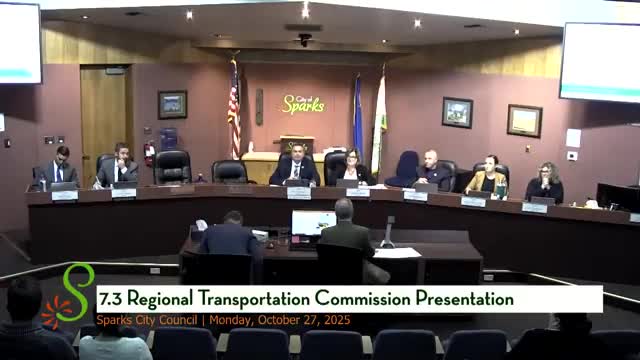
Summary
The Regional Transportation Commission of Washoe County told the Sparks City Council on Oct. 28 that the region faces roughly $1.4 billion in unmet roadway maintenance over the next 10 years, urged prioritization and described smart-traffic upgrades and potential revenue measures including vehicle registration fees and a voter-approved sales tax.
Bill Thomas, executive director of the Regional Transportation Commission of Washoe County, told the Sparks City Council on Oct. 28 that the region faces an estimated $1.4 billion shortfall in road maintenance over the next 10 years and outlined options to stretch existing dollars and find new revenue.
The RTC presented two recent studies: a comprehensive maintenance assessment that quantified the backlog and a policy study by the Gwynne group examining revenue impacts from increased electric vehicle adoption. Thomas said the region’s combined resources — RTC plus city and county contributions — are not sufficient to maintain the regional roadway network and that backlog and network decline are the likely result unless new choices are made.
The maintenance study, the RTC said, modeled the full scope of roadway upkeep — from asphalt repairs to street sweeping, snow removal, signing and striping — and found an approximately $1.4 billion gap between projected needs and currently available funds over 10 years. Thomas said federal funding tends to favor capital projects over recurring maintenance, so the city and region must prioritize how to deploy scarce local resources.
Why it matters: Sparks sits on regional travel corridors. A deteriorating regional network would reduce reliability and raise costs for residents and businesses that rely on shorter, frequent trips across jurisdictional lines.
The Gwynne study the RTC commissioned examined how increasing electric-vehicle adoption and more fuel-efficient vehicles reduce taxable gallons of fuel and therefore fuel-tax revenue — the principal local source for road maintenance. Thomas told council members that while EVs and hybrids were a small share of the fleet in 2020, adoption is projected to grow and to depress fuel-tax receipts over time, creating a structural revenue gap.
Policy options identified in the study and during RTC remarks included: - Vehicle registration fees for electric vehicles (already adopted in most states, Thomas said), a relatively simple near-term option; - A vehicle-miles-traveled (VMT) tax (per-mile fee), which would align payments with use but is complex and raises privacy and administrative-cost concerns; - Taxes on electric charging stations, which raise technical and collection issues; and - Local measures the RTC and county can pursue without state law changes: a supplemental government services tax (estimated in the study at roughly $20 million annually if adopted by the county) and a voter-approved sales-tax increase (an 1/8 cent option the staff said would generate an estimated $15 million a year if approved by voters).
Thomas and deputy executive director Dale Keller also described investments in intelligent transportation systems (ITS) — software, fiber, and signal coordination — as lower-cost ways to extract more capacity from existing infrastructure. Keller said ITS work already completed in Sparks (the Sparks intelligent corridor along Pyramid and Sparks Boulevard) dynamically adjusts signal timing and helped reduce travel delay by giving coordinated green times on major corridors. The RTC plans a traffic management center to coordinate real-time operations regionally.
Council members asked how the ITS system responds to incidents. Keller said ITS uses near-real-time data to reallocate green time during crashes or other interruptions and can reduce the “buffer time” drivers build into trips; he confirmed the RTC plans to expand the approach to Vista Boulevard and other corridors where the technology proved effective.
Thomas said Sparks Boulevard is a major multi-year capital project (he cited roughly $72 million) and that near-term big projects will be constrained by recent spending. He also warned that federal grant levels and priorities are changing, so the RTC would increasingly target projects that match new federal priorities.
The RTC staff asked the council to view their work as regional and to expect interlocal cooperative agreements before RTC proceeds on projects on city streets; those ICAs authorize RTC to act as the city’s agent for design, construction oversight and, if necessary, right-of-way acquisition.
The presentation closed with a request that local governments prioritize roadway spending, consider the revenue options under study and support ITS expansion to improve network performance without the cost of wholesale rebuilding.
Next steps: RTC staff said they will provide the full reports to council and continue coordination with Sparks staff on ITS and project timing.