Get Full Government Meeting Transcripts, Videos, & Alerts Forever!
Get email alerts on the Board Governance topic
No spam. Unsubscribe anytime.
Trainer urges transparency on meetings, executive sessions and school finance at Fremont County School District # 2 retreat
Summary
A Wyoming School Boards Association presenter reviewed public-meeting rules, executive-session limits, Robert's Rules guidance, and school finance basics — including recalibration, special-education reimbursement timing, and reserve guidance — during a board retreat for Fremont County School District # 2.
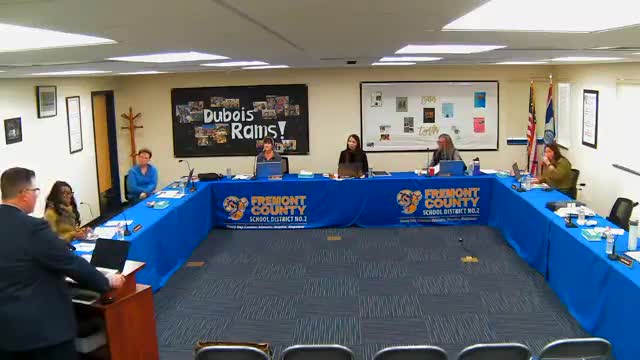
A Wyoming School Boards Association presenter told members of the Fremont County School District # 2 Board of Trustees on Oct. 30, 2025, that clear meeting procedures and transparent notice practices help preserve public trust and make governance easier.
The presenter said the district must treat work sessions and informational meetings as meetings under the state's public meetings law when a quorum assembles, and that special meetings require at least eight hours' notice. "If you think there might be action afterwards, put it in the notice," the presenter said, urging the board to give the public adequate advance information about possible executive sessions or votes.
The explanation was part of a broader training that covered when the board may lawfully go into executive session — including personnel matters, real-estate acquisition, litigation, and other privacy-protected topics — and the differences between a board policy and a rule under the Wyoming Administrative Procedures Act. The presenter noted that rules invoking the administrative procedures act generally require a 45-day public-comment period and an opportunity to be heard; changing a policy materially after public comment can require restarting that comment period.
On parliamentary procedure, the presenter recommended Robert's Rules of Order as a helpful template while noting small-board exceptions (for example, small boards may adopt relaxed requirements for seconds or allow the chair to participate without relinquishing the chair). The presenter said the chair is the judge of order but that boards remain "the best judge of their own rules" and can vote to overturn a chair ruling if they choose.
The training also covered school finance basics. The presenter summarized the state’s foundation program as a block grant adjusted by regional-cost and external-cost indices, with some categorical funding (such as special-education reimbursement) handled outside the block grant and paid in the following fiscal year. "Special education is funded as a 100% reimbursement in the year following," the presenter said, describing the cash-flow challenge smaller districts can face when a high-cost placement moves into their district.
The presenter described the recalibration process — the state's periodic (roughly five-year) review of the funding formula — and noted that recalibration is a moving target, with elements such as staffing, salary, at-risk weights, and service-level definitions changing over time. The presenter encouraged board members to use available recordings and materials and to follow the select committee's consultant reports to be informed participants in advocacy and district planning.
The presentation included practical governance suggestions: schedule committee-of-the-whole or listening sessions as regular, noticed events rather than relying on sequential or contemporaneous communications; consider rolling averages to smooth funding volatility; maintain operating reserves (the presenter cited typical business guidance of 25–33% of annual operating budgets as a benchmark); and follow district policy and counsel when questions about conflicts, nepotism, or abstentions arise.
On conflicts and abstentions, the presenter distinguished statutory conflict-of-interest rules from nepotism guidance and said practices vary among attorneys. For hiring or direct contracts involving family members, the presenter advised abstention and consultation with counsel, and suggested structuring votes (for example, allowing individual consent items to be pulled) to minimize the practical impact of declared conflicts.
No formal votes or motions were recorded during the training segment. The presenter closed by encouraging board members to use WSBA resources and staff (including named WSBA contacts mentioned during the session) for follow-up questions and to review materials provided during the retreat.