Get Full Government Meeting Transcripts, Videos, & Alerts Forever!
Get email alerts on the Maui Economic Recovery topic
No spam. Unsubscribe anytime.
Maui Economic Recovery Commission presents 11 priority projects; councilors press for timelines, short-term services
Summary
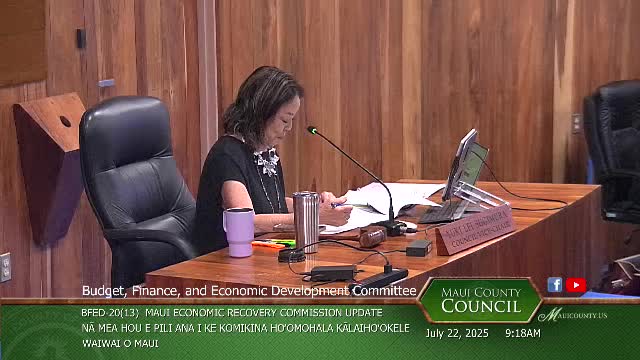
The Maui Economic Recovery Commission presented its final report to the Maui County Budget, Finance & Economic Development Committee on July 22, outlining 11 priority projects to support Lahaina and county economic recovery and pledging a July 31 convening for fully formed project proposals.
The Maui Economic Recovery Commission (ERC) presented its final report to the Maui County Budget, Finance & Economic Development Committee on July 22, outlining 11 priority projects meant to guide long-term economic recovery in Lahaina and broader Maui County. State Department of Business, Economic Development & Tourism Director James “Jimmy” Tokioka and community facilitators summarized recovery findings, data on losses from the August wildfires and a path for project implementation; SR Partners and Maui Economic Opportunity were named as implementation partners.
The report matters because it consolidates community-sourced recommendations into a set of projects that county, state and philanthropic funders can prioritize and potentially finance. The ERC process convened more than 100 participants across sectors; it distilled 34 recovery ideas into 11 priority project teams that the presenters said are intended to move from planning toward implementation with a two-year project-management horizon.
Presenters and data: Tokioka told the committee the ERC was community-led and that the commission’s final report (published in March and available on the Maui Nui Strong website) describes economic impacts including the temporary relocation of roughly 1,800 people in about 14 days, the disruption of about 1,000 businesses and an estimated 7,000 jobs tied to roughly $913,000,000 in annual business revenue. He also noted that more than 1,200 residential structures were destroyed and that preliminary population-movement data showed roughly 1,000 residents leaving the island area tracked in the report, with 430 moving out of state in the dataset the presenters cited.
Eleven priority projects: Facilitators described three water-related projects (recycled R-1 water expansion and distribution; watershed/recharge planning; and a “ViE dashboard” to make water data more accessible to community decision-makers), two workforce efforts (health care/construction/government and food-system workforce), an economic-diversification/creative-economy strand (including cultural and arts programming like the Halemakua initiatives), accelerated permitting and systems mapping, Lahaina Harbor restoration and operations, a Lahaina Business Park project to create commercial space for displaced businesses, and a healing-journey effort focused on community wellbeing.
Funding and alignment: Tokioka said DBEDT and the governor had approved a $6,000,000 restricted-state appropriation to support West Maui marketing; the state and SR Partners speakers said philanthropic support and county funds (the presenters noted a county allocation of approximately $200,000 to support phase 2 implementation) are part of the funding mix. Presenters mapped the 11 projects to elements of the Lahaina Long-Term Recovery Plan and to potential Community Development Block Grant–Disaster Recovery (CDBG-DR) program categories but said formal CDBG-DR allocation rules (the program’s guidance and county implementation framework) remain to be finalized before specific projects can determine eligibility and exact funding needs.
Council questions and immediate needs: Committee members repeatedly pressed for timelines, measurable start dates and clearer funding commitments. Council members raised short-term, service-oriented needs cited by West Maui residents — examples included laundromats, recycling/redemption centers and preschool/daycare — and cautioned that services which serve local residents and pay living wages should be prioritized to stem out-migration. Presenters and project facilitators said project teams will present fully formed proposals with budgets, partners and schedules at an all-day convening on July 31 at the Maui Arts & Cultural Center (MAC), 9 a.m.–4 p.m., where philanthropic funders and county leaders will be present to ask questions and offer feedback. SR Partners’ Melissa Umimori Hemp and Office of Recovery staff said July 31 is intended to be an interactive forum where teams will solicit funder and community input.
Water, permitting and harbor updates: Office of Recovery staff cautioned that water-resource issues remain complex and are constrained by the Commission on Water Resource Management (CWRM) verification process and existing meter allocation; those processes limit near-term ability to add new water allocations in West Maui, officials said. Regarding Lahaina Harbor, presenters reported active Harbor Recovery Working Group work with state harbor operators and county staff on critical-path items (restroom repairs, securing pedestrian areas and seawall/railing repairs) and said progress was being made toward resuming broader harbor access and ferry operations, though one outstanding critical-path item remained at the time of the presentation.
Process and next steps: Presenters emphasized the ERC’s community-driven origins and the plan to keep project teams moving toward implementation; they urged council members to attend the July 31 convening. The committee approved the presence of state and partner staff as resources under the committee’s Rule 18(a) with no objections, and no formal vote was taken on the ERC report. The committee’s chair said the ERC update will be returned to committee for continued oversight and follow-up after the July 31 convening.
Ending: The ERC presentation provided project-level groundwork and pledged a schedule for more fully formed proposals on July 31; committee members said they expect clearer timelines, funding requests and measurable outcomes at that meeting before specific county commitments are considered.