Lifetime Citizen Portal Access — AI Briefings, Alerts & Unlimited Follows
Committee backs SB 716 to extend a state Lifeline subsidy to home internet; industry questions funding
Loading...
Summary
SB 716 would create a Home Internet Lifeline program allowing eligible households to apply a subsidy toward home broadband plans capped at roughly $11 out-of-pocket; the committee approved the bill after amendments but wireless and broadband trade groups raised concerns about funding equity.
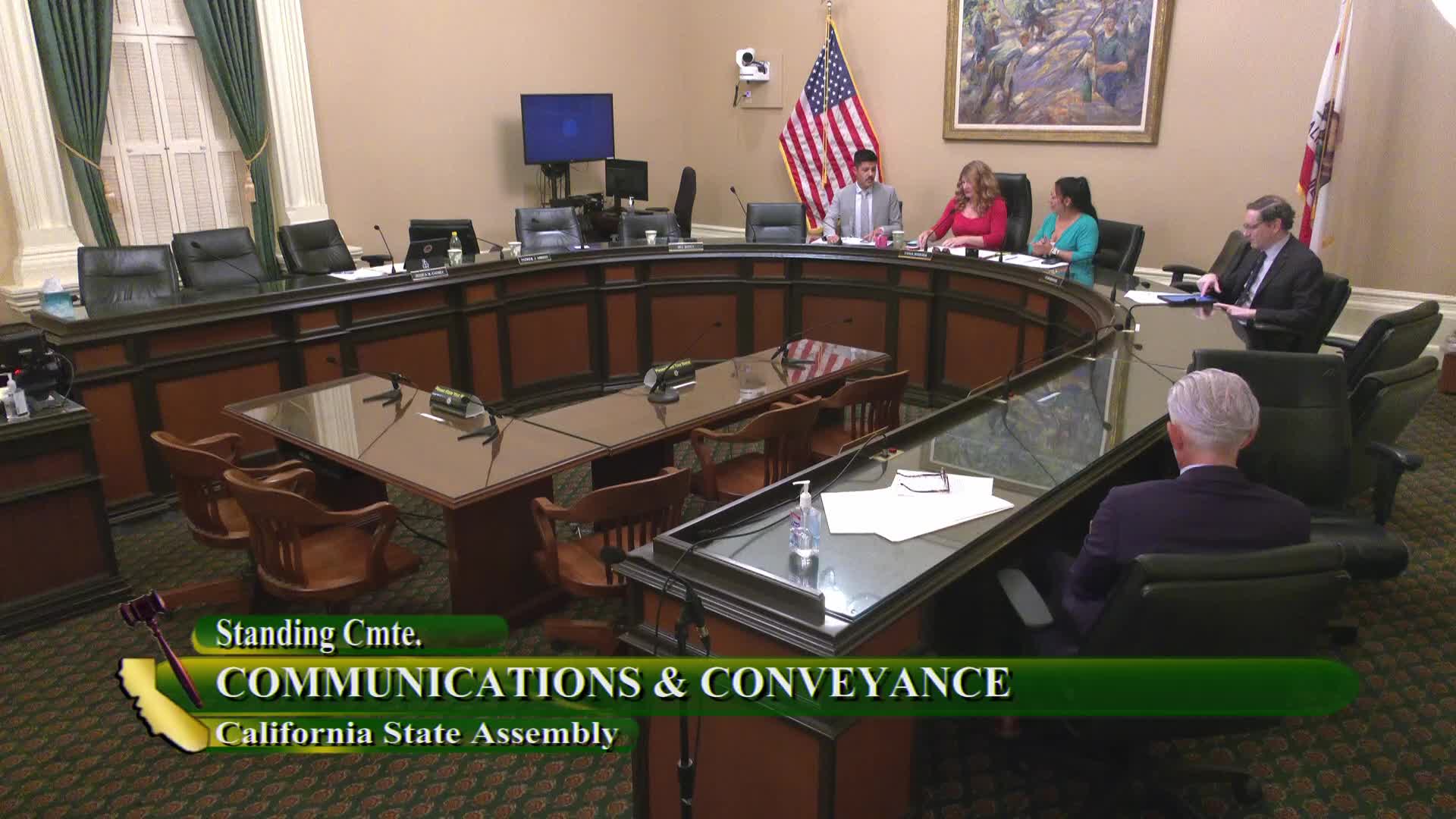
The Assembly Communications and Conveyance Committee approved SB 716, author Sen. Durazo’s measure to create a state Home Internet Lifeline program that allows eligible low-income households to use a subsidy toward home broadband service. The committee adopted amendments and sent the bill to the Assembly Appropriations Committee.
Sen. Durazo framed the bill as a response to the end of the federal Affordable Connectivity Program and to persisting affordability barriers. “Nearly one in three families in California can't count on reliable home Internet for the kids to do schoolwork,” Durazo said, and described SB 716 as letting eligible households apply lifeline support directly to broadband service. The bill sets implementation deadlines for the CPUC (rules by July 1, 2027), asks participating internet service providers to offer at least one $30 plan with speeds up to 100/20 Mbps, and establishes an out-of-pocket cap for participating households of about $11 per month. The measure includes a surcharge cap tied to the highest access-line rate charged over the prior four years and a sunset date of Jan. 1, 2032.
Proponents included the California Emerging Technology Fund (CETF), which sponsored the bill, retired Sen. Richard Polanco, and community groups. Trish Kelly of Valley Vision described school-level impacts and said affordability, not infrastructure, remains the primary barrier for many families. CETF representatives said they convened broad stakeholder workgroups over weeks to refine the bill.
Industry witnesses raised funding and fairness concerns. Jonathan Aaronbo of CTIA (wireless industry trade association) said the bill’s funding approach would place a larger share of the surcharge on wireless consumers and argued that broadband providers and other services that benefit from broadband access do not pay equivalently into the existing access-line funded pools. US Telecom and other trade groups echoed the concern. CETF and committee members responded that the universal-service access-line fee base has broadened and that amendments in committee capped the surcharge at the highest rate charged in the last four years.
Committee members voiced support for the goal while acknowledging funding complexity. The motion to due-pass SB 716 as amended carried in committee; the clerk later reported the bill out with a 7–1 tally. Members said they expect close CPUC oversight in implementation and follow-up on equitable contributions over time.
The bill was referred to the Assembly Appropriations Committee.