Get Full Government Meeting Transcripts, Videos, & Alerts Forever!
Get email alerts on the Rideshare Insurance topic
No spam. Unsubscribe anytime.
Assembly committee approves SB 371 to lower rideshare uninsured/underinsured motorist limits; proponents and opponents dispute effect on fares and protection
Summary
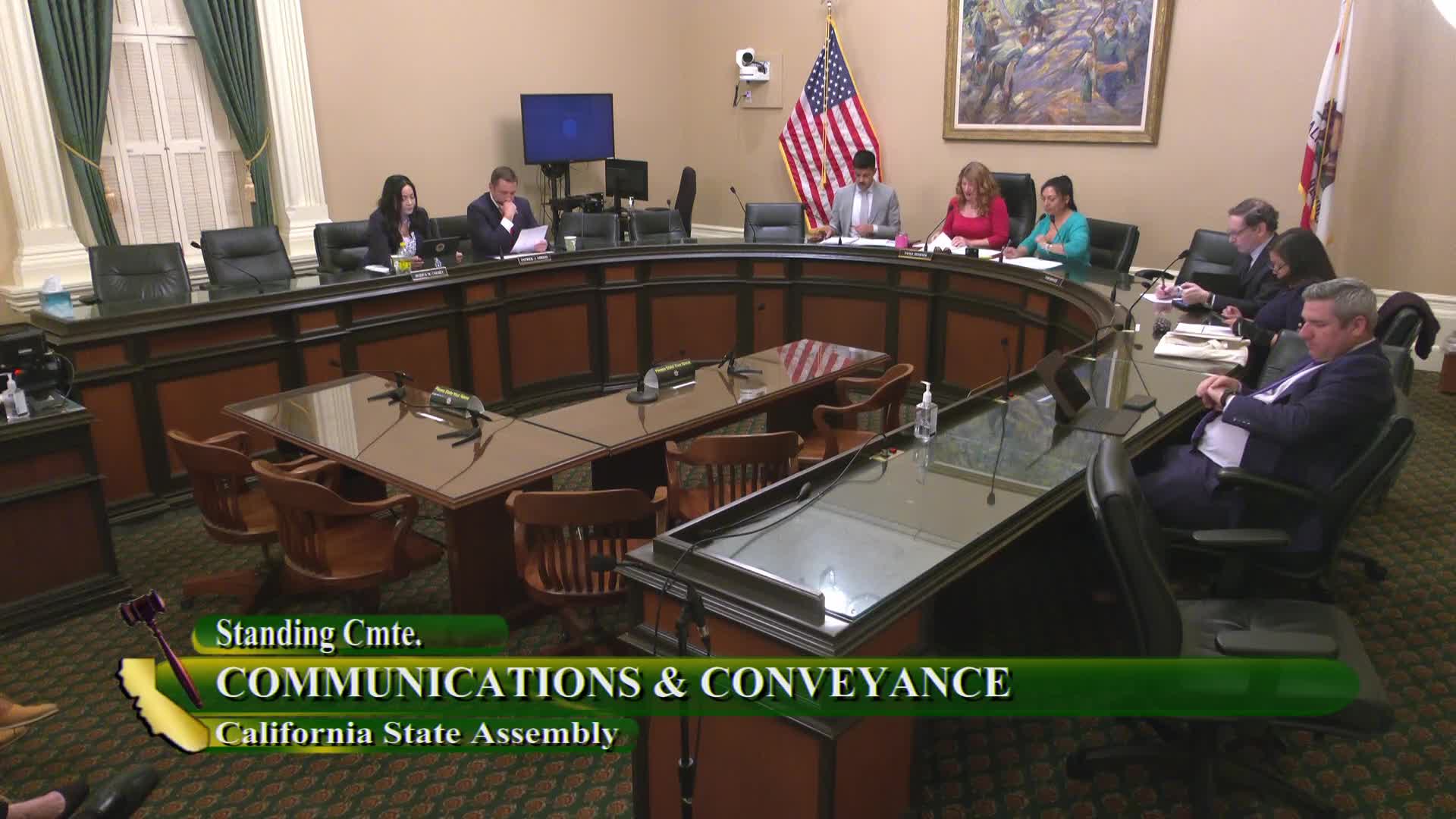
The California Assembly Communications and Conveyance Committee voted to give SB 371 a due-pass recommendation as amended, sending the bill to Appropriations. The measure would reduce required uninsured/underinsured motorist (UIM) coverage for transportation network companies and require a joint study by state regulators.
The California Assembly Communications and Conveyance Committee voted to give SB 371 a due-pass recommendation as amended, sending the bill to the Committee on Appropriations. The bill, carried by Sen. Cabaldon, would lower the required uninsured/underinsured motorist (UIM) coverage for transportation network companies and direct state regulators to study impacts.
SB 371’s author, Sen. Cabaldon, told the committee the bill targets only the UIM layer of coverage, which he said was set early in the sector’s development and now exceeds the level of claims. “This legislation is here because when the rideshare sector began … we had to come up with a comprehensive regulatory framework,” Cabaldon said, and the UIM portion “happened to be what one of the rideshare companies was doing at that time.” He said the bill accepts committee amendments to set a $100,000 per-person and $300,000 per-accident UIM cap and to require a joint study by the Department of Insurance and the California Public Utilities Commission on UIM impacts.
Proponents from the industry said the UIM requirement has materially increased riders’ costs. Ramona Prieto, director of public policy for Uber, told the committee that multiple insurance layers currently attach to each trip and that the UIM policy has become “the single biggest cost driver to riders.” Prieto said those costs are passed through as the booking fee on receipts and urged support for SB 371. Nick Johnson, public policy director at Lyft, said lowering the UIM limit would keep coverage “primary” and better match the distribution of claims, while still leaving TNCs’ liability coverage intact.
Opponents said the proposal would sharply reduce protections for injured passengers and drivers. Casey Johnson, vice president at Consumer Attorneys of California, said the bill would cut UIM protection from $1,000,000 to $100,000 per person or $300,000 per incident — a “90% cut” — and described that as a “corporate windfall at the expense of real people.” Sarah Flocks of the California Labor Federation said savings are not guaranteed to reach drivers or riders and warned that the TNC business model leaves drivers without the workplace protections available to employees.
Committee members pressed proponents on data and enforcement. Several members asked for concrete mechanisms to ensure any savings flow to drivers and riders rather than to corporate profits; the author and company witnesses said they were negotiating potential auditing and “look-back” mechanisms and noted operational constraints under existing law, including Proposition 22. The author and the committee accepted amendments clarifying that TNC UIM would be primary to other applicable UIM policies and added the joint Department of Insurance/PUC study requirement.
The committee motion to due-pass SB 371 carried on a recorded voice and roll call vote; the clerk later reported the bill out with a 9-0 tally. The committee referred SB 371 to the Assembly Committee on Appropriations for further consideration.
Votes and formal actions are recorded on the committee record and the clerk’s roll call.