Get Full Government Meeting Transcripts, Videos, & Alerts Forever!
Get email alerts on the Accessory Dwelling Units topic
No spam. Unsubscribe anytime.
Carbondale planning panel votes to begin rewrite of ADU rules; public hearing set Aug. 28
Summary
The Carbondale Planning and Zoning Commission voted unanimously to initiate a code text amendment to review regulations for accessory dwelling units (ADUs), directing staff to prepare an application and public notices ahead of a first public hearing on Aug. 28.
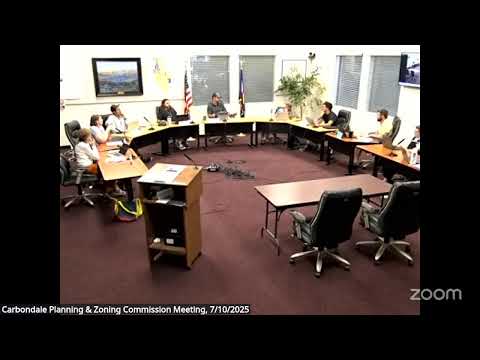
The Carbondale Planning and Zoning Commission voted unanimously Thursday to initiate a text amendment to the town’s Unified Development Code to review rules governing accessory dwelling units, commonly known as ADUs, and directed staff to prepare an application and public notices ahead of a first public hearing on Aug. 28.
The amendment process, as staff described it at the meeting, will include public hearings before the Planning and Zoning Commission and the Historic Preservation Commission and a final ordinance by the Board of Trustees. “Ultimately, what we're asking the planning zoning commission to do is to initiate a code text amendment, direct staff to notice a public hearing, invite the community to provide feedback, and really start discussing regulations in a public forum,” said Jared Moore, town staff presenting the proposal.
The change is intended to address several matters commissioners and staff raised: whether detached ADUs should be permitted in Old Town and other zones, when ADU proposals should be handled administratively versus through a Planning and Zoning public hearing, how to treat ADUs inside or adjacent to PUDs, size and massing limits, parking requirements and whether ADUs may be used as short-term rentals.
At least two procedural details were repeated during the discussion: code text amendments are townwide actions that are noticed in the paper and do not use the 300-foot property-notice rule used for individual land-use applications; and, if the Board of Trustees adopts an ordinance, there is typically a roughly 30-day period before the ordinance goes into effect unless the board declares an emergency.
Commissioners and staff discussed possible thresholds to speed straightforward ADU approvals. Staff said minor site-plan review currently triggers a noticed public hearing and adds time and cost; commissioners suggested many ADU types could be processed administratively (for example, basement conversions that do not alter setbacks or massing), while projects that add new detached buildings or increase vertical massing would continue to receive commission review to protect neighbors and historic character. One commissioner noted the town’s current minor site-plan fee (about $500) plus notice costs (about $50) and the time required to attend hearings as real costs to applicants.
Public comment included a resident who urged allowing detached ADUs in Old Town. “I’m specifically here to give my support for allowing OTR to have detached ADUs,” said Kenny Titler, who said he had previously filed an application blocked by the current Old Town restriction and that a detached unit would help house an elderly relative and later serve as affordable housing.
Commissioners also debated short-term rental uses of ADUs. Views ranged from recommending an initial prohibition on short-term rentals for ADUs to leaving the choice to property owners (with the caveat that enforcing deed restrictions or occupancy rules would require staff capacity and monitoring). Commissioners suggested the drafting process should include exploring incentives — such as fees waivers or owners occupying ADUs for a set period — that could encourage long-term local housing rather than investor-driven short-term units.
Staff said they will prepare draft code language, coordinate review with the Historic Preservation Commission, and return to the Planning and Zoning Commission for further meetings before forwarding a recommendation to the Board of Trustees. The motion to initiate the amendment and direct staff to prepare notices passed on a voice vote with all present commissioners voting “aye.”
The commission collected several follow-up points for staff: prepare draft language that distinguishes administrative versus noticed review thresholds; produce a map clarifying how the amendment would apply to various PUDs; outline parking options and fee impacts (water/sewer connection fees apply but amounts were not specified); and gather comparative data about ADU prevalence and regulations in other Colorado mountain towns. Staff said they anticipate multiple Planning and Zoning meetings to refine the language and will include Historic Preservation review within that timeline.
The commission’s action does not itself change regulations. It initiates the public process to propose amendments to the Unified Development Code; any final change would require hearings and an ordinance adopted by the Board of Trustees.
Votes at a glance: The Planning and Zoning Commission voted to initiate a Unified Development Code text amendment to review ADU regulations and directed staff to prepare an application and public notices; outcome: approved (voice vote, unanimous).