Get Full Government Meeting Transcripts, Videos, & Alerts Forever!
Get email alerts on the Housing And Transit Overlay topic
No spam. Unsubscribe anytime.
South Salt Lake council adopts Housing and Transit overlay district; related items moved to later meeting
Summary
The South Salt Lake City Council voted to enact a new Housing and Transit (HT) overlay district to encourage denser, mixed‑use redevelopment in downtown and tabled two related unfinished-business items to a future meeting.
The South Salt Lake City Council on July 9 approved an ordinance creating a new Housing and Transit (HT) overlay district intended to encourage mixed‑use redevelopment in the downtown area.
The ordinance enacts Section 17.03.185 of the South Salt Lake Municipal Code and amends several sections across Title 17 to implement the new overlay. Spencer Cawley, senior planner, told the council the overlay will allow developers to petition for rezoning if projects meet minimum standards, including a minimum site size of 5 acres, a minimum density of 50 units per acre and a minimum average building height of 50 feet. Developers seeking the overlay must enter into a development agreement with the city, Cawley said, and the example driving the proposal was the Marcus Center project near the S‑Line stop.
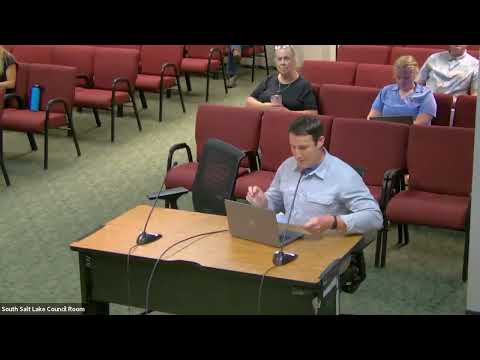
"The item for action this evening is enacting the housing and transit overlay district. This is a district that will assist in the redevelopment of downtown," Spencer Cawley, senior planner, said during the meeting.
Council member Ray DeWolf made the motion to approve the ordinance; Clarissa seconded. The council proceeded to a roll call and the motion passed.
Council members also moved two separate unfinished‑business items (listed on the agenda as items 2 and 3) to the council's next regularly scheduled meeting. The council acted on item 1 (the HT overlay) and separately voted to continue items 2 and 3 so that those measures could be revisited at a later date.
Why it matters: the HT overlay creates a formal pathway for denser, transit‑oriented redevelopment downtown by setting minimum scale and density thresholds and by allowing flexibility through development agreements. The overlay’s requirements and the development‑agreement process will be relevant to property owners, developers and residents near downtown.
What the ordinance contains: the new overlay sets quantitative thresholds (5 acres, 50 units/acre, average 50‑foot height) that properties must meet to petition for rezoning to the HT overlay. The ordinance also includes broader amendments across multiple chapters of the zoning code to align permitted uses and development standards with the overlay.
Next steps and context: council members tabled two related agenda items to the next regular meeting for further consideration; the council’s motion to adopt the HT overlay was immediately followed by a motion to continue the separate items.
Votes at a glance: the motion to adopt the HT overlay ordinance was made by Council member Ray DeWolf and seconded by Clarissa. The motion passed on roll call.
Community members and developers interested in petitioning for the overlay will need to satisfy the ordinance’s size, density and building‑height thresholds and negotiate a development agreement with the city.