Get Full Government Meeting Transcripts, Videos, & Alerts Forever!
Get email alerts on the Waste Reduction topic
No spam. Unsubscribe anytime.
Marin supervisors adopt 'Plastic Free July' resolution; staff to revisit reusable foodware ordinance
Summary
The Marin County Board of Supervisors voted to adopt a resolution recognizing Plastic Free July after presentations from an intern, Zero/0 Waste Marin, and regional partners. The board also heard about county waste-reduction efforts, new staff and campus sorting stations, and agreed to revisit the county's reusable foodware ordinance.
The Marin County Board of Supervisors on Tuesday adopted a resolution recognizing Plastic Free July after presentations from interns, county partners and local nonprofits and public comment urging stronger action on plastic pollution.
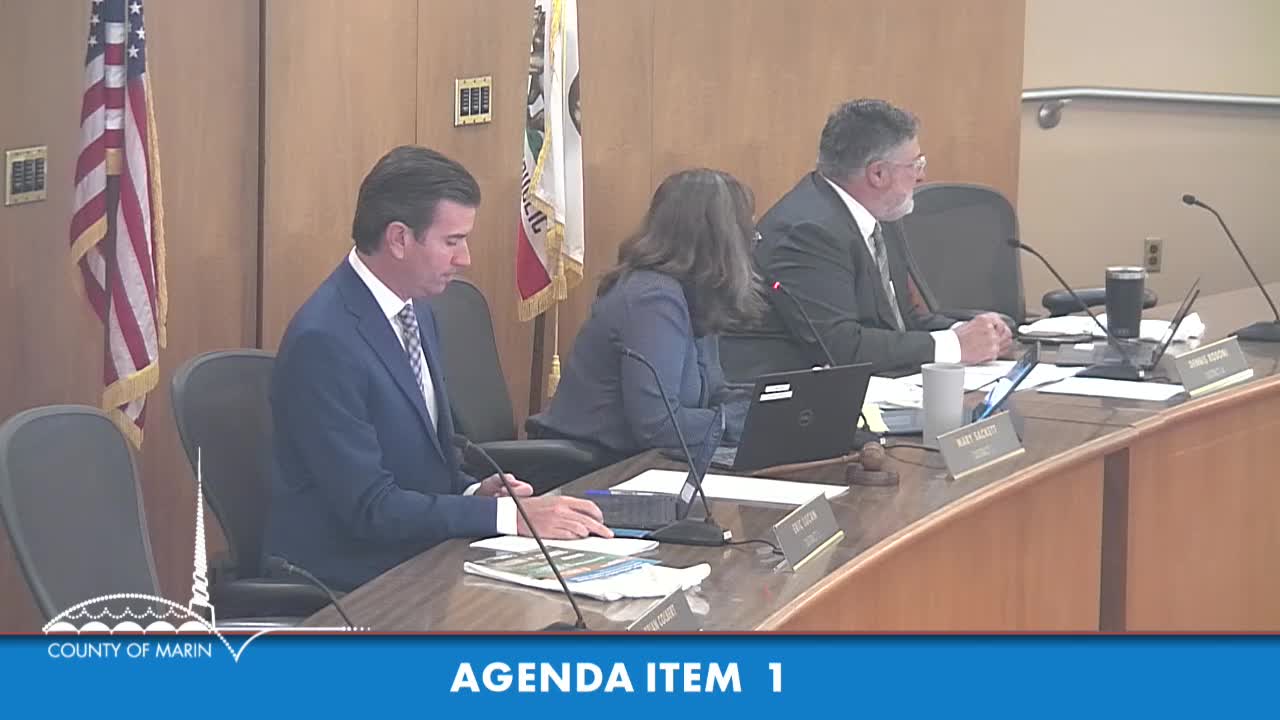
The resolution was moved by Supervisor Rodoni and seconded by Supervisor Lucan; the board approved it on a voice vote and then by roll call, with Supervisors Lucan, Colbert, Rodoni, President Sackett and Supervisor Milton Peters recorded as voting yes. "I move we I move we adopt the plastic free July resolution. Second," Supervisor Rodoni said on the floor before the vote.
The action followed a short slide presentation and several public remarks laying out local waste trends and outreach plans. Greta La Famina, an intern in the District 1 office, summarized Marin statistics: "So first of all, just some county statistics. So the waste generated by our community increased 2% between 20 22 and 20 23. By 2023, waste generated was 26% the 2,005 level, and this is based on countywide disposal data. And emissions from waste disposal decreased 50% due to the lower organic content of landfill waste. The Climate Action Plan's target is to reduce waste disposal emissions 70% below the 2,005 level by 02/1930." The presentation introduced the Plastic Free July challenge and everyday steps residents can take to reduce single-use plastics.
Kimberly Scheible, identified in the meeting as Executive Director of 0 Waste Marin, placed the local campaign in a regulatory and regional context, noting state mandates and joint local governance. "In 1989, the Integrated Waste Management Act was signed into law," she said, and described the Marin Hazardous and Solid Waste Joint Powers Authority (0 Waste Marin) as the formal body that coordinates regional waste reduction. Scheible and other presenters emphasized the limits of recycling and the need to reduce demand: the presentation cited industry figures such as the commonly reported statistic that only a single-digit percentage of historic plastic production has been recycled and county and state waste-characterization figures indicating a substantial plastic component of disposed material.
Speakers from partner organizations described ongoing county activities: Madeline Nieto Hope, project coordinator for the Cleaner California Coast initiative, said the program coordinates outreach across Marin, Sonoma and Mendocino and partners with the county on reuse and cleanup events. "The purpose of our initiative is that it is a 3 county initiative with Marin, Sonoma, and Mendocino County, raising awareness, reducing litter, single use plastics through education, public engagement, and stewardship," she said. Holly Eberhard of the Environmental Action Committee of West Marin urged adoption of the resolution and cited volunteer cleanup work. Scott Tai of Surfrider Foundation thanked the county and said, "We're never gonna solve the problem until we stop it at the source."
County staff and 0 Waste Marin said the county has recently upgraded sorting stations at the Civic Center and at public events, launched an employee training program and is expanding outreach. The county introduced a new waste management program manager who will lead franchise-agreement oversight, state-mandate compliance in county buildings and outreach to residents and businesses. A speaker from 0 Waste Marin called attention to recent studies and local waste-characterization findings and urged residents to use reusables and to check with haulers about what is actually recyclable.
During public comment some callers and in-person speakers praised the work and others urged broader systemic changes. One caller noted that individual behavior change is insufficient by itself and pointed to larger producers and infrastructure as the primary drivers of plastic pollution.
Supervisor Rodoni said the county's reusable foodware ordinance (passed in 2023 and implemented in late 2023) had been a key effort to stop plastic at the source but acknowledged implementation challenges and asked staff to "reimagine and restart" the ordinance in coming months. He said he looks forward to meeting with county departments and nonprofit partners later in the summer to clarify education and compliance steps for businesses.
The board's formal motion adopts the Plastic Free July recognition and directs continued county collaboration with 0 Waste Marin and regional partners on outreach, implementation of sorting and training programs, and further work on the reusable foodware ordinance.
County staff and presenters provided contact points for more information: the county's waste and sustainability teams and 0 Waste Marin representatives were available after the meeting to discuss outreach materials and local refill/refuse resources. The board welcomed staff and partner representatives for a ceremonial photograph after the vote.
The meeting record shows the resolution passed unanimously among supervisors present; Supervisor Milton Peters participated remotely for parts of the meeting while attending legislative business in Sacramento.
The county will continue to publish progress and work with partners on outreach, and staff said they will return with follow-up items related to the reusable foodware effort and implementation details for county facilities and franchise areas.