Get Full Government Meeting Transcripts, Videos, & Alerts Forever!
Get email alerts on the Municipal Budgeting topic
No spam. Unsubscribe anytime.
Kuna council questions large budget increase, city reserves and police funding
Summary
At a Kuna City Council budget workshop, council members and a resident pressed staff for clearer breakdowns of a proposed jump in the city's budget and for justification of large reserve balances; staff said the top-line increase largely reflects carryover, contingency and infrastructure funds and warned House Bill 389 limits property tax revenue.
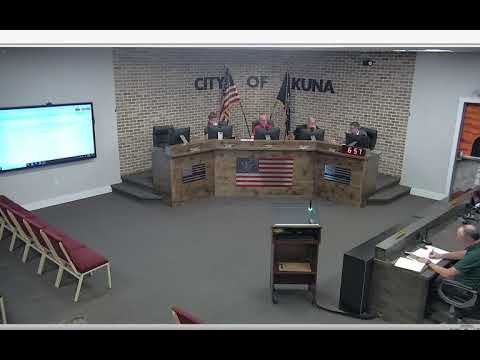
At a Kuna City Council budget workshop, council members and a public commenter pressed city finance staff for more detail on a proposed jump in the city's 2026 budget and on why Kuna is holding large reserve balances.
The workshop followed a public comment earlier in the meeting from Michael Rackle, who warned the council against a "rubber stamp" and questioned a jump in the budget from about $112 million to $153 million. "Why is the city accumulating reserves to this scale," Rackle asked, noting the proposed budget lists about $87.6 million in carryover and that more than $49 million is allocated to water, sewer and irrigation funds.
Jared, finance staff, told the council the headline numbers in the packet include carryover and contingency and therefore overstate expected spending. "When you actually look at the true spending, which is strip out carryover and contingency, honestly, the budget hasn't really increased dramatically," Jared said, adding the city uses carryover to fund depreciation and future asset replacement. He said the city is seeing a record year for building permit revenue and that some funds (for example sewer and water east funds) did not exist in prior years, complicating year-over-year comparisons.
The council pressed for more granular departmental detail. Council member Bruce and others asked that department directors present line-item needs and multi-year capital plans so the council and public can see what the carryovers are being saved for. Council member Leroy said he wants to know "how much cash should a city government keep on hand for the future" and asked whether a lower carryover would allow returning money to taxpayers.
Staff said some capital pressure is driven by aging wastewater infrastructure. Council members noted that replacement costs have risen (one council member estimated sewer installation went from roughly $1 million per mile historically to about $3 million per mile now). Jared warned that reducing carryover reduces interest revenue the city uses to subsidize current residents instead of bonding for projects.
Council members also asked about employee pay studies. Jared and staff said they are exploring a subscription-based compensation benchmarking service (about $600 per year) that would update when positions are posted; the city recently leveraged a study done by the city of Eagle as a cost-effective reference.
Police funding and state constraints were discussed at length. Jared said House Bill 389 (2021) has shifted the relationship between Levy revenue and police costs; he told council members that had Kuna retained its 2021 levy rate the city could fund roughly nine more officers. Mike Fortunesco, Kuna chief of police, said Kuna residents pay less per capita for law enforcement than other Ada County cities and that the city currently spends a high share of its levy on police services.
Staff said outstanding adjustments (payroll true-ups, capital cash-flow timing, updated property tax figures from the county and a revised police contract COLA) will be reflected in the tentative budget scheduled for the council's July 15 meeting. Council members asked staff to produce department-level requests and multi-year capital plans before the next public hearing so the public and council can better assess where money would be spent.
No spending decisions were made at the workshop; council members asked staff for more information and scheduled follow-up material for the tentative budget meeting on July 15.