Get Full Government Meeting Transcripts, Videos, & Alerts Forever!
Get email alerts on the Electrification topic
No spam. Unsubscribe anytime.
Los Alamos utility consultants say Eastgate substation needed to serve projected electrification load
Summary
Consultants from Burns & McDonnell presented an intermediate draft electrification study June 25 that finds large distribution and substation upgrades will be required under high‑adoption scenarios; a full financial analysis will be provided at the July meeting.
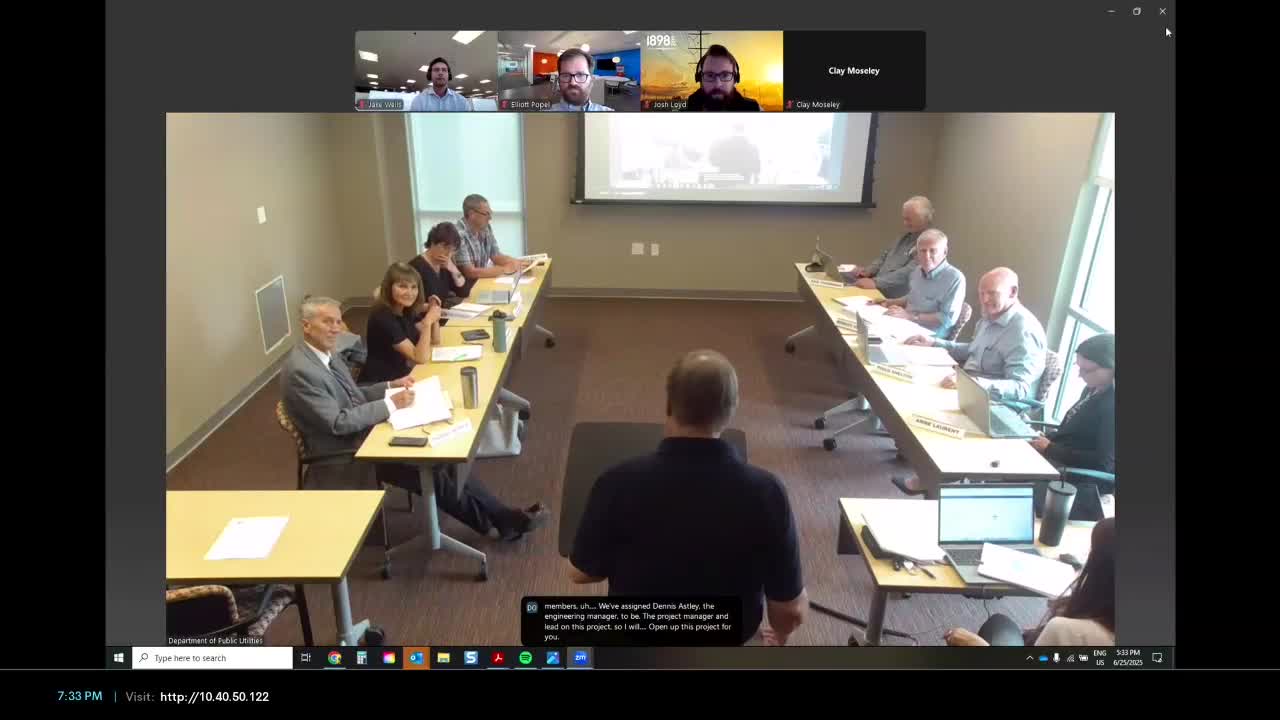
Los Alamos County Board of Public Utilities members on June 25 reviewed an intermediate draft of an electrification study that models 30 years of load growth if transportation and building electrification accelerate.
Consultants with 1898 & Company, a division of Burns & McDonnell, told the board the draft includes chapters 1–4 of the full report and focuses on inputs, existing system assessment, electrification forecasts and power‑flow simulations. "This intermediate draft release contains chapters 1 through 4 of the full electrification study report," presenter Jake Wells said, introducing the materials.
The draft centers on three electrification scenarios. The most aggressive scenario projects about a 44.4 megawatt increase in winter peak load by 2055, driven mainly by electric vehicle charging and electric space heating. The consultants said that, across all high‑growth scenarios modeled, Los Alamos would need a new Eastgate substation and several feeder and conductor upgrades to maintain planning criteria and contingency performance.
Why it matters: the study attempts to separate routine asset replacement from capacity improvements required to serve additional electrification load. The consultants said they will present the financial impacts and options to minimize rate impacts at the board’s July meeting; tonight’s session focused on technical findings and assumptions.
Key technical findings and assumptions
- Substation capacity and transmission: the report treats the LANL TA‑3 supply as having a contracted limit of roughly 20,000 kVA (20 MVA); that constraint is a principal driver of the Eastgate recommendation so additional county load would not exceed that TA‑3 contractual limit. Consultants said discussions with LANL and transmission owners are needed before committing to transmission upgrades.
- Eastgate and distribution upgrades: to serve high electrification growth in the townsite the team modeled relocating and adding feeders westward from a proposed Eastgate substation, upgrading conductors and constructing new feeders to spread load and maintain contingency performance.
- White Rock: consultants found White Rock’s primary transformer (rated ~7,500 kVA) has limited contingency margin (approximately 3,900 kVA present load and 5,000 kVA reserve transformer). The draft recommends targeted feeder upgrades and an additional feeder under high adoption scenarios to reduce risk in contingency events.
- Hosting capacity and rooftop PV: the team exported the WindMil (power‑flow) model to Eaton’s Syme software to run hosting‑capacity analysis. The most common limiting factor was reverse power flow near substations; one example showed hosting‑capacity limits on a feeder near the substation of about 915 kW before reverse power flow violations. The consultants noted hosting capacity is a snapshot and will change as customers add generation.
- Load allocation and modeling choices: the team used a kilowatt‑hour billing method to allocate customer peak demand to the power‑flow model where possible. Where model convergence failed (for example on Feeder 13 and the EA4 LANL feeder) the team used alternate allocation methods (transformer kVA and length‑weighted allocation). The project team assumed a 95% power factor and used a 70% assumed PV output for minimum‑daylight scenarios when modeling hosting capacity.
- Asset life and replacement estimates: the report estimates service transformer life at roughly 25–40 years and mainline switch life around 20 years. Using the provided WIML/GIS data the consultants estimated roughly 43 line miles of primary overhead and 58 line miles of primary underground cable in the county; underground replacements were modeled as materially more expensive in the team’s representative cost estimate.
Model limitations and next steps
Consultants flagged model fidelity issues that affected some simulations: secondary service transformer detail caused convergence issues when the team added large 30‑year loads, so some service transformer elements were removed for primary‑level analysis. The team recommended improved GIS integration, more frequent hosting‑capacity updates and better SCADA and metering data flows to maintain a "living" WindMil model.
The draft also includes a suite of grid‑modernization options (distribution‑scale batteries, mobile batteries, microgrids, FLISR, volt‑VAR optimization and inverter control) with initial pros and cons. The consultants noted many inverter‑based mitigation measures (for example, volt‑VAR control) are already standard on IEEE‑1547‑compliant inverters and can be required through interconnection rules to limit high‑voltage events.
Board members pressed for clarity on how the study separates costs for routine modernizations versus electrification‑driven capacity projects. The consultants reiterated they will present a financial analysis in July that distinguishes capacity improvements associated with electrification from asset replacement and modernization projects that would be needed regardless.
Quotes and attributions
- "This intermediate draft release contains chapters 1 through 4 of the full electrification study report," Jake Wells, presenter, said while opening the team’s technical overview.
- "We really were focused on capacity and maintaining voltage in a peak load scenario," Elliot Popeld, a member of the consultant team, said when asked how the report separates modernization from electrification capacity projects.
What the board asked to see next
Board members requested the final draft’s financial analysis, clearer documentation linking specific upgrades to electrification versus replacement, and additional detail on transmission capacity assumptions and any discussions with LANL. The consultants said Burns & McDonnell will deliver the financial impact tables and recommended rate‑mitigation approaches at the July meeting, and that transmission conversations remain outstanding.
Ending note: the draft is technical and contains multiple scenario outputs; the board scheduled follow‑up discussion and a financial presentation for its July meeting before any rate or policy decisions are made.