Columbia City Council adopts major amendment to Bull Street plan; members call for city-led traffic study
Summary
The council approved a major amendment to the Bull Street neighborhood plan development on second reading after residents and council members raised concerns about traffic and tree canopy; council asked the city manager to coordinate a broader traffic study.
The Columbia City Council voted to adopt a major amendment to the Bull Street neighborhood plan development (item 12) after residents and council members raised traffic and tree-canopy concerns and urged a coordinated study of future growth. The measure passed on second reading by unanimous roll call.
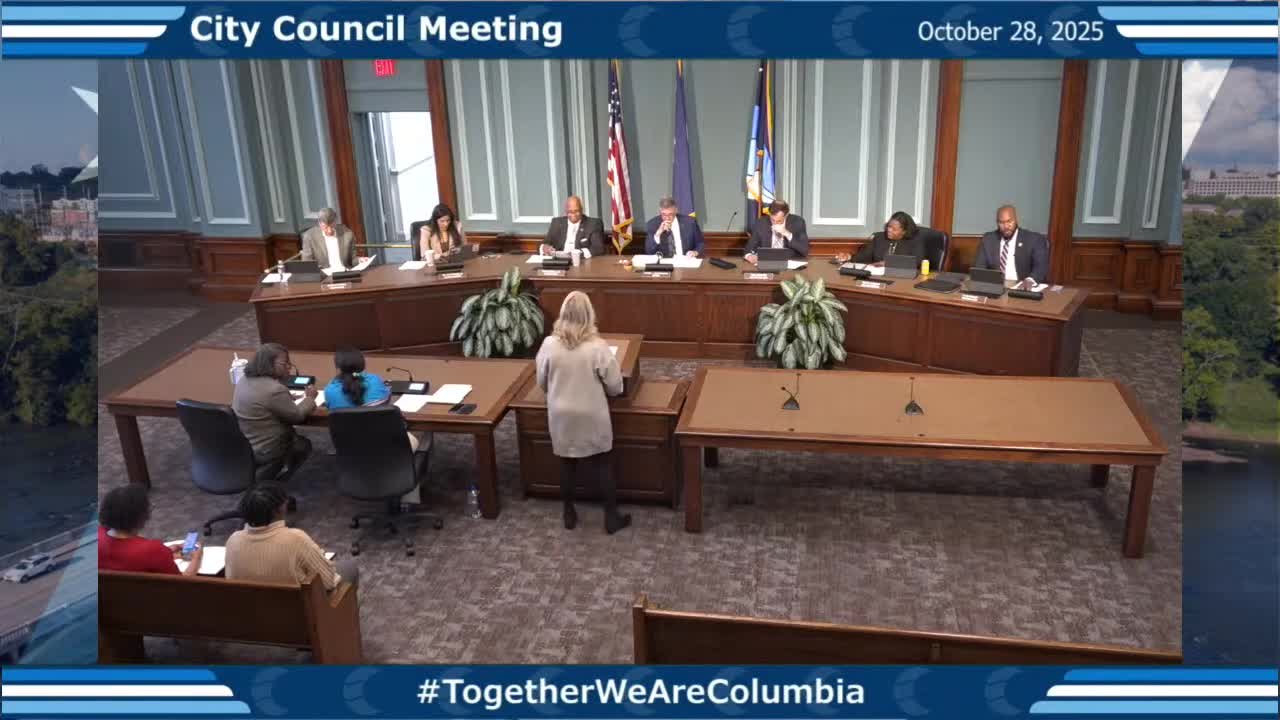
The amendment affects properties generally bounded by Bull Street, Colonial Drive, Hardin Street and Calhoun Street within Council District 2. Denise Wellman, president of Cotton Town, told the council she and her neighbors support development in the Bull Street District but urged caution, saying the approval “seems to imply that you might that want to go up to 10 stories.” She also listed recent and proposed projects in and around downtown, including developments at 2222 Main Street (described in the public comment as about 330 units), a 102-unit project at Scott and Sumter, and a 288-unit project at Bull and Elmwood, and said current traffic on Boland and Elmwood already leaves some residents blocked from exiting their neighborhood.
Council members spent the bulk of their discussion on traffic impacts and long-range planning rather than on the amendment’s numeric limits. Councilman Bailey and others said they supported moving the amendment forward but urged the city to commission or coordinate a comprehensive traffic study that would look at the next five to ten years of growth rather than relying solely on developer-provided analyses. Councilman McDowell and other members suggested the study should include transient flows on U.S. 277 and commuting peaks, and Mayor Rickman and Councilman Brennan endorsed a collaborative approach that would bring the city, developers and the university together.
Councilmember Wilson (city manager) was asked to convene partners and to bring a formal referral back to council with details on scope and next steps. Councilmembers indicated they would adopt the amendment on second reading while pursuing a separate, city-led traffic study.
On the adoption vote the clerk recorded: Bailey—Aye; Brown—Aye; Herbert—Aye; Bustles—Aye; Brennan—Yes; McDowell—Yes; Mayor Rickman—Aye. The clerk confirmed the motion passed. Council discussion and the public comment specifically distinguished the formal adoption of the amendment from the separate direction to city staff to coordinate additional traffic study work.
The council did not specify a timeline, consultant, or funding source for the study during the meeting; members said those details would be part of a formal referral to the city manager.