
Greenbelt council hears national overview of rent stabilization; no action taken
Get AI-powered insights, summaries, and transcripts
Sign Up Free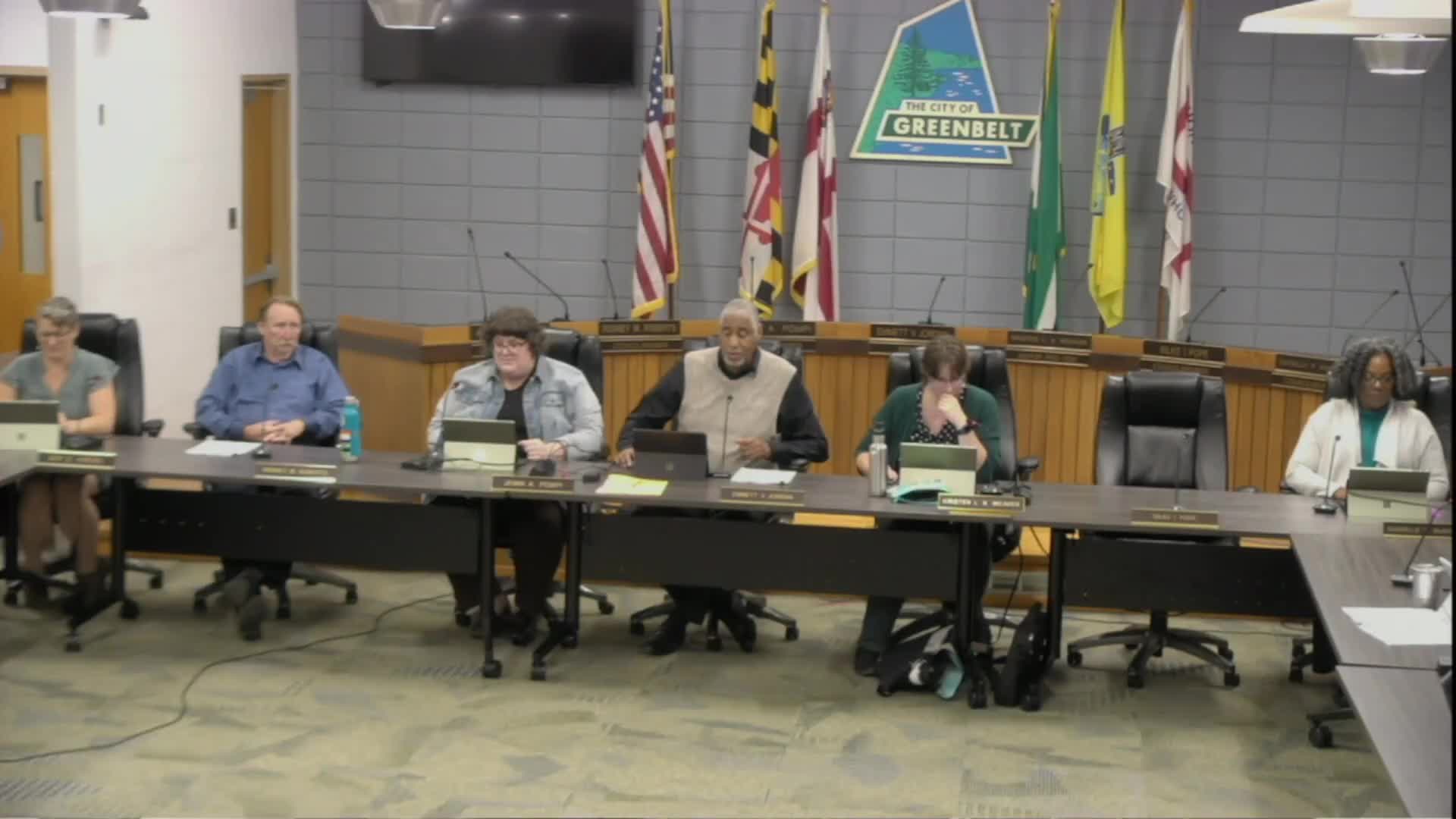
Summary
At a Greenbelt City Council work session, researchers and former local officials outlined how rent stabilization policies work, trade-offs observed in national studies, and regional examples. Council members raised maintenance, enforcement cost and supply concerns and asked staff to post slides and regional data; no formal action was taken.
Greenbelt — At a Greenbelt City Council work session, Mayor Emmett Jordan and council members heard a national overview of rent stabilization policy from Dr. Christina Stacy of the Urban Institute and a local perspective from former Laurel councilman Martin Mitchell, then discussed how a policy might interact with recently adopted county rules and local conditions. The mayor opened the session saying the topic was rent stabilization and that the meeting was an informational work session where “no votes or formal actions are taken.”
Dr. Christina Stacy told the council that rent stabilization (sometimes called rent control in public discussion) covers a spectrum of rules that typically limit how much landlords can raise rent each year while allowing modest increases tied to inflation or other formulas. “Rent control or rent stabilization are kind of loose terms used to cover a spectrum of regulations,” Stacy said. She summarized national data and academic findings, noting both tenant benefits and potential market trade-offs.
Stacy said research generally finds that tenants living in controlled units save money and may be less likely to be displaced, but policy design and local housing markets matter. “Rent stabilization on average does reduce the overall supply of housing by about 10%,” she said, while also noting her team’s finding that such policies can increase the number of units affordable to extremely low-income households in some settings. She stressed design choices — permitted annual increases, which housing types are covered, vacancy decontrol or partial decontrol, allowed pass-throughs for capital improvements, condo-conversion limits, and enforcement capacity — strongly shape outcomes.
Council members and staff focused on local implications. Mayor Emmett Jordan and Council Member Jenny Pompey asked whether Greenbelt should pursue a municipal policy given Prince George’s County recently adopted a permanent rent stabilization policy in March 2025 and Montgomery County and nearby municipalities use differing approaches. City Manager Summerlin and economic-development staff said the city has local rental-price data from CoStar and would post the council slides and staff charts online for public review.
Council members raised multiple implementation concerns. Council Member Silky Pope and others emphasized the need to preserve incentives for landlords to maintain and upgrade property and noted the expense of major projects such as window replacements and HVAC work. Pope described a large local complex (Franklin Park) and said, in effect, a policy that prevents needed capital investment could harm residents’ safety and building quality. Council Member Rodney Roberts and others argued for a collaborative approach with landlords while protecting tenants from sudden, large rent increases.
Martin Mitchell, who led Laurel’s rent-stabilization discussions in 2022, described a local episode that helped prompt policy work there: a building where long-term senior residents faced sharply higher rents. Mitchell summarized components his city considered — a cap tied to a percent increase (he cited a 3% cap as an initial proposal in Laurel), a rental registry, full vacancy decontrol in some drafts, and exemptions for small landlords — and urged Greenbelt to study troubled-property enforcement structures as Montgomery County had done. Mitchell told the council his city used federal ARPA funds as a short-term measure in some cases while pursuing longer-term policy.
Public commenters urged stronger tenant protections and clearer definitions of landlord “fair return.” Resident speaker Mr. Orleans said, “I think the debate hinges on fair return,” and argued municipalities should define the standard. Tenant-advocate Frankie Fritz urged Greenbelt to coordinate with county enforcement and consider “piggyback” approaches so municipalities can set lower caps while relying on county enforcement capacity. Several speakers said tenant organizing and proactive code enforcement are essential to make any regulation effective.
Dr. Stacy highlighted regional examples to show how design varies: Montgomery County uses CPI-U plus an escalator and a cap (CPI-U + 3% not to exceed 6%) and a 23-year new-construction exemption; Prince George’s County’s permanent act (March 2025) sets county-level caps and enforcement provisions; the District of Columbia uses CPI-W plus 2% and has other exemptions; Takoma Park imposes a stricter cap (CPI-U with no upward escalator) and shorter new-construction exemptions. Stacy also explained several design features the council asked about: rent banking (saving allowable increases for later use), partial decontrol on vacancy, fair-return exceptions or reviews, limitations on condominium conversions, and the cost of administering a proactive rent-registry and enforcement program.
Council discussion ended with no direction to draft a municipal ordinance. City staff said they had created local rental-market charts (sourced from CoStar) and would post Dr. Stacy’s materials and the city’s data online. Council members asked staff to track how the Prince George’s County policy performs and to return with estimates of enforcement needs and costs if the city were to consider a separate municipal policy.
Because this was a work session, no motions or votes were taken. The session closed with the council thanking Dr. Stacy for the presentation and urging continued study of regional rules and local enforcement capacity. Mayor Jordan said staff would post the materials and follow up on additional questions raised during the session.