Get Full Government Meeting Transcripts, Videos, & Alerts Forever!
Get email alerts on the Elections topic
No spam. Unsubscribe anytime.
Public witnesses urge JCAR to reject Secretary of State rule set on voter-roll maintenance; committee lacks quorum
Summary
At a Joint Committee on Administrative Rules hearing, election-advocacy groups and community speakers urged rejection of a proposed Secretary of State rule set (referred to as rule set 13), raising legal, cost, and transparency concerns. The committee lacked a quorum and scheduled a follow-up hearing with the Bureau of Elections.
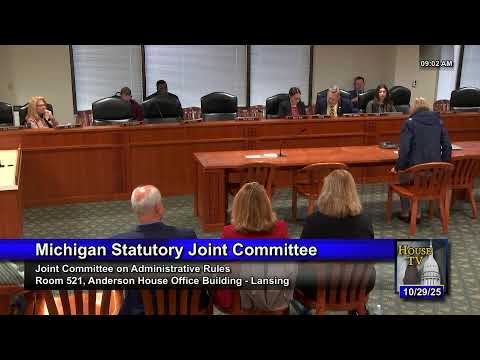
The Joint Committee on Administrative Rules (JCAR) heard public testimony opposing a proposed Secretary of State rule set on voter-registration maintenance — referred to repeatedly in testimony as “rule set 13” — but the committee did not take formal action because it lacked a quorum.
Advocates told JCAR that the rule set would impose a “personal knowledge” requirement on voter challenges, make routine list maintenance effectively optional, and add notarization and certified-mail costs that could block citizen-initiated challenges. Patrice Johnson, chair of Pure Integrity Michigan Elections, called the package “unlawful, it’s unworkable, and it’s harmful to Michigan voters.”
Why it matters: Witnesses argued the rule would conflict with federal and state law, discourage public participation in maintaining the Qualified Voter File (QVF), and raise procedural barriers that would reduce transparency and oversight of local election records.
Testimony and key points
Patrice Johnson, chair of Pure Integrity Michigan Elections, said the proposed rules impose an impossible standard by requiring “personal knowledge” for a challenge and by excluding widely used documentary sources such as USPS change-of-address records, death certificates and online databases. Johnson told the committee, “No Michigan law requires personal knowledge” and urged JCAR to reject “rule set 13 in its entirety.”
Johnson also raised cost concerns tied to notarization and certified mail in the draft: “R 1682562 and R 1682593 require separate notarization, which could cost around $15 and certified mail, around $8 per voter,” she said, and calculated that submitting 100 challenges under those rules could cost about $2,300. She said the rule language repeatedly uses discretionary terms that would “encourage clerks to ignore cleanup and consider citizens’ sources as unreliable.”
Jeff Schafer (identified in testimony as representing Southeast Oakland Patriots) echoed those concerns and stressed that citizen-sourced data and public records have been reliable for civic groups and, he said, are used by government officials in other states. Schafer described the effect of excess registrations on canvassing and record accuracy: “Keeping excess registrations on the QVF just causes confusion and causes potential for harm.”
Amanda Love, a community organizer and candidate for Michigan secretary of state, said the personal-knowledge requirement would “restrict community members from using reliable data to flag ineligible registrations” and risk inconsistent enforcement that could disenfranchise communities.
Committee questions and procedural notes
Senator Theis asked whether any other jurisdictions use a 20-year inactivity threshold referenced in the rules; witnesses said they were not aware of comparable provisions and described the 20-year language as likely to conflict with federal law. Senator Theis said she found the 20-year provision “shocking” and called it a potential legal problem.
Members raised an apparent conflict between a 30-day response window for challenged registrants and a separate rule (referred to by witnesses as rule set 14) that would require poll-book data to be erased seven days after certification, which witnesses said could limit local oversight and comparison with the QVF.
No final action; next steps
The committee had no quorum early in the hearing; the clerk reported that three representatives and three senators must vote in the affirmative for a motion to prevail. The committee chair said the Bureau of Elections from the Secretary of State’s office had a scheduling conflict and would attend a follow-up hearing next week. Senator Tice moved to excuse absent members; that motion prevailed by unanimous consent (no objection) during the session. The chair adjourned the meeting and said the committee would hold another hearing with Bureau of Elections participation.
Public record and contact information
Witnesses provided written materials to the committee. Patrice Johnson said Pure Integrity Michigan Elections (a nonprofit formed in 2021) can be reached at pureintegritymichiganelections.org or mifairelections.org. The hearing record will include testimony cards and submitted materials in the minutes.