City auditor finds documentation gaps, dashboard discrepancies in $750 million "Moving Atlanta Forward" review
Loading...
Summary
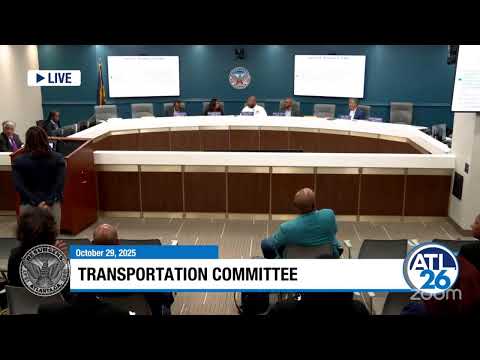
The City of Atlanta's city auditor presented the third annual performance audit of the Moving Atlanta Forward infrastructure program, telling the Transportation Committee the program has spent nearly $97,000,000 as of the end of fiscal year 2025, about 15% of the roughly $750,000,000 program budget.
The City of Atlanta's city auditor presented the third annual performance audit of the Moving Atlanta Forward (MAF) infrastructure program, telling the Transportation Committee the program has spent nearly $97,000,000 as of the end of fiscal year 2025, about 15% of the roughly $750,000,000 program budget.
Dwayne Braithwaite, presenting on behalf of the audit team, said the program is funded by a combination of a transportation special-purpose local-option sales tax (TSPLOST) and general obligation bonds, and includes $36,000,000 in council discretionary funds. "We reviewed recommendations made in the previous audit against current program progress to identify which risks have been mitigated, analyze program spending, and review project phases for all projects identified in the strategic delivery plan," Braithwaite said.
Why it matters: The audit evaluates whether the program's project-management controls, spending and public reporting provide reliable information for council and residents as the city seeks to accelerate delivery.
Key findings and context - Spending and pacing: The audit reported roughly $97,000,000 expended across MAF projects, up from prior audits, and noted spending acceleration each quarter through the end of fiscal year 2025. The strategic delivery plan lists 202 funded allocations; auditors tracked those projects and found 168 (83%) had begun, with many still in planning/scoping.
- Documentation gaps: Auditors tested required documentation for projects in planning/scoping and construction/closeout phases. Braithwaite said his team found that none of the six sampled planning-phase projects had a completed project management plan and only one-third of construction daily reports met department completeness criteria. "For the planning and scoping phase, departments improved from previous audits by having all roles and responsibility matrix and all but one fully filled out risk register," the auditor said, "but none of the six projects had a completed project management plan."
- Dashboard and financial discrepancies: The audit found potential discrepancies between the public dashboard and Oracle financials, noting Oracle showed about $6,700,000 more paid funds than the dashboard. Braithwaite recommended clearer reconciliation and improved explanations for at-risk projects on the dashboard.
- Recommendations status: The audit team reported four of 10 prior recommendations from the 2023 review had been implemented (decision criteria for prioritization, a central oversight position, project-level spending on the dashboard, and separate purchase orders by project). Six recommendations remained in progress; the audit team dropped one lower-priority in-progress action.
Council questions and administration response Council members pressed for clarity on district-level allocations, pace of delivery, and whether record gaps mean budgets are understated or project spend is simply lagging in the system.
- Council member Dozier asked whether the district breakout on the dashboard used new council district boundaries that take effect later this year; audit staff said they used the district identifier stored with each project in the dashboard and project/grants modules and would work with departments to reproduce analysis by NPU if possible.
- Council member Juan raised concerns that missing invoices could either understate progress (if bills are unpaid) or understate total incurred costs (if expenses hit general ledger but not project modules). Braithwaite said some reconciliation issues exist where moving Atlanta forward dollars were posted to the general ledger but not to project modules, and the audit plan includes additional reconciliation work.
- Transportation Commissioner Solomon Cabaniss said the administration sees the audit as a constructive review and emphasized that some differences reflect market and scoping changes since the 2022 legislation: "When we think about the timelines, there's a conversation that needs to be had relative to what's considered at risk and where we actually are in the real world," he said. He described steps to accelerate delivery, including use of IDIQ procurement and consultant support.
Committee action and follow-up The Transportation Committee voted to accept and file the audit report (vote recorded as 6 yays, 0 nays). Committee members asked the administration to accelerate implementation of outstanding recommendations, continue reconciliation work between Oracle and the dashboard, and provide clearer district- and project-level reporting. The committee recorded a request that outstanding documentation and reconciliation issues be addressed in subsequent audit cycles.
Ending The audit presentation concluded with a commitment from the audit team to follow up on reconciliations and with the committee forwarding the audit acceptance for administrative follow-up.