
Redmond reviews final TMP chapters: e-mobility priorities, e-motorcycle outreach, maintenance costs and a fiscally constrained Transportation Facilities Plan
Get AI-powered insights, summaries, and transcripts
Subscribe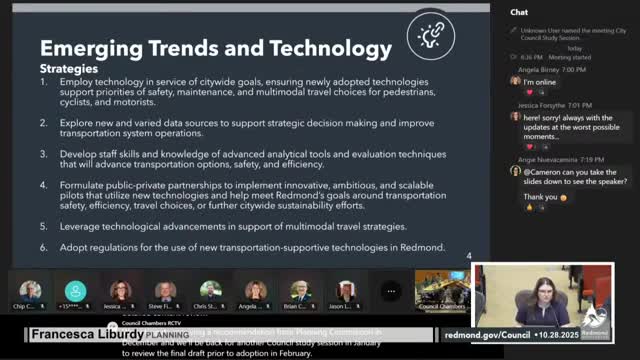
Summary
Staff walked council through the remaining Transportation Master Plan chapters (emerging technology, e-mobility, maintenance, monitoring), highlighted a draft TFP aligned to Redmond 2050, and said the public review draft will be posted Nov. 12 ahead of a Dec. 3 Planning Commission hearing and February 2026 adoption.
Planning and transportation staff presented the remaining chapters of Redmond’s Transportation Master Plan (TMP) on Oct. 28, covering emerging technologies, e-mobility strategies, maintenance and monitoring metrics, and the Transportation Facilities Plan (TFP).
Francesca Liberti, senior transportation planner, said the TMP schedule anticipates adoption in early February 2026 and that a public review draft will be published Nov. 12 with a three-week comment period before a Planning Commission public hearing Dec. 3. The chapters presented update the city’s approach to technology, data governance and performance monitoring.
On e-mobility, Transportation Planning Manager Michael Hintz described actions to expand EV charging access — particularly at multifamily properties identified as a high-priority gap — and to work with property owners and utilities on private-property charging solutions. Hintz said staff are exploring program structures to leverage utility and state incentives.
Hintz and Liberti also raised concerns about motorized devices classified as e-motorcycles (vehicles with more than 750 watts of power). ‘‘Some model speeds top out at 50 plus miles per hour,’’ Hintz said; cities are focusing on outreach and education while the Association of Washington Cities pursues statutory changes to clarify vehicle definitions and enforcement authority. Staff noted policy tradeoffs where such higher-speed vehicles do not belong in bike lanes or on trails.
The TMP includes a maintenance chapter calling for a maintenance level-of-service standard and a funding plan. Staff noted city ordinances require adjacent property owners maintain sidewalks but said the city has not systematically enforced that rule; options include city crews charging property owners for concrete work, a community sidewalk fund, or neighbor-adopted maintenance programs. Initial high-level estimates presented: roughly $63,000,000 to fill sidewalk gaps and approximately $38,000,000 for sidewalk maintenance and replacements.
The TFP, a Growth Management Act requirement, is fiscally constrained and was updated to align projects with Redmond 2050 policies; staff removed some projects and added others based on TMP analysis. For example, bus pullouts on Avondale were removed pending a corridor study that will evaluate multimodal trade-offs including space for protected bike lanes. Staff will return with a Planning Commission recommendation in December and a final draft to the council in January prior to adoption.
No formal action was taken at the study session.