
Flagstaff beautification commission narrows five-year priorities, flags need for more staff and funding
Get AI-powered insights, summaries, and transcripts
Subscribe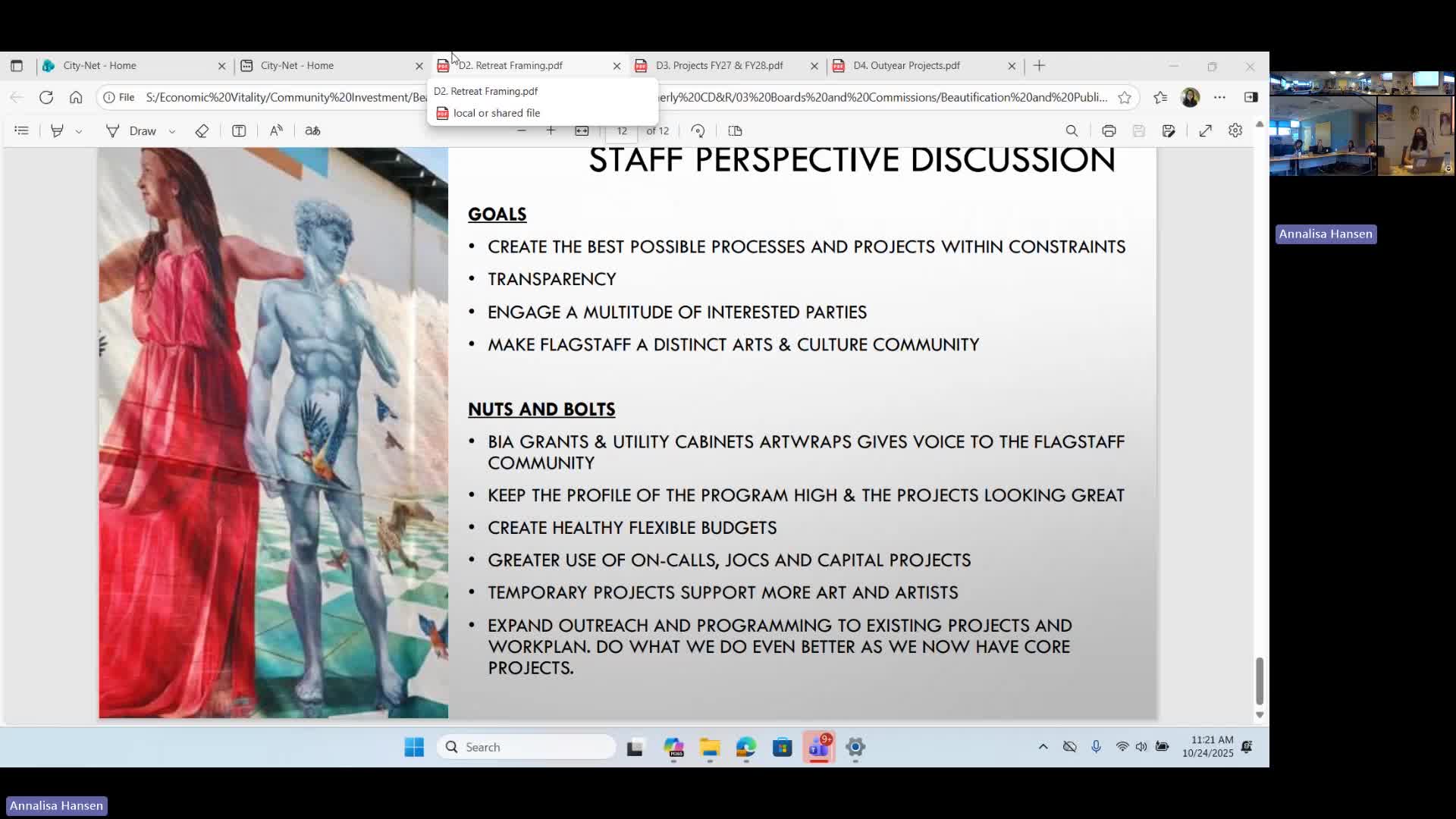
Summary
The Beautification and Public Art Commission (BPAC) in Flagstaff met for a retreat to review the structure and limits of the beautification and arts & sciences funds, to update the commission on project status, and to prioritize candidate capital and programmatic projects for the next five-year plan.
The Beautification and Public Art Commission (BPAC) in Flagstaff spent a retreat-style meeting reviewing how two city special revenue funds operate and ranking projects for the next five-year plan.
City staff, led by a budget presentation from a program staff member identified in the meeting as Dave, told the commission that the beautification and arts & sciences programs are separate by ordinance and that each fund has its own rules and balances. "Beautification receives 20% of the BBB," Dave said during the presentation, and he said arts and sciences receives 9.5% of the same revenue stream. Staff explained that unused recurring funds flow into that fund's balance and may be carried forward for later use, while one-time capital allocations are handled through a separate five-year capital plan and can be carried forward until a project is complete.
Why it matters: The distinction between recurring and one-time funds determines what kinds of projects the commission can commit to year after year. Staff told commissioners that recurring funding is harder to secure because it represents a multi-year obligation; one-time funding is more flexible but still constrained by the city's annual expenditure limit and by staff capacity to deliver projects.
Staff and commissioners discussed how position costs are split across funds (for example, a position that is 80% beautification and 20% arts & sciences), and they noted an existing $30,000 transfer from the beautification fund for a volunteer litter-pickup program as an example of an early allocation that reduces near-term project capacity. Officials also said tourism receives 30% of the BBB and employ 13 people in the division that houses beautification and arts programs; Heidi Gens, the city's Economic Accounting Director, described the division as a revenue-producing part of the city and a candidate for expanded staffing.
Commissioners and staff reviewed a set of candidate capital projects and current work in progress. Staff reported progress and timing for multiple projects including the Lone Tree/overpass aesthetic work, the Swiss Watch Wedge and Canyon Roundabout projects, Route 66 improvements, an African American mural expansion, Motion (a sculpture) refurbishment and other pieces of the public-art collection. Staff noted that several projects approved in earlier years are still completing installation and some items will carry into FY28 or later.
On project selection, the commission completed a prioritized ballot. Staff reported preliminary tallies placing an airport-terminal-related project, Heritage Square, Montoya and an indoor/portable art exhibition among the highest-ranked items for FY28; other projects (the school walkway mosaic, green school-yard grant ideas and additional downtown roundabout art) were placed into later years or designated as candidates to roll into FY29 if not funded in FY28. Dave told commissioners that unselected items would be rolled forward and that staff will coordinate with public works, sustainability and capital projects staff to refine scopes and to identify lead departments before final CIP submittals.
Staff signaled two immediate budget-related actions. First, they said they will explore a recurring increase for beautification action grants and other popular recurring programs (which have seen record applications) but warned that recurring increases are more difficult to secure because they commit the city over multiple years. Second, staff said they will evaluate whether to request an additional staff position or other staffing support for the program; Heidi Gens said the division has been producing more in the last three years than she had seen previously and called for additional capacity to sustain the work. "I feel like it is the very best division we have at the city because we are revenue producers," Gens said, adding that she will help advocate for staffing in upper-management budget conversations.
Commissioners and staff also discussed venue and facility strategy after the recent cultural-sector study and council inquiries about the Orpheum and other downtown facilities. Staff cautioned that owning and operating theaters or other venues would likely add significant ongoing maintenance and operating costs and that BPAC's funding should not be allowed to be consumed by facility maintenance without broader city and partner commitments.
The commission and staff identified several out-year items that need more scoping and interagency work before investment, including a Habitat for Humanity parcel that could qualify only if an amenity is open to the public (HOA rules and ownership details must be resolved), Gallister/McAllister Ranch interpretation (which staff said needs new energy and interdepartmental leadership), and a science-oriented installation program the group has called Lunar Landing/Pluto 3-D. Commissioners suggested the idea of an arts-and-science master plan to coordinate multiple interactive or education-oriented projects.
Next steps: Staff outlined a budget calendar for the commission: five-year plan materials to divisions in early December, personnel and capital submittals in January, a capital retreat for all divisions on March 26, and requests for final BPAC input before council submittal in April. Staff said they will return with refined scopes and with any formal budget or staffing requests during that cycle.
The commission did not take any motions or formal votes on funding increases during the retreat; commissioners completed a nonbinding prioritization ballot and staff will carry those recommendations into interdepartmental budget conversations and the formal capital submittal process.
Ending note: Commissioners and staff emphasized that future prioritization will be guided by staff time capacity and interdepartmental partnerships as much as by raw fund totals. Commissioners asked staff to bring the cultural-sector study back for review and to continue outreach to potential partners for venue and downtown programming discussions.