
Sumner frames 2026 legislative agenda around housing, state revenue and public safety
Get AI-powered insights, summaries, and transcripts
Subscribe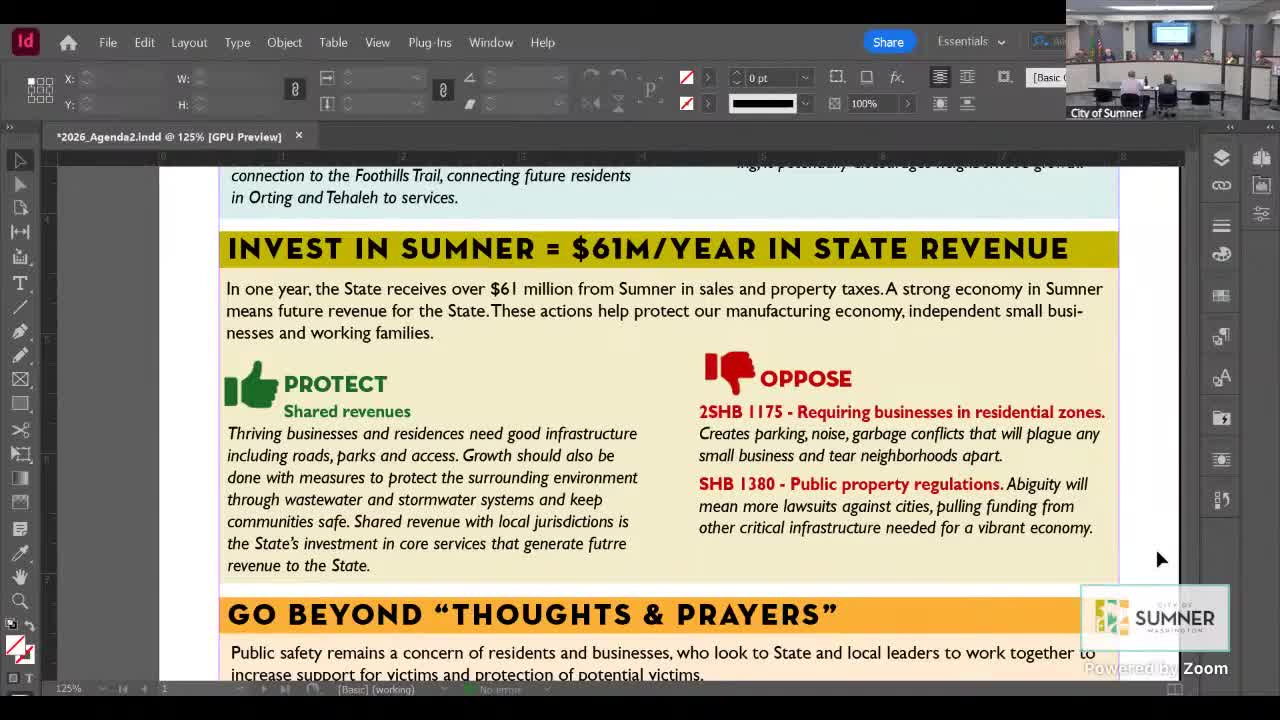
Summary
Sumner City staff presented a compact 2026 legislative agenda at a City Council study session on Oct. 27, asking state lawmakers to prioritize three headline goals: keep housing affordable, recognize the state revenue generated through Sumner, and support public-safety measures that local officials say will reduce crime and protect victims.
Sumner City staff presented a compact 2026 legislative agenda at a City Council study session on Oct. 27, asking state lawmakers to prioritize three headline goals: keep housing affordable, recognize the state revenue generated through Sumner, and support public-safety measures the city says will reduce crime and protect victims.
The agenda compresses the city's priorities into three takeaways and a second-page set of "guardrails" staff can use when fast-moving bills surface in Olympia. "We split these up into three big takeaways," Communications Director Carmen Balmer told the council. "One is keep housing affordable in Sumner." Balmer said the city will again pursue local capital projects such as the River Grove pedestrian bridge to improve pedestrian access and preserve housing affordability in that neighborhood.
Why it matters: staff said a short, focused agenda is easier for legislators and helps avoid an adversarial dynamic with Olympia. "Based on what the city brings in in property tax and sales tax alone we estimated what the state receives from within the city of Sumner and it's $61,000,000 a year," Balmer said, explaining the "remind the state" element of the agenda. The city says that reminding the legislature of the revenue produced locally is a way to argue against shifting costs or imposing regulations that would weaken local tax bases.
Key positions and bills: staff identified specific bills the city supports and opposes. On housing and land use, staff recommended opposing a bill (referred to in discussion as HB 1175) that would require cities to allow "neighborhood stores and neighborhood cafes" in zones that permit residential uses; Ryan Windisch, Sumner's community economic development director, warned that a state-level requirement could trigger conversions of houses on high-visibility streets, create parking and noise impacts, and divert customers from downtown storefronts. Several council members said they preferred investment in downtown and caution about the bill's unintended consequences.
On civil-litigation exposure, staff flagged a bill colloquially referred to as the "Homeless Bill of Rights" (discussed in the packet as 1380) and explained it is written, in staff's view, in ambiguous language that could prompt litigation against cities. "This is not an anti-homeless bill; this is an anti-lawsuit bill," Balmer said, framing the opposition as a fiscal-protection concern for limited local dollars.
Public safety: the third headline asks the Legislature to support measures Sumner says will strengthen public safety locally, including reforms to public defense caseloads and measures addressing juvenile sentencing and diversion (referred to in discussion as bill 1322). Staff also mentioned an aviation-support request for regional mutual aid. Bill Clark, the city's lobbyist, told council members the 2026 short session (Jan. 12'March 11) will be compressed and dominated by budget work.
Process and next steps: staff said the packet includes a second page of policy "guardrails" that city staff and elected officials can rely on when bills or amendments drop rapidly during session. The agenda will be used for AWC (Association of Washington Cities) meetings and possible visits to Olympia during AWC City Action Days in January. Council members and staff discussed opportunities to coordinate with neighboring cities and countywide groups on corridor and mitigation funding.
Council feedback: council members asked for more specificity in some guardrail language, requested inclusion of the 162 corridor and port-related language in transportation notes, and expressed mixed views on the neighborhood-business bill. Staff said the agenda is intentionally concise for legislative audiences and that a longer second page provides detailed guardrails for staff and elected officials.
What remains uncertain: the agenda lists priorities and staff positions but does not bind council members speaking in a personal capacity; formal positions and any testimony will be shaped as bills are introduced or amended during the session. Public hearing or formal council action on the agenda itself was not recorded at the session.