Get Full Government Meeting Transcripts, Videos, & Alerts Forever!
Get email alerts on the Dual Enrollment topic
No spam. Unsubscribe anytime.
Sun Prairie Area School District board hears report on Early College Credit and Start College Now programs
Summary
District staff presented details on the Early College Credit Program (ECCP) and Start College Now (SCN), including eligibility, deadlines, application flow, cost-sharing, per-credit tuition examples and recent district expenditures that have risen markedly in recent years.
Dr. Sarah Chaya, a district staff member, told the Sun Prairie Area School District Board of Education that the Early College Credit Program (ECCP) and Start College Now (SCN) give eligible high school students opportunities to earn college credit while still enrolled in high school.
Chaya said the ECCP is authorized under Policy IGCE and Wisconsin Statute 118.55 and permits public or private high school students to enroll in University of Wisconsin institutions, tribally controlled colleges, or private nonprofit colleges in the state. "Through ECCP, students may take one or more nonsectarian courses and earn high school credit, college credit, or both," she said.
The report explained how applications are handled and key deadlines. "Students must notify the board by October 1st for spring enrollment and March 1st for summer or fall," Chaya said. The district provides approval decisions by Nov. 15 and May 15, and applications are routed through each high school's counseling office and the College, Career and Life Readiness Coordinator. Chaya said the district may deny a course if a comparable course is already offered in the district.
On budgeting and billing, Chaya said once coursework begins tuition and textbook costs are budgeted within the Secondary Teaching, Learning and Equity department and the district is billed after a student registers for approved courses.
Staff described Start College Now as outlined in Policy IGCF and a state statute the presentation referenced as "38.12, PARENS 14," and said SCN operates through Wisconsin Technical Colleges for career-focused or technical courses available to eligible public high school juniors and seniors.
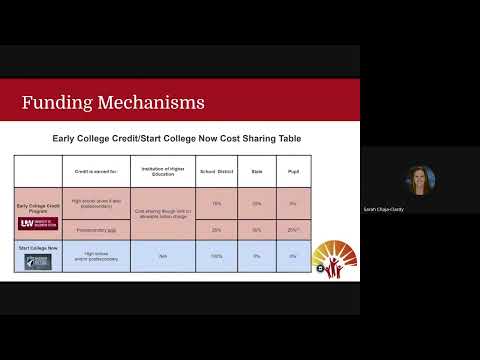
Chaya summarized the district's cost-sharing arrangements, saying: "If the course counts for both high school and college credit, the district pays 75% and the state pays 25%. If the course counts for college-only credit, the district share drops 25% with 50% covered by the state and 25% by the student." She also said that when coursework is taken for high school credit the district covers 100% of approved costs.
To illustrate per-credit costs, Chaya gave examples: Madison College liberal-arts transfer courses at $192.20 per credit; career-focused medicine courses at $152.85 per credit; and a per-credit figure of $133.93 at the University of Wisconsin'Madison, which the presentation said reflects the district's 75% share of the total tuition.
Chaya provided year-by-year district expenditure figures and a trend of rising costs: "In 2019'20 school year, district costs were just over $4,000. That number rose to over $29,000. The following year we dipped a bit in 21'2 to $24,000 and then greatly magnified costs in 22'3 at over $51,000. In the 2023-24 school year, those costs rose to $56,000 approximately and last year we incurred a total cost of nearly $75,000, $74,661.54 to be specific." She tied the increase to expanded student participation and course options.
Chaya named participating sites and resources: students from Sun Prairie East, Sun Prairie West and Prairie Phoenix Academy take part each semester; an ECCP/SCN application chart accompanies the report and a one-page overview is available on each high school's website to help families understand deadlines and course eligibility.
She acknowledged the district staff who process applications and thanked students for participating, and said the district will continue to monitor enrollment trends, fiscal impact and outcomes to keep the programs equitable and sustainable. Chaya invited questions at an upcoming Board of Education meeting.
(Note: the article reports program descriptions, deadlines, cost-sharing percentages and expenditure figures as presented by district staff in the meeting transcript.)