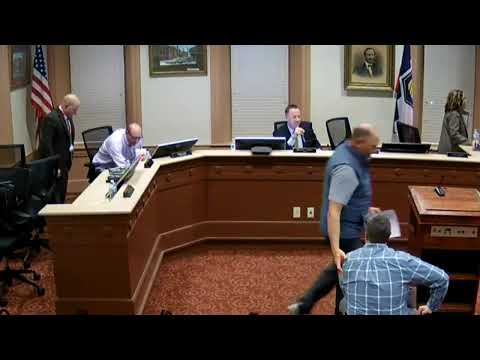
City conditionally overrules denial, allows concrete‑crushing at I‑1 site with strict conditions
Loading...
Summary
The American Fork City Council voted Oct. 28 to conditionally overrule the city administrator’s denial of a business license for Dunn Construction LLC, clearing the way for concrete crushing and recycling at a property in the I‑1 industrial zone if the applicant satisfies site‑plan and mitigation requirements.
The American Fork City Council voted Oct. 28 to conditionally overrule the city administrator’s denial of a business license for Dunn Construction LLC, clearing the way for concrete crushing and recycling at a property in the I‑1 industrial zone if the applicant satisfies site‑plan and mitigation requirements.
The council’s decision, moved on the record by Council member Hunter, said the operation may proceed only after the applicant obtains a site plan that explicitly incorporates the crushing and recycling operations, implements identified mitigation measures, and demonstrates compliance with all applicable state and local environmental regulations. Council members recorded their votes in favor; the motion carried.
Why it matters: Neighbors and council members raised concerns about dust, silica, stormwater and visual impacts from aggregate piles. The council framed its approval as conditional — allowing the use in the I‑1 zone only after the city verifies engineering, environmental controls and annual proof that no state enforcement (for example DEQ or MS4-related actions) is pending.
Background and applicant materials Paul Washburn, representing the applicant, told the council an amended site plan had been submitted that shows locations for material storage, a weigh station and a mobile crushing unit. Washburn said the site will ultimately be graded and raised in places to allow buildings and that the crushing equipment is mobile. He said earlier engineering for drainage and other infrastructure had already been completed for the property.
City staff identified outstanding procedural and technical steps. Patrick, a city development reviewer, told the council that the applicant had delivered a packet but had not yet filed a formal site‑plan application. Patrick said site plans previously approved are typically valid for two years and that the city’s preference for a large additional phase would be to process a new site‑plan application rather than amend the earlier approval.
Conditions the council placed on future approval The council’s written findings and the motion list several explicit conditions that must be met before a business license is issued for the concrete‑crushing operation: - The applicant must obtain site‑plan approval that specifically incorporates the concrete crushing and recycling operation and addresses all land‑use requirements for the I‑1 zone. - Dust control must meet applicable Utah Department of Environmental Quality standards and the applicant must continue daily mitigation practices such as on‑site watering, trucking and sweeping as demonstrated in its materials and any additional measures required through the planning process. - An 8‑foot perimeter screening/fence must be constructed around areas where crushing and storage occur. - Stored or processed material piles on the property may not exceed 45 feet in height. - Concrete processing shall be limited to concrete (no other construction debris mixed for processing) and to hours of operation between 7 a.m. and 5 p.m. - Annual business‑license renewal must include evidence that there are no pending DEQ, MS4 or other relevant state enforcement actions against the operation.
Staff and enforcement Sam Kelly, the city’s public works director, explained that stormwater management staff already review long‑term stormwater plans and respond to complaints, and that best management practices for dust and stormwater are part of the permitting and monitoring framework. He said staff can perform inspections tied to recorded long‑term stormwater management plans.
Council debate Council members said they sought a balance between allowing a local recycling operation and protecting neighbors and the environment. Several members pointed to the proximity of other concrete operations on adjacent properties when weighing whether the use could be found acceptable in the industrial zone. Council member Hunter said the council could approve the use so long as the mitigation safeguards are in place; other members urged clarity on how the city would confirm ongoing compliance, particularly with environmental rules administered by the state.
Applicant position The applicant indicated it already uses water trucks, sweeping and other mitigation at similar facilities and said it could meet the conditions if approved. Paul Washburn stated the amenable operational controls and said developers planned to build on the front portion of the site once the site is finished and approved.
Next steps The council’s motion expressly conditions issuance of a business license on subsequent site‑plan approval that incorporates the crushing operation and satisfies the conditions listed above. Staff said a new site‑plan application and the typical engineering reviews and permitting steps remain required before issuance of any business license.
Ending note The council’s action does not grant an immediate license to operate; it establishes that the use can be permitted in the I‑1 zone subject to the listed safeguards and to formal site‑plan approval and evidence of environmental compliance.