Bellevue Planning Commission recommends staff'draft of Critical Areas Ordinance to City Council after heated public hearing
Loading...
Summary
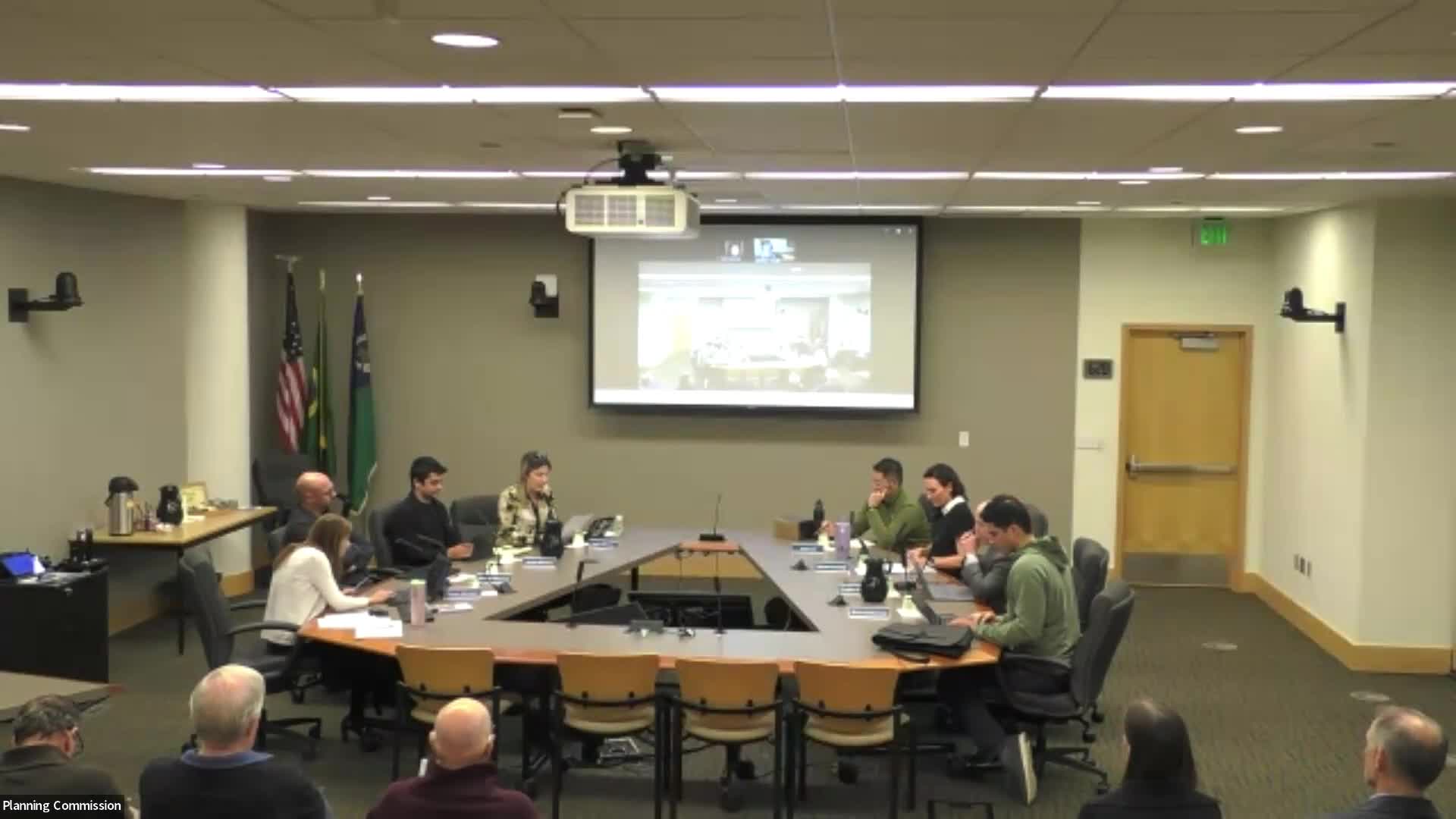
The Bellevue Planning Commission voted Oct. 22 to recommend staff'prepared amendments to the Critical Areas Ordinance to City Council after a public hearing that included testimony from state fish-and-wildlife officials, developers and neighborhood residents.
The Bellevue Planning Commission voted Oct. 22 to recommend staff'proposed amendments to the city''Critical Areas Ordinance (CAO) to City Council, following a public hearing that drew state wildlife officials, developers and neighborhood residents.
The commission's recommendation, based on the version in staff's packet ("Attachment A"), instructs staff to forward the draft to council for final consideration; commissioners also asked staff to flag questions about wetland-fill flexibility for future council consideration. The motion to recommend carried in a roll-call vote at the end of the hearing.
The draft CAO updates would revise how the city regulates streams, wetlands, critical-aquifer recharge areas and geologic hazards. Among the most consequential changes: the draft splits non-fish-bearing Type N streams into seasonal and perennial categories (proposed buffers: seasonal 50 feet, perennial 75 feet), retains a 150-foot buffer for fish-bearing streams, introduces vegetated-buffer criteria that allow a reduced standard buffer when a restoration planting plan is implemented, updates wetland habitat scoring to align with Department of Ecology guidance, and creates an "innovative mitigation" pathway to allow development flexibility on previously developed sites in exchange for demonstration of equal or greater ecological function.
"Bellevue's urban streams are vital home and highway for local fish and wildlife," said Lori Devereaux, the city's Stream Team program administrator, in the staff presentation. Devereaux opened the hearing with photographic and video examples from Kelsey Creek to show salmon, cutthroat trout, otters, herons and beavers that use Bellevue's waterways.
State officials urged stronger protections. "The decisions made by the Commission today will have lasting impacts on the health of Bellevue's waterways and by extension the survival of our region's iconic salmon," said Morgan Krueger, regional land-use lead for the Washington Department of Fish and Wildlife (WDFW). Krueger told commissioners WDFW's best-available science shows a 100-foot vegetated buffer "is the minimum necessary to effectively filter most pollutants" and urged Bellevue to adopt a 100-foot standard for Type N, NP and NS streams.
Developer and neighborhood testimony framed the proposed code as a trade-off between habitat protection and housing redevelopment. Chase Preppula of Grama Crow Residential and Kramer Canup of Soundview Consultants described a concept in East Main (BelRed) in which small, degraded Category 3 wetlands in paved parking areas would be removed to allow dense transit-oriented housing while funds and design would restore a larger, higher-value wetland and adjacent stream channel. "We believe there's a real win-win here," Preppula said, describing a proposed project that he said could add more than 300 housing units while funding on-site stream restoration.
Habitat for Humanity and several neighborhood advocates supported the staff draft as a balanced, science-based approach. "The staff proposal strikes the thoughtful balance between environmental stewardship and responsible development," said Sahar Amini of Habitat for Humanity.
Planning commissioners pressed staff and consultant Facet Engineering for technical clarifications on wetland category thresholds, mitigation sequencing, and how the innovative-mitigation pathway would apply to wetlands versus stream buffers. Staff and consultants said the innovative-mitigation provisions are primarily targeted at buffer averaging and buffer-edge flexibility (using the edge of existing improvements as the regulated edge when compensated by demonstrated improvements) and are not a blanket allowance for wetland fill; they noted wetland-fill decisions often require federal and state review processes.
Planning staff emphasized the policy trade-offs that shaped the draft. The CAO periodic review is required under the Growth Management Act and must be grounded in best-available science. Staff told commissioners the draft aims to translate scientific guidance into an urban context where many stream corridors and wetlands are already developed or degraded.
After roughly two hours of testimony and a robust question-and-answer period, the commission voted to recommend the staff draft to council. Commissioners who voted in favor said the draft strikes a reasonable balance and provides clearer pathways for mitigation and restoration; a minority of commenters urged larger, 100-foot minimum buffers as recommended by WDFW.
The recommendation now moves to City Council for decision. Staff said the council timeline must fit Growth Management Act deadlines and indicated the city will separately reconcile shoreline code references to the updated CAO as part of a later shoreline master program update.
What's next: the Planning Commission's recommendation and the staff report will be transmitted to City Council for final action; staff and commissioners noted council-level review is the next opportunity to address narrow questions about wetland-fill allowances and shoreline code alignment.
Votes and motions recorded at the meeting (agenda adoption, opening and closing of the public hearing, and the final recommendation) are included in the meeting record and staff packet.