Get Full Government Meeting Transcripts, Videos, & Alerts Forever!
Get email alerts on the Stormwater Monitoring topic
No spam. Unsubscribe anytime.
University City commissioners ask council to fund automation of river flood-monitoring system
Summary
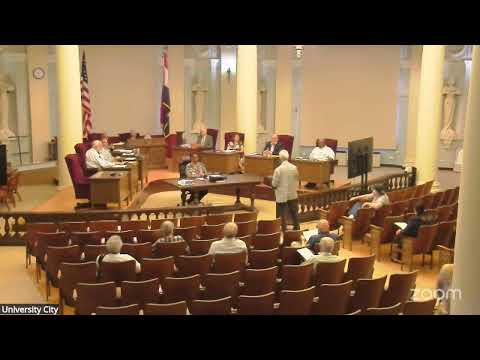
University City — At a study session on Oct. 13, 2025, the University City City Council heard a presentation from the Stormwater Issues Commission seeking city support to automate its river- and rainfall-monitoring system, which commission members said can provide roughly a 30-minute flood-warning lead time.
University City — At a study session on Oct. 13, 2025, the University City City Council heard a presentation from the Stormwater Issues Commission seeking city support to automate its river- and rainfall-monitoring system, which commission members said can provide roughly a 30-minute flood-warning lead time.
Todd Thompson, chairman of the Stormwater Issues Commission, said the commission has installed nine river-level sensors and three rain-gauge sites since 2019 and added radar level sensors over the last year. "With 95% accuracy, we're able to predict the river level ... with about a 30 minute warning system," Thompson told the council.
Phil Easton, who presented the request, described a two-phase plan to move the commission from a largely manual, person-dependent system to an automated, city-accessible platform. Phase 1 would consolidate data from Fondriest equipment onto a private IoT network provided by a vendor identified in the presentation as I Neighborhood; Easton listed a conversion cost of $7,000 and an annual access/license fee of $950 to bridge Fondriest's cellular database into the new system. Phase 2 would program the predictive algorithms to run live (raising data cadence from five minutes to one minute when rainfall surpasses about 1 inch per hour), with recurring cellular/instrument costs estimated at roughly $3,000 per year.
Easton summarized the line-item amounts as about $7,000 for phase 1, $7,000 for phase 2 and about $3,000 in annual fees; he said the commission was "asking for is is $20,000 approximately." At one point in the presentation the transcript records a different total phrase — "total of about $1,819,000 dollars" — which the commission did not clarify during the meeting; the transcript therefore does not establish a single confirmed total.
Commissioners said the system combines quantitative data (rain gauges and level sensors) with camera feeds for qualitative visual confirmation. They reported three cameras on the commission's system and one on a private network. Council member Spudelson pressed for clarity about public access; presenters said the data and images are available on a stormwater commission website but that the site was not currently integrated into the city's website.
Mayor Pro Tem Smotherson and staff discussed operational integration with the fire department. The city manager and presenters said the fire chief would have responsibility for defining alert levels and that the commission intends to align its outputs with the city's existing Code Red emergency-notification system. The presentation named Dr. Bob Chris as the primary technical contact and the person currently managing the live data.
City staff said the formal budget process begins in January and named Marilla as the liaison who will work with the commission to include a proposed budget item. Several council members, noting recent flood events and the system's potential to help public safety, urged staff to explore expedited funding (for example, a supplemental appropriation) rather than waiting for the regular budget cycle. No formal motion or vote was taken at the study session.
What the commission asked the council to decide next: whether to include requested funding in the January budget process or pursue an expedited supplemental appropriation and to identify the operational liaison so fire and public-safety staff can gain access to the data and camera feeds.