
Board moves to contested hearing after comptroller investigation finds governance failures at Sevier County utility
Get AI-powered insights, summaries, and transcripts
Sign Up Free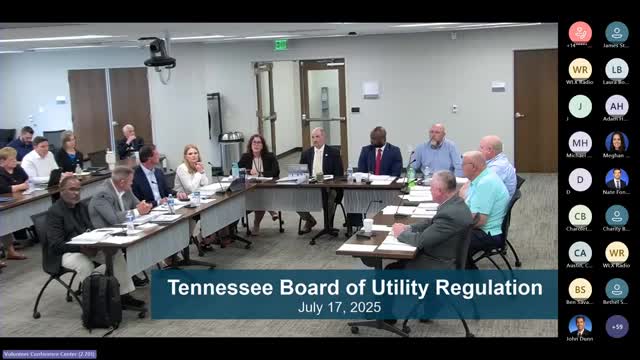
Summary
Following a Comptroller Division of Investigations report documenting long-running internal-control and governance failures, the Tennessee Board of Utility Regulation voted to initiate a contested-case hearing to consider removal of two Sevier County Utility District commissioners.
The Tennessee Board of Utility Regulation voted June 26 to initiate a contested-case hearing to determine whether two current commissioners at Sevier County Utility District should be removed from office, after staff presented a Comptroller Division of Investigations report alleging long-running management, internal-control and oversight failures.
Board staff summarized the investigative findings for commissioners and described a pattern of alleged misappropriation and operational gaps dating back more than a decade. Ross Colonna, board staff director, told the board the case traced to issues that predated current members but said the existing governing body had failed to act decisively when the problems persisted. "This board failed their utility by allowing an environment to exist in which this manager got away with what he did," Colonna said.
The investigators' report detailed alleged unauthorized transactions, inadequate procurement and record-keeping problems that took place while a long-serving manager was in charge of Sevier County Utility District. Board staff said the board had met with the district, and some reforms had been implemented, but the comptroller's investigators recommended further action against current commissioners whose oversight the report characterized as inadequate.
After lengthy staff presentation and public comment, the board authorized staff to begin a contested-case process under the administrative hearings statute. The action will initiate an administrative-law process in which an ALJ will be assigned and a hearing scheduled; the TBOR will sit as the final decision-maker and may remove commissioners if the evidentiary record supports that outcome.
Why it matters: Commissioner removal is a rare and serious enforcement step. The contested-case mechanism provides due process: the affected commissioners will be entitled to representation, evidence, and an administrative hearing before the TBOR renders a final decision. Board members stressed the board's responsibility to protect ratepayers when governance breakdowns create risks to funds or service.
Board action: The board authorized staff to commence a contested-case hearing to determine whether removal is warranted. Staff will seek an ALJ assignment and schedule, and will present the investigative evidence to the board at hearing. The board authorized staff to close the contested case if the commissioners resign prior to the hearing.