Get Full Government Meeting Transcripts, Videos, & Alerts Forever!
Get email alerts on the Municipal Budget topic
No spam. Unsubscribe anytime.
Narberth officials flag $324,000 budget gap, weigh EIT and millage options to fund capital projects
Summary
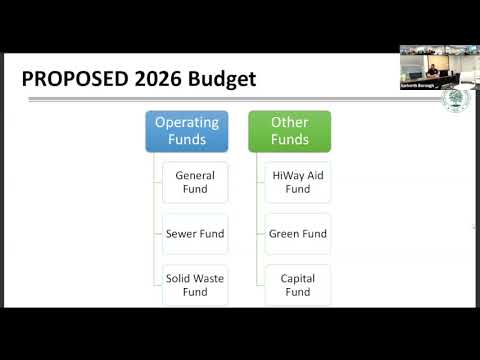
Borough staff presented a preliminary 2026 general fund budget and told council members the current service level would produce a roughly $324,000 operating shortfall unless revenues increase or expenditures are cut.
Borough staff presented a first look at Narberth’s 2026 general fund budget on Oct. 7, telling council members that under current service and staffing levels projected revenues fall short of recurring expenditures by about $324,000.
The shortfall arises as personnel and operating costs rise while some revenue streams remain uncertain, staff said. The presentation showed a three‑month reserve target of about $1.4 million based on three‑year averages and projected real‑estate tax revenue of roughly $3 million at the current 9.865 mill rate. Earned‑income tax (EIT) collections were conservatively estimated at $1.35 million; rental net revenue from the Sabine property was estimated at roughly $400,000, and business‑privilege tax revenues near $150,000.
Manager Maggie (borough staff) said, “TLDR, guys, revenues minus expenditures gives us a small shortfall about $324,000,” and walked the council through options to close the gap. The options included cuts to services (which staff did not recommend), raising the borough EIT from the current 0.75% to the statutory 1.00% limit, and modest increases in the real‑estate millage. Staff said raising EIT to 1.0% could yield roughly $241,000 under conservative collection assumptions; combined EIT and millage changes were presented as a way to distribute burden across residents.
Why this matters: council members said they want to protect service levels and accelerate funding for capital needs. Staff emphasized a $1.0 million balance in the capital fund but warned that without recurring transfers those reserves could be drawn down rapidly. Council discussed formalizing the $300,000 transfer that had been made this year as a budgeted annual transfer to the capital fund but noted that doing so would increase the operating deficit unless matched by revenue growth or other savings.
The presentation also reviewed the capital improvement program, prioritizing life‑safety and infrastructure projects including sewer main repairs, the Elmwood Avenue pedestrian bridge, stormwater (MS4) work, and fleet replacement. Staff said a worst‑case sewer replacement scenario could exceed $3.25 million, while less‑invasive lining and cleaning might cost in the neighborhood of $125,000. Staff indicated grant funding would be sought for the bridge and other projects.
Council members asked staff to refine revenue projections — especially for EIT, business‑privilege tax and rental income at Sabine — and to provide a scenario matrix showing how incremental changes in EIT and millage would affect average households and capital funding. Council directed small‑group follow‑ups and asked staff to return to a November workshop with updated numbers and a prioritized list of CIP projects.
The meeting record shows no formal budget vote at this session; councilmembers agreed on additional review in small groups and a return workshop in November.
Context and next steps: staff will ask Berkheimer for updated EIT projections, confirm assessment timing for new mixed‑use properties (650 Montgomery Ave, 203 Appleford, 100 Forest) with the county assessor, refine Sabine occupancy forecasts, and present refined revenue and capital‑fund transfer scenarios at the next budget workshop. The council scheduled small‑group sessions to refine priorities and directed staff to aim for changes effective Jan. 1 if tax rate changes are proposed so bookkeeping and reporting are cleaner.