
Residents, expert and PWD clash over causes and response to District 7 water main breaks and sinkholes
Get AI-powered insights, summaries, and transcripts
Subscribe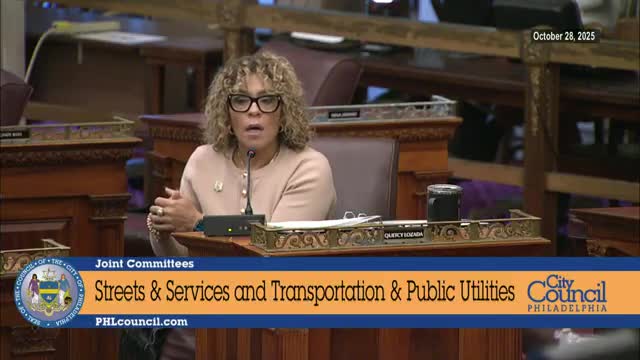
Summary
At an Oct. 28 joint council hearing, Seventh District residents described repeated sinkholes, basement flooding and large repair bills while an independent engineer urged faster pipe replacement; Philadelphia Water Department acknowledged aging infrastructure and pledged follow-up on staffing, replacement pace and contractor oversight.
Philadelphia City Council members and residents heard repeated accounts Oct. 28 of water main breaks, sinkholes and related property damage in the Seventh Council District, and received technical and administrative responses from an independent engineer and the newly appointed commissioner of the Philadelphia Water Department.
Councilmember Ketsi Lazada, sponsor of Resolution 250160, opened the hearing describing how sinkholes, potholes and cave-ins “impact community residents in a way that sometimes we as government don't expect,” and said the committee would gather testimony on causes, accountability and remedies.
Residents gave detailed examples of damage and disrupted lives. “I called 311 in July. In November they came and put signs. Come December, nothing was done. January, I called and I was informed that the case had been closed because why? I don't know,” resident Zelda Hernandez told the committee, describing lost parking, medical complications for a disabled veteran in the household and ongoing mold concerns.
Pablo Ayala said he found roughly “32 inches of water on my pavement” after a May break and described 82 days of pumping and repeated visits by city crews who left without resolving the source. Maria Arona said she had filed “over 100” 311 reports since 2022 about street collapse, roof leaks and mold and criticized nearby development and unpermitted work.
An independent engineer, George Conkle, who described a decades-long background in water systems, said Philadelphia confronts an especially large challenge because much of its distribution system is older than systems elsewhere. Conkle cited industry benchmarks and recent PWD data, saying Philadelphia’s break rate “has been well over 20 breaks per 100 miles for many years,” compared with an American Water Works Association guideline of 15 breaks per 100 miles. He also cited PWD’s 2024 audit figure of about 161.7 gallons per service connection per day lost to leakage, a rate he said is higher than roughly 90% of comparable systems.
Benjamin Jewell, commissioner of the Philadelphia Water Department, acknowledged the scale of the problem while describing PWD’s inventory and programs. “PWD owns and operates 3,057 miles of water mains, of which approximately 328 miles are in the Seventh Councilmanic District,” Jewell said. He said PWD deploys roughly 280 employees in distribution, load control and pumping units and about 300 in sewer maintenance and flow control, and that the department provides emergency loans (the HELP program) and other assistance to homeowners when private laterals require replacement.
Committee members pressed PWD on the pace of main replacement. Conkle and others told the committees that replacement would need to approach 35–40 miles per year to materially reduce failure rates; PWD’s publicly stated planning range included a 32-mile-a-year target and internal bids for larger mileage. Commissioner Jewell said the department bid for about 45 miles during fiscal 2025 but identified cost pressures — including unit costs for relays that the department says have risen substantially — and competing capital needs across water, sewer and treatment systems.
Councilmembers also raised questions about lines of responsibility for service laterals and billing. Jewell affirmed that, under Philadelphia’s existing rules, property owners are responsible for private service lines from the tap into their buildings and said changing that demarcation would have major fiscal implications for the utility because the city is a fee-for-service entity and would likely need to finance additional capital and operating costs that affect rates.
Multiple residents and councilmembers pressed PWD on communication, timetables and contractor oversight. Councilmember Anthony Phillips told the commissioner, “We don't expect perfection from city agencies…but we do expect a lot of effort and a lot of strong responses, strong follow-up.” Witnesses described repeated promises that crews or contractors would return and examples where backfilling or temporary patches failed and created new problems.
Jewell said the department is reviewing capital planning and has initiated a liaison system with council offices to improve communication. He also said PWD is assessing staffing and procurement timelines; during the hearing he provided a citywide head-count estimate of roughly 2,200 employees working against about 2,600 approved positions and agreed to provide a detailed vacancy breakdown and hiring timelines to council offices.
Discussion at the hearing produced several near-term directions rather than formal votes: councilmembers proposed a multi-member working group with PWD to review outstanding cases and prioritize coordination; PWD agreed to follow up with requested data (replacement mileage by year, contractor complaint records, vacancy lists and response timelines) and to inspect specific sites cited by members. No formal policy change or vote occurred at the hearing.
Why it matters: repeated water main failures and sinkholes impose health and economic harms — from basement sewage and mold to high out-of-pocket repair bills — and reflect system-wide aging and funding choices. The hearing spotlighted competing trade-offs: accelerating pipe replacement reduces future failures but requires funding and contractor capacity; shifting private/public responsibility for service laterals would redistribute cost but raise utility rates unless subsidized.
Next steps noted by the committee include PWD providing the requested operational and staffing data, the possible creation of a council–PWD working group, and additional oversight if promised follow-up does not materialize.