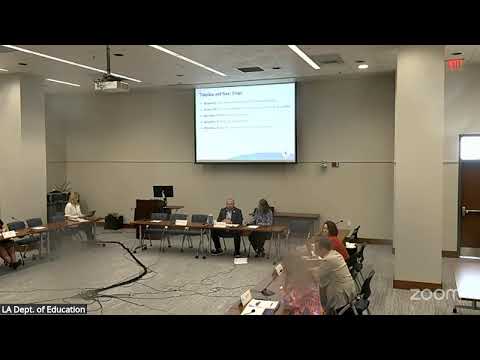
Parent and Family Engagement Task Force endorses five-part recommendations, emphasizes high school, communications and SPED supports
Loading...
Summary
The state task force voted to endorse a final report urging stronger partnerships, clearer communications and increased support for school leaders and parent organizations; members highlighted high-school counseling, truancy interventions and special education gaps as priorities for implementation.
The Parent and Family Engagement Task Force voted to endorse a final report that recommends five priority areas for strengthening family engagement across the state: partnerships and collaboration; communication, clarity and access; support and capacity building; elevating family voice; and financial and policy alignment.
The final report, prepared in response to House Resolution 239 (2024), was presented by LDOE staff and circulated to members before the meeting. A staff presenter summarized the research basis, saying, “When parents are involved in their children's schooling, students show higher academic achievement, school engagement and motivation,” and noted a more detailed PDF of studies was available to members.
Task force members pressed for closer attention to high school engagement and counselor capacity. One member cited state data showing low career-diploma rates in some districts — “Orleans Parish, 2.4 percent; EBR, 8.7 percent” — as evidence families and students may not be receiving or using information about career pathways. Members urged clearer guidance and stronger implementation of individual graduation plans (IGPs), and recommended expanding counseling supports so students and families can have meaningful, one-on-one planning conversations rather than a single "box‑checking" interaction.
Communication and access were recurring themes. The report recommends a parent-facing toolkit aligned to student milestones, translation and non-digital formats for families without broadband, and multiple outreach methods including in-person family engagement nights focused on postsecondary planning. LDOE staff described existing division work — for example, an attendance team advising districts on required parent conferences after unexcused absences and translated materials from the diverse learners and English-learner teams — and said divisions would support schools in targeted areas.
Members discussed building a statewide repository of businesses and nonprofits willing to partner with schools for internships, work-based learning and targeted supports to address truancy and other barriers. Caroline Romer of the Louisiana Charter School Association said business and nonprofit engagement will look different locally but can include volunteer support, sponsorship of parent nights, or direct services to help students attend school.
Several public commenters urged a grassroots focus on establishing and strengthening parent organizations (PTA/PTO or school-level parent advisory councils). One public speaker said, “If you get a PTA started, which is in the school, they can address and help the students,” and offered volunteer help to start PTAs. Task force members debated whether guidance on creating effective parent organizations belongs in the communication toolkit or the capacity-building recommendations; the report text was revised in discussion to emphasize both school- and district‑level supports and models of success.
Special education families raised concerns about staffing and curriculum supports. A parent who identified herself as representing special education families described cases where a single special education teacher covered kindergarten through fifth grade and urged clearer supports and standards for SPED services and parent access to necessary modifications.
On policy and funding, members recommended examining how state and federal funding streams (including Title I) can support family engagement activities and suggested that some state-level investments could help publicize parents' statutory options (for example, transfer windows or course choice) so families know available choices. Members differed on whether state funding should be used for broad public communication campaigns, with some cautioning against using classroom funds for advertising.
The task force concluded by approving a motion to endorse the report as revised. Dejanae Jackson moved to endorse the report; an unnamed member seconded. The motion passed on a voice vote with no recorded opposition. The report will be submitted to the Board of Elementary and Secondary Instruction and the House Committee on Education for consideration.
The meeting record and circulated materials list the five focus areas with specific items the task force recommended be advanced, including: (1) a statewide partner repository and business-facing guidance; (2) a parent-facing toolkit aligned to student milestones and translated/non-digital formats; (3) capacity-building for school leaders and frontline staff with examples of successful models; (4) steps to elevate family voice through school-level advisory councils or integrated parent seats on existing committees; and (5) a review of how funding and policy can better support family engagement efforts.
Next steps identified at the meeting included final edits to the report before submission to BESI and the House education committee; members discussed possible future monitoring or data collection to track implementation but noted the original task force resolution terminates on delivery of the report.