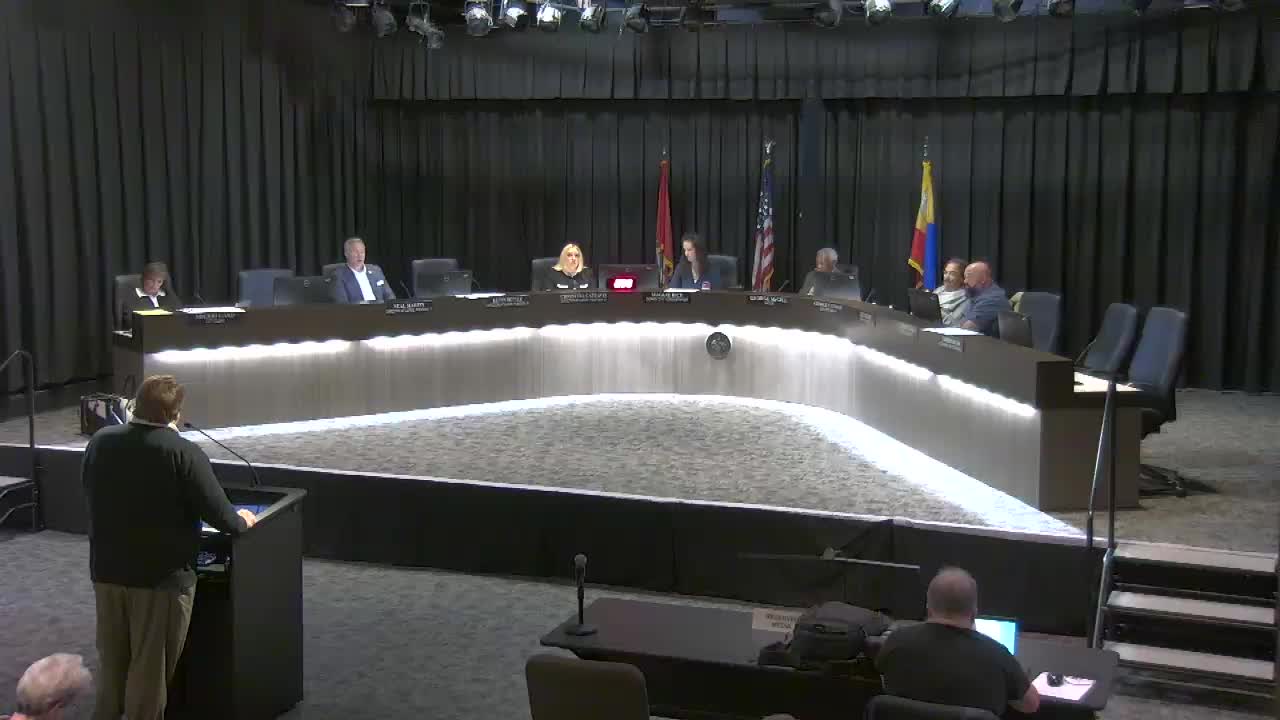
Fort Smith directors review five departmental capital improvement plans as sales‑tax cut reshapes projects
Loading...
Summary
The Fort Smith City Board of Directors reviewed five departmental capital improvement plans during a study session on Oct. 28, with staff laying out revised multi‑year schedules and funding impacts from recent sales‑tax adjustments.
The Fort Smith City Board of Directors reviewed five departmental capital improvement plans during a study session on Oct. 28, with staff laying out revised multi‑year schedules and funding impacts from recent sales‑tax adjustments.
Ben Martz, interim director of engineering, told the board the streets, bridges and drainage CIP was similar to the plan presented previously but revised to reflect reduced sales‑tax receipts. "This is all the sales and use tax, which is the five‑eighth," Martz said when asked about the funding source; he and directors said the change reduces annual receipts from roughly $30 million to about $18 million going forward. Martz said the packet shows a roughly $51 million carryover in 2025 that, combined with reduced annual receipts, helps bridge project costs in the near term.
Directors pressed staff on how that carryover will be spent and on prioritization. Director Neil Martin said residents expect the city to spend dedicated sales‑tax funds and raised concerns about seeing large early‑year expenditures. Martz said some projects were moved earlier after finishing ahead of schedule, and that staff used a 10‑year view to show how projects could be deferred as revenues decline.
Towson Avenue and the Jenny Lind extension drew extended discussion. When asked whether the city is considering taking over Towson Avenue from the state, staff said discussions with the Arkansas Department of Transportation (ARDOT) are ongoing and that ARDOT may address water‑line work. Martz said the Jenny Lind extension would link the Fianna Hills subdivision to White Bluff Road and noted a willing landowner has offered an easement that helped bring the project forward.
Public Works Director Matt Meeker presented the Streets and Traffic Division CIP and a proposed 2026 sidewalk program. The sidewalk plan would build 3.09 miles of new sidewalk and repair 0.85 miles, with project prioritization based on proximity to schools, pedestrian usage and connectivity. Meeker said most street maintenance funding comes from state turnback (fuel and highway tax), property taxes and sidewalk assessment fees. "Potholes or street damage ... can be reported through the text-my-gov or they can call directly to our office, 784‑2360," Meeker told the board.
Parks Director Sarah Duster reviewed a 2026–2030 parks CIP funded by a voter‑approved dedicated one‑eighth‑cent sales and use tax (approved 2012; renewed in 2022 through 2030). Duster highlighted a $5.1 million Maybranch Greenway project and said nearly $3.5 million of that total is expected from grants and private contributions. She also presented smaller items such as a $75,000 shade structure for the Riverfront Skate And Bike Park and said staff is evaluating compact, vandal‑resistant restroom options sometimes called a Portland Loo as a lower‑cost alternative to permanent restroom buildings.
Duane McDonald, solid waste services director, presented a 10‑year replacement schedule for collection and landfill equipment funded from a dedicated sinking fund built from user fees. McDonald listed trucks, a landfill bulldozer and excavator, a skid steer and a new routing and scale system as near‑term priorities; he said some planned replacements were deferred after review and that older units can be moved to a reserve fleet or sold at auction.
Transit Director Ken Savage presented the Transit Asset Management Plan required by the Federal Transit Administration (FTA), outlining approximately $9.6 million in five‑year investments and anticipating about $8.0 million in grant reimbursements with roughly $1.6 million in local matches. Savage said the department is requesting a 35‑foot replacement bus and a service crane truck in the 2026 budget and noted FTA typically reimburses 85 percent of new revenue vehicles.
Directors asked for clearer evaluations and scoring for resurfacing decisions, pressed staff on staffing gaps that affect project delivery, and requested a closer look at road‑rating and master‑plan cadences. Several directors said they want future study sessions to include more detailed pavement‑rating data and alternatives for prioritizing high‑use corridors rather than strictly following age or schedule.
The board did not vote on CIP adoption during the study session; the presentations will inform the budget process and future study‑session review.