Get Full Government Meeting Transcripts, Videos, & Alerts Forever!
Get email alerts on the Parks Recreation topic
No spam. Unsubscribe anytime.
Parks & Recreation advisory commission briefs supervisors on projects, revenue gains and space constraints
Summary
The Parks & Recreation Advisory Commission presented completed projects, operating‑revenue gains and a multi‑year capital plan to the Board of Supervisors on Oct. 27. PRAC emphasized safety and ADA improvements, rising facility use (85% capacity) and the need for an updated master plan for long‑deferred projects such as Fighting Creek Park.
Members of the Parks & Recreation Advisory Commission (PRAC) and department staff presented an overview of completed projects, recent revenue increases and a five‑year capital improvement plan at the board’s Oct. 27 meeting.
Judy Kane Oliver, PRAC chairperson, said the commission’s vision is “promoting community through play, learning opportunities and social interactions.” She outlined PRAC goals that include public outreach, fundraising to augment operating budgets, and improved communication with the Board.
Parks staff reported a 210% increase in departmental revenue from fiscal year 2022 to 2025, which PRAC attributed to a 2023 cost‑recovery model and new online registration tools. Staff added pavilion rentals and new recreation management software that allow 24/7 reservations by credit card; those program and fee changes were cited as significant contributors to revenue gains.
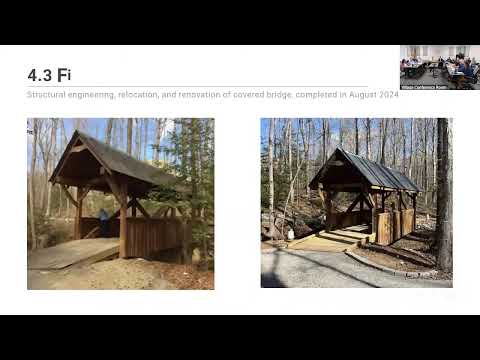
The commission highlighted recent capital investments: a 2019 gym renovation at the Pocahontas Landmark Center (PLC), conversion of tennis courts to six pickleball courts, reconstruction of the Fighting Creek Park covered bridge, fencing/backstop replacements and concession/bathroom renovations. PRAC credited community fundraising and league partnerships on several projects (for example, a soccer‑field fence extension funded in part by the local club; a community‑built snack shack that benefits local charities).
Looking ahead, PRAC asked the board to prioritize projects and master plans so the department can pursue grant funding and perform fiscally responsible scheduling. PRAC singled out Fighting Creek Park as a long‑standing master‑plan item (master plan completed in 2002) that needs updating before major infrastructure or road extensions could be considered. Turner Park master‑plan work was described as active, with phase‑one pavilion replacement completed and pavement/parking projects staged in the CIP.
ADA accessibility improvements and efficiency projects were also described as priorities. Staff showed examples of ADA gaps at athletic fields and playgrounds and described a planned ADA trail linking athletic fields, playgrounds and the library. The department has installed “smart‑rain” irrigation controllers at several fields that staff say are already saving water and operating costs; staff reported they will produce annual usage comparisons.
Board members asked PRAC and staff to prioritize safety and deferred maintenance if additional revenue is not identified. Supervisors suggested the department present a short prioritized list (maintenance to reach an “A” level, then projects to reduce facility utilization from 85% to a lower target) along with probable costs so the board can evaluate future CIP allocations and grant match opportunities.
PRAC closed by asking the board for direction on the county’s parks goals over the next two to five years, emphasizing the department’s constrained indoor space and the community benefits of expanded recreation facilities for multiple age groups.