Get Full Government Meeting Transcripts, Videos, & Alerts Forever!
Get email alerts on the Parking And Loading topic
No spam. Unsubscribe anytime.
Brook Park mayor proposes ordinance to curb commercial loading on city streets
Summary
Mayor Orcutt introduced an amendment to Section 351.13 to prohibit businesses from using public streets as substitute loading zones where on‑site commercial loading exists, add a written‑permit process for temporary exceptions, and give police authority to enforce the restriction. Council moved the measure to the Oct. 21 meeting for first reading,
Mayor Robert Orcutt introduced an ordinance to amend Section 351.13 of the city code to restrict the use of public rights‑of‑way as substitute loading zones by businesses and to create a written‑permission process for limited exceptions.
The amendment adds a new paragraph (c) forbidding businesses in nonresidential districts from using public streets, rights‑of‑way or other public places as substitute loading zones if the business "provides designated commercial parking or loading areas on its premises," except where the city issues written permission. Paragraph (d) would allow the city to grant temporary, limited or conditional permission after determining (1) no reasonable on‑site alternative exists, (2) street use will not unduly interfere with traffic flow or emergency access, and (3) unloading occurs only during specified hours. The ordinance references enforcement under Section 351.99, a fourth‑degree misdemeanor, which the mayor said carries up to 30 days in jail or a $250 fine.
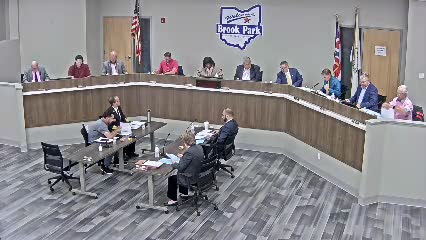
"This is for offloading purposes in areas that are nonresidential," Mayor Orcutt told the caucus, citing recurring problems along West 130th Street where delivery trucks have parked in travel lanes instead of using businesses' parking or loading areas. "We put new signs up, and what they've done is just gone into other areas to be able to offload vehicles," he said.
Council members questioned whether the current draft could be interpreted to exempt businesses that provide on‑site loading areas but do not use them. "If they provide it, the way I read this, it doesn't apply," Councilman Troyer said. The law director suggested a possible edit to read "does not provide and use designated commercial parking" or to simply remove the clause; council members asked the mayor to consult with the police chief and law director and return with recommended language.
Council also discussed enforcement limits in areas that are effectively private property or industrial districts near large manufacturers. "That is private property," the mayor said about truck parking near the Ford facility and noted jurisdictional limits when no signage exists.
Council voted to place the ordinance on the Oct. 21 council meeting agenda for first reading so staff can return with refined language and the police chief's input. The motion passed on a roll call vote with all members present voting yes.
The council did not adopt the ordinance at caucus; members directed staff to refine the draft, clarify whether the clause should cover businesses that "provide but do not use" on‑site loading areas, and seek the police chief's enforcement guidance before first reading.