Get Full Government Meeting Transcripts, Videos, & Alerts Forever!
Get email alerts on the Plan Spokane Eis topic
No spam. Unsubscribe anytime.
Plan Commission reviews Plan Spokane 2046 EIS alternatives, seeks clearer data and faster path to preferred option
Summary
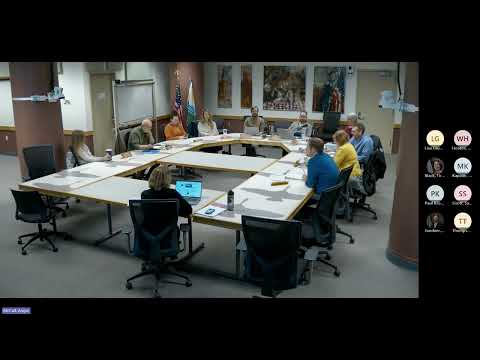
The Spokane Plan Commission on Oct. 22 reviewed emerging findings from the environmental impact statement (EIS) work for Plan Spokane 2046 and began a parallel conversation about rewriting the city’s land‑use framework to make zoning more flexible.
The Spokane Plan Commission on Oct. 22 reviewed emerging findings from the environmental impact statement (EIS) work for Plan Spokane 2046 and began a parallel conversation about rewriting the land-use framework that will guide zoning and future development.
Consultants from Burke and city planning staff told commissioners the draft EIS is in preparation but delayed while transportation-modeling issues were resolved; staff now expect a Dec. 10 release and said public engagement on the draft will be concentrated in January to avoid the December holidays. “We are still in the preparing the draft EIS stage,” consultant Lisa Greeter said, and the team expects to publish a public draft on Dec. 10.
The EIS will evaluate a no-action alternative and at least two action alternatives. The no-action alternative (alternative 1) uses the regional SRTC model as a baseline and, according to presenters, reflects a roughly 65% single-family / 35% multifamily split in housing units on the ground as of 2022. Alternative 2 (described as “distributed and balanced” or a transit-oriented development approach) shifts more multifamily and mixed-use growth to frequent-transit corridors, Indian Trail and southern parts of the city to close gaps in lower-cost housing stock. Alternative 3 concentrates more growth in Center City and regional hubs and pairs that land-use pattern with a higher job-growth projection.
Consultants said those three options were chosen to provide bookend scenarios for environmental review and infrastructure planning. “We looked at a variety of projections,” Greeter said, noting the team compared the SRTC regional forecast, the state Employment Security Department (ESD) projection and local workforce-council inputs to develop job scenarios.
Commissioners pressed staff and consultants for more transparency about the base data and modeling assumptions. Commissioner Terrell said the city should not make ‘‘big consequential moves’’ without clarity about whether the SRTC 2022 base model fully reflects zoning and policy changes enacted since 2022, including middle-housing reforms. ‘‘If there are questions about the data that is underpinning a lot of these decisions, it’s concerning from my perspective,’’ Terrell said.
Burke and staff described how they combined the SRTC baseline with the city’s land-capacity and housing-affordability analyses to arrive at unit-share splits for each alternative. Greeter said the modeling balance reflects what was in the SRTC model for the 2022 baseline and adjustments based on the city’s housing-gap findings: ‘‘we shifted the gap number basically over into the multifamily because that’s what the city will need to consider under commerce guidance,’’ Greeter said.
Commissioners also questioned the city’s approach to pairing job-growth assumptions with different land-use patterns. Staff said the range of job projections helps the city understand capital‑facilities and utility consequences across outcomes, and that the council and commission will choose a single employment assumption when they select a preferred alternative. Staff emphasized the need for a single, auditable math when a preferred alternative is selected: ‘‘when we get to the preferred alternative stage … we will have to clearly show our math as well,’’ a staff member said.
The draft EIS memo circulated to commissioners includes a topic-by-topic ‘‘report card.’’ Natural-environment impacts are concentrated in the Latah (Hangman) Valley and other tree‑rich areas where active subdivision and buildout are expected; consultants flagged likely tree loss and the need for mitigation in those areas. Built-environment, utilities and transportation impacts were also highlighted; consultants said some alternatives would require different capital‑facilities investments and that water/sewer/transportation needs vary by where growth is concentrated.
Separately, city staff (Kevin) opened a discussion about land-use categories and zoning implementation that the commission said is tightly linked to Plan Spokane. Staff described the difference between a land‑use plan (a forward‑looking policy map that expresses a vision) and zoning (the code that sets exact standards). Kevin proposed reducing the current ~19 land‑use categories to about 9–10 broader categories and ‘‘decoupling’’ the plan map from a strict one-to-one mapping to zones so that smaller rezones could proceed via the code-level rezone process instead of requiring a comprehensive-plan amendment.
Kevin told commissioners the goal is to increase flexibility, reduce the number of legislative comprehensive‑plan amendments, and make rezones more predictable for applicants while retaining clarity and standards: ‘‘If you are residential low, you got 1 choice. If you’re residential mod, you get 1 choice … we want to spread decision making out,’’ he said. Staff argued the change could make it easier to allow small, neighborhood-serving commercial uses inside residential areas when appropriate and to reduce the volume of citywide plan amendments driven by site‑specific proposals.
Commissioners raised practical concerns. Several asked how the approach would treat existing nonconforming uses and whether reducing land‑use categories might unintentionally create more uncertainty without very clear, measurable rezone standards. Staff responded that any move to permit more flexible rezoning without a plan amendment would require tight, predictable criteria and that the concurrent, planned development‑code rewrite would be coordinated with the land‑use changes.
Next steps: staff and consultants said they will release the draft EIS targeted for Dec. 10, follow with public outreach in January, and return to the commission to seek a preferred alternative in late February–March 2026. Staff also asked commissioners for written comments on the land‑use discussion and said development‑code updates would follow the preferred alternative to implement zoning and standards.
Discussion points: commissioners pressed for clearer documentation of assumptions behind the 65/35 split, clearer linkage between the land‑capacity/housing affordability work and the EIS modeling, and a public, auditable calculation for the preferred alternative that will drive capital‑facilities planning and code changes.