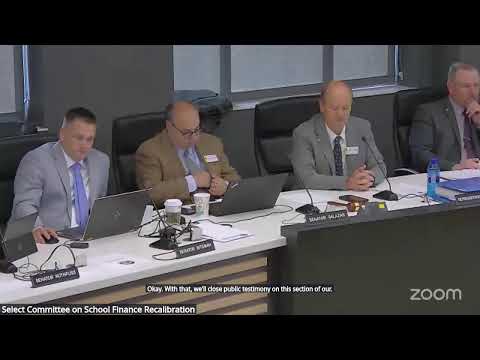
Recalibration panel recommends weighted average teacher salary near $70,500 for 2025–26
Loading...
Summary
Dr. Chris Stoddard, the consultant presenting the committee’s salary analysis, told the Select Committee on School Finance on Oct. 28 that labor-market changes in recent years have eroded teacher pay relative to other professional occupations and neighboring states.
Dr. Chris Stoddard, the consultant presenting the committee’s salary analysis, told the Select Committee on School Finance on Oct. 28 that labor-market changes in recent years have eroded teacher pay relative to other professional occupations and neighboring states. “Labor markets really matter because they affect the quality of teachers,” Stoddard said, summing up the rationale behind his recommendation.
Stoddard showed that Wyoming’s funding-model (or “model”) salaries were relatively flat from 2010 through about 2020 while average salaries paid by school districts rose, widening a gap particularly after the pandemic. He projected district and nonteacher wage growth and recommended a weighted-average model-teaching salary of about $70,500 for the 2025–26 school year as a defensible target to keep Wyoming competitive.
Why it matters: Stoddard argued that teacher pay matters to recruitment and retention and therefore to classroom quality. He used Bureau of Labor Statistics and state-collected data to compare model salaries, district averages and wages for comparable professional occupations (such as nurses and finance professionals). After adjusting for teaching’s shorter contract year, Stoddard estimated a days‑of‑work adjusted target that matches projected professional wages and district behavior.
Evidence and numbers: The Wyoming Department of Education reported a 2024–25 average district teacher salary of $65,265; Stoddard said an 8.5% district increase (the recent ECA) would put that average very near his recommended figure. He also told members that the evidence‑based model’s teacher salary now sits materially below comparable wages in adjacent states and below teacher pay relative to other professionals in the national data.
Public testimony echoed the consultant’s concerns. Kyla McConnell, a second‑year teacher in Sheridan County School District No. 3, described multiple preparations and out‑of‑class work, saying she works “about 50 plus hours a week, during the school year” and urged a starting salary of $70,000 to help teachers afford local housing and stay in small communities.
What Stoddard recommended: (1) set the model weighted average teacher salary near $70,500 for 2025–26 (his defensible midpoint after projecting ECAs and wage growth); (2) create a centralized, systematic applicant-tracking system so the state can directly measure whether higher pay is increasing candidate supply; and (3) pursue targeted recruitment of high‑ability University of Wyoming students to shore up the pipeline.
Committee questions and caveats: Members pressed Stoddard on benefits, contract days, and whether the analysis accounted for class-size differences. Stoddard said his salary comparisons exclude benefits (he used salary-only series) and noted Wyoming’s contract year is 185 days. He also cautioned that some comparisons are limited by public reporting differences across states and that his projection assumes a 3% wage growth for nonteacher occupations.
Next steps and context: The committee did not vote on the recommendation during this session. The presentation and the large number of public comments — including testimony from superintendents and business managers on local hiring and insurance pressures — make the teacher-salary discussion a likely focus for follow-up work by the Select Committee on School Finance.