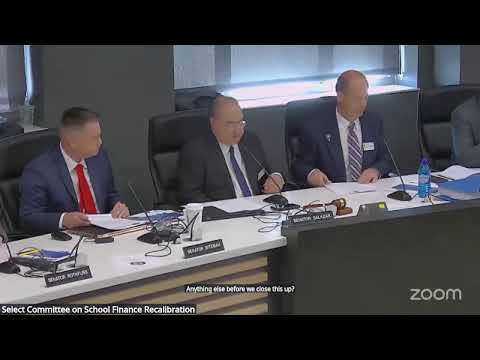
Committee told to separate cash-flow carryforward from emergency reserves after consultants explain 30% figure
Loading...
Summary
CHEYENNE — The Select Committee on School Finance heard on Oct. 31 that Wyoming’s statutory ‘‘reserves’’ are functioning as carryforward accounts to meet early‑year cash needs and that the statute should distinguish between cash‑flow carryovers and smaller emergency reserves.
CHEYENNE — The Select Committee on School Finance heard on Oct. 31 that Wyoming’s statutory ‘‘reserve’’ allowance — currently written in statute as a percentage of the foundation program — is being used by districts as a carryforward to cover early‑year cash shortfalls, not solely as an emergency nest egg.
Dr. Pikus, lead consultant to the committee, told lawmakers the term ‘‘reserve’’ as used in Wyoming statute has been interpreted by many districts as carryforward money needed to pay July‑through‑November costs before property taxes and state entitlements arrive. He proposed separating two accounts in statute: a cash‑flow carryover account that districts may spend early in the next fiscal year for routine front‑loaded costs, and a smaller emergency reserve for unplanned events.
The consultant team presented national practice and research showing typical emergency reserve levels closer to 3–15% of annual spending while carryforward policy is handled separately to address revenue timing differences. Pikus suggested carryover funds be limited by a requirement that cash‑flow carryovers be expended within the first three months of the school year (extended to six months in districts that do not receive major property‑tax installments until November), while emergency reserve accounts remain restricted to true emergencies.
District officials said the distinction matters. Several superintendents and business managers told the committee that for some districts — especially those that receive most property‑tax revenue in two large installments a year — a 3‑month carry limit would force districts to borrow or default on near‑term obligations, or to lease buses and other capital items at higher long‑term cost.
Trent Carroll of the Wyoming Department of Education described how the state bridge‑loan program works and said the department evaluates prior‑year and projected six‑month cash flows when approving loans. Business managers and school leaders, including representatives from Teton and Carbon counties, asked the committee to either preserve adequate carryover authority or improve and expand the loan program’s timing and certainty.
The committee directed legislative staff to draft a recalibration bill that would codify a clearer separation between carryforward and reserve accounts and to examine related loan program timing — including making bridge loans available more than once a year — before the bill is finalized later in the interim and at the January public hearing.
— Reporting for the Select Committee on School Finance