Get Full Government Meeting Transcripts, Videos, & Alerts Forever!
Get email alerts on the Step Housing topic
No spam. Unsubscribe anytime.
Kenmore committee backs code edits to allow step housing, seeks stronger outreach and enforceable agreements
Summary
Kenmore staff and the Step Housing Advisory Committee agreed on draft code changes to allow step housing types across mapped zones, but committee members urged mandatory applicant outreach, safety and security plans, clearer enforcement tools (licensing or code remedies) and parking and services standards before council consideration on Nov. 17.
Kenmore planning staff presented draft code changes and definitions for "step housing" and related types and told the advisory committee on Oct. 1 that they will bring the committee's recommendations to City Council on Nov. 17.
The committee's discussion focused less on whether to allow step housing'which staff said state law requires in certain zones'and more on how projects will be permitted, noticed and enforced. Committee members described public distrust following the Plymouth project and urged measures to increase transparency and accountability for proposed developments.
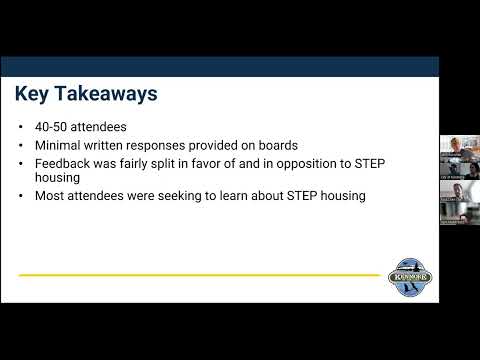
"There was a bit of a cynical edge to it," a committee member said of the open house feedback, describing how some residents felt outreach had previously failed. "People still walk away feeling like, okay. I've checked the box and I've gone because the city has checked the box and they've done this little thing, and now they're just gonna do what they're gonna do." (committee member, 11:56)
Staff reviewed proposed definitions that will appear in the code: emergency shelter, emergency housing, transitional housing, permanent supportive housing (PSH) and the umbrella term step housing. The committee debated whether the PSH definition's language about residents' rental or criminal histories was too broad and concluded that operational eligibility criteria are better addressed in operator agreements than in the municipal definition.
"It doesn't hurt to stipulate, at least in language, what we expect to see and what we don't expect to see," said Karina, a committee participant who cited practices used in Bellevue and Shoreline that put specific behavioral or criminal-history conditions into operator or good-neighbor agreements rather than the underlying definition. (Karina, 44:04)
The group also discussed permitting tracks. Kenmore code distinguishes Type 1 administrative permits (no public notice), Type 2 discretionary permits (notice and administrative appeal) and Type 3 quasi-judicial permits (hearing examiner). Staff said the draft would allow many step housing proposals to proceed under streamlined processes similar to other affordable-housing paths, but some committee members opposed relying on Type 1 where the public would receive no notice.
"My feeling here is that we have to, in some way, allow public notice and awareness of the projects," one member said, arguing that lack of notice will reinforce community distrust even when the city lacks discretion to deny a permitted use. (committee member, 32:20)
Rather than eliminate notice, the committee favored requiring applicants to demonstrate outreach before approval and asked staff to identify how that requirement could be framed in code. Staff recommended placing any mandatory pre-application outreach requirement outside the operator agreement (which takes effect after approval) so that outreach occurs during review.
Enforceability of good neighbor and operator agreements was a central concern. Committee members asked staff to research whether a business or operating license, tighter code enforcement, or other municipal tools could be used to enforce terms such as cleanliness, nuisance response, and specified safety measures.
"If there's no ability to turn down to shut down a facility that is operating outside of its good neighbor agreement, that's where these things go south," one member said, urging a mechanism for sanctioning repeated violations. (committee member, 52:20)
Members urged adding site-level safety and security plans to the operator materials and recommended police or fire sign-off as a best practice. Shoreline and Bellevue were cited as local examples where plans and maps tied to notification areas are required and where sign-off by public safety is part of the process.
On services and zoning, the committee debated whether on-site services should be mandatory. Members noted Kenmore's residential zoning and home-based business limits (which, as discussed, could restrict ancillary services and the number of staff) may keep providers from delivering on-site case management. Several members recommended the city evaluate allowing small neighborhood commercial uses ("corner stores") on minor arterials to support decentralized services for smaller projects.
Parking requirements were also discussed. Providers and committee members said many step-housing residents do not own cars; members proposed a mechanism for parking reductions (for example, director-level findings or location-based exemptions) and suggested conditions such as shared vans for appointments and prohibitions on abandoned vehicles.
No formal votes were recorded during the meeting. Staff said they will circulate revised drafts and collect written comments from absent members before finalizing the committee's recommendation to council on Nov. 17; council adoption of an ordinance would follow later after environmental review and other procedural steps.
The committee asked staff to return with specific wording for: (1) minimal outreach or "pre-application" notification requirements; (2) model contents for site safety and security plans and operator agreements; and (3) options for making agreements enforceable (business license conditions, code-enforcement remedies or other sanctions). Staff also agreed to confirm how fees-in-lieu or mandatory-affordable-unit rules would interact with step housing projects.
The committee agreed that permanent supportive housing should be included among allowed housing types required by state law, but members sought flexibility to tailor operator agreements and enforcement measures project-by-project. Staff will incorporate the committee's direction into revised materials and post them for last review prior to the Nov. 17 Council briefing.