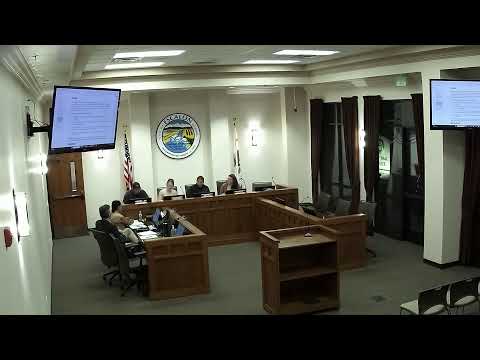
Escalon recreation commission votes to explore chartering Little League for 10U-and-up play
Loading...
Summary
Commissioner Stephanie Hogan urged the Escalon Recreation Commission on Oct. 1 to consider chartering a local Little League to run baseball and softball for players age 10 and older, saying the change would shift operational responsibility from the city to an independent volunteer board.
Commissioner Stephanie Hogan urged the Escalon Recreation Commission on Oct. 1 to consider chartering a local Little League to run baseball and softball for players age 10 and older, saying the change would shift operational responsibility from the city to an independent volunteer board.
“During the 2025 baseball and softball season, there were issues that arose that showed that regardless of what the change was, that we needed some sort of change agent,” Commissioner Hogan said, summarizing parent complaints about schedule changes, organizer turnover and uniform concerns from the prior season.
Hogan laid out three options: keep the current City-run program, create a locally focused baseball/softball advisory board, or charter a nonprofit Little League that would be a member of District 67. Under the Little League option, the local board would be a volunteer nonprofit able to accept donations, manage scheduling and enroll through SportsConnect; Hogan said the district assignment would place Escalon near Ripon, Manteca and Salida for interleague play.
Presenters and district representatives answered commissioners’ questions about facilities, equipment and cost. A Little League representative said some field adaptations can be made to fit local fields and that SportsConnect centralizes registrations and documents. A Ripon league representative said leagues commonly begin with paid umpires for a season to provide consistency while a volunteer umpire pool develops: “For the first year of us being a league, they brought in an umpire company, and they were paid to to umpire the game just so we could get started off on the right foot.”
Hogan presented sample costs: a $10 charter fee per team, district insurance and patch fees, and a rough per-player estimate that included jerseys and Little League fees. She said Little League offers the first 125 background checks free each year and that leagues generally set registration fees in the $100–$200 range depending on facility and umpire costs. Hogan described a target ballpark of about $100 per player to keep registration comparable with prior City-run fees (staff cited current enrollment fees near $106–$111).
Members of the public asked whether donations to a Little League nonprofit could be used for field improvements and whether the board could contract with the school district for additional practice space; City staff said such agreements and donated funds could be explored, subject to district or City rules on infrastructure work and use fees.
After discussion, a commissioner moved — and the commission seconded — a motion directing staff and community volunteers to explore moving 10U-and-up baseball and softball to a newly formed Escalon Little League, with the condition that a board be formed to govern the league. The motion passed by voice vote. Commissioners also approved a separate motion to host a public town-hall meeting (at least 10 days’ notice) so residents can ask questions and offer input.
The commission did not adopt any immediate binding changes to facility contracts or fee schedules; staff said those details would be negotiated with the community and, where needed, brought forward to the City Council for approval. Staff also emphasized flexibility on timing: evaluations would likely occur in January and practices in February if the community pursues a 2026 transition.
Commissioners and staff said they would help facilitate the transition if the community chooses to proceed and that the City would work with the board on facility scheduling, potential temporary fee waivers during an initial transition and use of the City’s registration platform for the first season.
The commission’s direction is exploratory rather than final: the motion asks staff and interested volunteers to form a board and report back with specific documents, a proposed fee schedule and any recommended facility agreements before any binding commitments are made.