Get Full Government Meeting Transcripts, Videos, & Alerts Forever!
Get email alerts on the Dixie Tif topic
No spam. Unsubscribe anytime.
Public hearing on Dixie Cup redevelopment draws debate over affordable‑housing opt‑out fee and tax‑increment financing
Summary
At a statutorily required hearing Oct. 16, Northampton County Council heard extensive public comment on a proposed TIF to support redeveloping the longtime‑vacant Dixie Cup complex into about 405 apartments. The hearing centered on the project scale, financing structure and the ordinance’s $27,000 per‑unit fee‑in‑lieu of set‑aside for affordable r
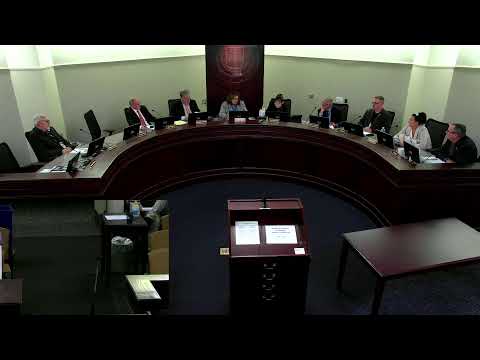
Northampton County Council held a public hearing Oct. 16 on a proposed tax‑increment financing (TIF) district that would support redevelopment of the Dixie Cup manufacturing complex into a roughly 405‑unit residential project. The hearing was advertised as required by Pennsylvania TIF law; counsel for the developer entered required documents into the record and the council confirmed the ordinance will be considered at its Nov. 6 meeting.
Jonathan Cox, public finance counsel for the developer, told the council the plan contemplates gross bond proceeds of about $26 million and net proceeds of just under $20 million for the project, with two bond series proposed (roughly $5 million series A and $15 million series B). His explanation said the series A bonds would be secured by TIF revenues and the b bonds would be secured by a second lien on TIF revenues plus a first and exclusive lien on special assessments if needed. Cox said the county’s share of foregone incremental taxes under the draft plan is the smallest of the three taxing bodies involved (county, borough and school district).
Developer Brian Barty and his team said the project would convert the dilapidated structure into housing, trails and neighborhood connections and that management will be handled by an experienced national operator. "We have a market study done that we paid $8,800 for," Barty said; he offered to circulate the market‑rent study after questions about assumed rents that were raised during the hearing.
The most sustained objections and technical questions focused on Article 13 of the draft ordinance, which requires that 10% of the units be set aside for affordable housing or, alternatively, allows property owners to opt out by paying $27,000 per unit (10% of the total) into a county affordable‑housing fund. Public commenter Armando Moritz Japelkin urged council to amend the $27,000 figure and argued the sum appears inconsistent with the rent gap that would be generated by market rents. He presented a calculation that, using HUD fair‑market rents and the project’s projected market rents, the long‑term affordability gap could be materially larger than the $27,000 opt‑out fee implies.
Supporters including Wilson Borough officials, Palmer Township economic‑development staff, and Wilson Area School District leadership urged council to allow the redevelopment, citing decades‑long blight at the site, an estimated $185 million total investment, and potential community benefits including construction jobs, increased downtown activity and school‑to‑career programs. Wilson Mayor and Borough Council representatives were among those who said the redevelopment would be a major revitalization for the borough and the eastern part of Northampton County.
Several council members questioned details that will require further review — including the logic behind the $27,000 opt‑out figure, projected student enrollment impacts for the school district, how the county’s 11% participation would affect taxpayers, and whether bond proceeds and underwriting assumptions remain feasible given rising construction and capital costs. Jonathan Cox and the developer offered technical details and said required notices and the IDA’s approval are in the record.
The ordinance will be formally considered at the Nov. 6 council meeting after the three‑week public‑notice window required by the TIF statute. At that time council members said they expect to discuss the ordinance and vote; the record from Oct. 16 contains both supporting letters (including from Easton’s mayor) and public commenters who urged changes to the affordable‑housing terms.
Why it matters: The TIF, if approved, would use incremental tax revenue generated by the developed property to pay debt service on bonds issued for the project for a fixed term, redirecting the increases in taxes over baseline for that period to the bond trustee. Supporters framed the TIF as a risk‑sharing tool to convert a long‑vacant site into taxable economic activity; critics questioned whether the county and school district will be adequately protected and whether the affordable‑housing provision is sufficient.
What’s next: Council discussion and a formal vote are scheduled for Nov. 6. Supporters and opponents both asked council members to review the developer’s market study, the IDA resolution in the record, and the specific calculations behind the Article 13 opt‑out fee before that meeting.