Get Full Government Meeting Transcripts, Videos, & Alerts Forever!
Get email alerts on the Needlepoint Sanctuary Rezoning topic
No spam. Unsubscribe anytime.
Council approves rezoning to allow Needlepoint Sanctuary syringe services at 1009 Ohio Street
Summary
The Bangor City Council voted 6–2 to rezone about 0.42 acres at 1009 Ohio Street from Neighborhood Services District to Government & Institutional Services District, clearing a zoning barrier that had prevented Needlepoint Sanctuary from operating a permanent syringe-exchange location in that building.
The Bangor City Council voted 6–2 to rezone about 0.42 acres at 1009 Ohio Street from Neighborhood Services District to Government and Institutional Services District (GISD), approving Ordinance 25‑295 after extended public comment and a planning-board recommendation. The vote, taken by roll call, recorded six yes votes and two no votes.
The rezoning was introduced by Councilor Fish and described by Anne Krieg, director of community and economic development, as a decision that should focus on the district’s permitted uses rather than binding the property to a specific future development. Krieg told the council the planning board had recommended approval by a 5–1 vote and noted the parcel lies outside the city’s growth boundary and is shown on the comprehensive plan’s future land-use map as rural residential.
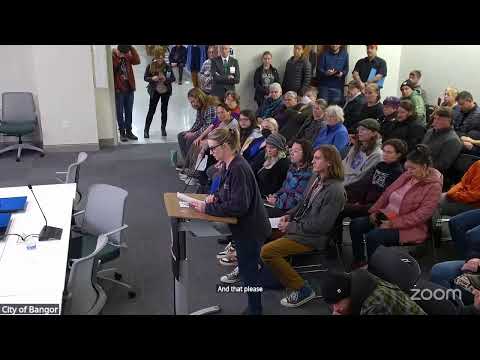
Supporters of the rezoning, including public-health professionals and nonprofit staff, told the council the change would allow Needlepoint Sanctuary to operate a fixed syringe-services site at the address and argued that such a site is a proven tool for preventing blood-borne disease and connecting people to treatment. State Representative Ambreen Rana and clinicians from Maine Family Planning and local harm-reduction groups cited Maine CDC figures in the current cluster and urged expedited action. Needlepoint director Willie Hurley said the organization has already placed people into detox and recovery and described the proposed location as accessible by bus and not embedded in the downtown core.
Opponents, including several residents and a local pastor, said a sanctioned syringe exchange could normalize open drug use, increase loitering, and bring safety concerns near residential or commercial properties. Opponents urged investment in detox and residential treatment rather than a brick-and-mortar syringe site.
Council discussion returned repeatedly to process: Councilors debated whether the rezoning constituted appropriate land-use policy given the parcel’s surrounding NSD zoning, whether the planning-board recommendation should carry decisive weight, and whether Needlepoint had exhausted opportunities to co-locate with existing providers. Councilor Trimble explicitly endorsed the planning-board recommendation, saying the board’s role is to review technical and community impacts; Councilor Fish said she was not satisfied the request fully matched the comprehensive-plan guidance and ultimately voted no.
Roll call on the final motion recorded: Councilor Beck — Yes; Councilor Dean — Yes; Councilor Fish — No; Councilor Haas — Yes; Councilor Leonard — Yes; Councilor Mallor — No; Councilor Trimble — Yes; Councilor Fournier (Chair) — Yes. The ordinance passed and will change the zoning designation for the parcel at 1009 Ohio Street to GISD.
The rezoning does not itself authorize any specific operations beyond what GISD allows; future operational details, permits, and health‑department collaborations were discussed repeatedly but would require subsequent actions and approvals. Several public speakers and organizations noted time-sensitive public-health concerns — including the Penobscot County HIV cluster — as a reason to move quickly.
Needlepoint Sanctuary and multiple local health providers said they are prepared to open services immediately once the zoning is cleared and urged the council to support coordination with public-health agencies and neighboring businesses to reduce potential conflicts.
The council’s action resolves only the zoning question. Any licensing, site-plan review, or programmatic approvals necessary for syringe-services operation will follow standard permitting processes and additional coordination with city staff and public-health entities. The council recorded the planning-board review (10/21/2025) and the parcel owners, Steven P. Prey and Tina M. Prey, in the record.