Get Full Government Meeting Transcripts, Videos, & Alerts Forever!
Get email alerts on the Telecommunications topic
No spam. Unsubscribe anytime.
Oxnard committee approves three-year Frontier agreement as staff warns of rising POTS costs
Summary
The Oxnard City Finance and Governance Committee approved staff’s recommended three-year agreement with Frontier Communications (agreement #32600201) and discussed the rising costs and long-term plan for the city’s remaining analog telephone lines.
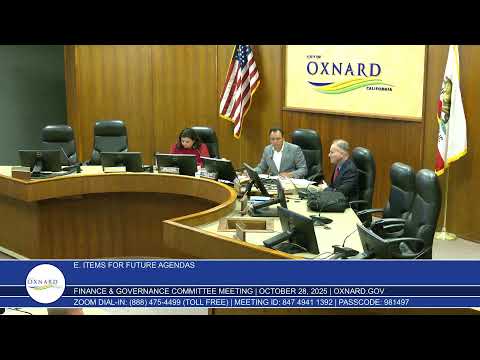
The Oxnard City Finance and Governance Committee on Oct. 28 approved staff’s recommendation to enter a three-year agreement with Frontier Communications for telephone services (agreement number 32600201). Committee members voted 3-0 to recommend approval to the full City Council.
Staff and committee members spent much of the discussion on the long-term costs and operational implications of the city’s remaining plain old telephone service (POTS) lines. Rob Rubin, Oxnard’s chief information officer, told the committee the city still has substantial analog infrastructure in place and that prices have risen for those services under deregulation of a statewide contract.
"We have roughly a little over a 100 that are in analog lines for phone service," Rubin said, adding that 55 of those lines "are for alarm systems" and that "we still have over 5 dozen for faxes across the city." Rubin said some analog lines are used for elevators and access-control systems and described the situation as one that requires a multiyear plan: "This doesn't sit well with me at all... this is going to be a multi year kind of thing to deal with." He told the committee an 18-month analysis would likely yield a strategy for prioritizing conversions where feasible.
Committee members asked whether the city could convert lines to voice-over-IP (VOIP) more quickly. Rubin said many of the city’s main buildings are already on VOIP, but smaller or remote facilities, alarms and elevators may require additional equipment or network connectivity to switch services. He said whether conversion yields net savings depends on site-specific factors and the cost to retrofit connectivity.
The transcript did not contain a clear, unambiguous total dollar figure for the Frontier contract in the spoken record; staff identified the agreement by contract number in the agenda (32600201) and described the term as three years. The committee approved the recommended action on a 3-0 vote and forwarded the recommendation to the full City Council.
What happens next: Staff said it will prepare an analysis and long-term plan for addressing POTS conversions and other telephony strategy issues; Rubin suggested a targeted analysis within six months with a fuller strategy in about 18 months, dependent on resources.