Get Full Government Meeting Transcripts, Videos, & Alerts Forever!
Get email alerts on the Public Safety topic
No spam. Unsubscribe anytime.
Vallejo council approves AX9 security pilot, asks staff to seek bigger scope after VPOA side letter limits hours
Summary
The Vallejo City Council on Tuesday approved a one‑year contract with AX9 Security Inc. to provide a citywide supplemental security pilot but also adopted a side letter with the Vallejo Police Officers Association capping private security at 40 hours per week; the council directed staff to return promptly with options to expand coverage.
The Vallejo City Council on Tuesday approved a one‑year contract with AX9 Security Inc. to provide supplemental security services at sites across the city while directing staff to seek ways to expand coverage and return with alternatives. The vote authorized a contract package with a first‑year not‑to‑exceed amount of $1,900,000 and four one‑year options to extend.
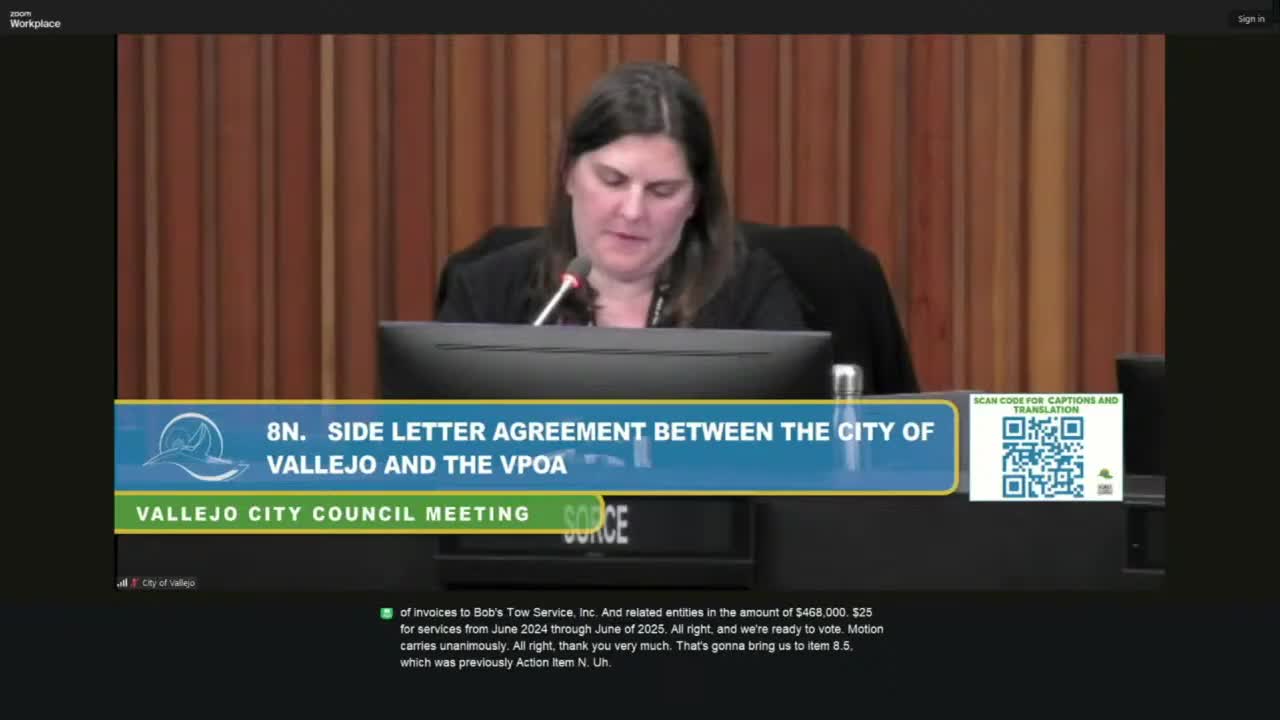
The vote followed an extended public and council debate about how many hours private security can provide as a stopgap while the police department rebuilds staffing. Earlier in the meeting the council approved a separate side‑letter agreement negotiated with the Vallejo Police Officers Association that limits private security work under the pilot to a total of 40 hours per week. Several council members said that cap would severely limit the pilot’s effectiveness and asked staff to negotiate increased hours with the union and to come back in closed session to discuss labor and implementation details.
Deputy Chief Knight and interim public‑works staff described how staff used Vallejo Police Department crime data to design four patrol‑route options that focus on burglary and daytime larceny hotspots and proposed a blended option (Option 3) for the pilot: burglary routes during late‑night/early‑morning hours and larceny routes during daytime hours. The routes will be periodically adjusted to reduce predictability, Knight said, and the department will evaluate effectiveness using quantitative incident data and community feedback.
Councilmembers pressing for more coverage pointed to the city’s ongoing public‑safety staffing shortage. “Forty hours is not enough,” Vice Mayor said during discussion, arguing the pilot should start with substantially more hours while the city pursues recruiting and other staffing solutions. Multiple council members asked staff to return quickly with expansion scenarios and budget paths if the pilot proves effective.
City staff said funding for the pilot is a mix of sources: general fund, parking revenues, Measure P, marina and water funds and others, and that the AX9 contract language allows the city to add supplemental services as needed.
The council’s action allows the city to begin the pilot immediately. Council also required staff to brief the Surveillance Advisory Board and the union as part of further implementation and to return with a recommendation on the pilot’s scale and measurable evaluation metrics.
The motion to approve the AX9 agreement passed unanimously.
Ending: Staff will monitor the pilot closely, report back on measurable outcomes, and return to the council with options to increase hours, funding scenarios, and labor‑agreement implications.